


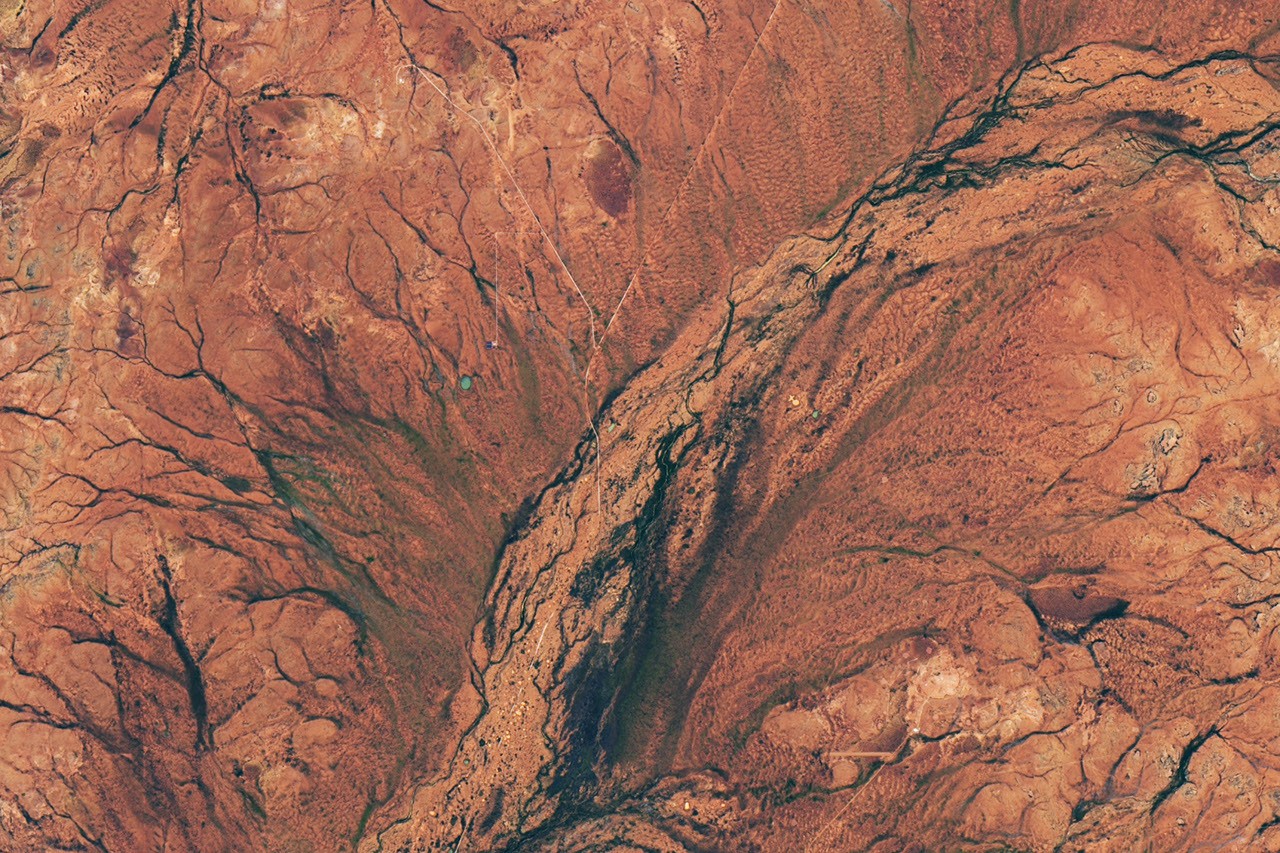
Western Australia’s Desert Bursts Into Color After Record-Breaking Rainfall
After several months of above-average rain earlier in 2026, Western Australia’s arid bushland has transformed into a vibrant wildflower landscape. Dormant seeds awakened across the rusty ocher terrain, creating carpets of flowers in the Murchison region. Local experts believe the display could be the best seen in the area in nearly 20 years.

How rain transformed the Murchison landscape
The images above, captured by the Operational Land Imager (OLI) aboard the NASA-USGS Landsat 8 satellite, compare the Murchison region in late August 2026 with a drier period in 2025. The area lies about 600 kilometers (370 miles) north of Perth and is one of Western Australia’s major sheep and cattle grazing regions.
Native vegetation in the region includes grasses, saltbush and slow-growing mulga trees. Wildflowers appear periodically, but the abundance and color of the 2026 display have attracted particular attention.
Rainfall was above average in June and well above average in August, according to the Australian Bureau of Meteorology. Several cold fronts also passed through the region in August, providing the moisture that triggered flowers to bloom across the interior.
The flower display includes several endangered species. The Murchison region also contains the Murchison Radio Astronomy Observatory, operated by Australia’s national science agency, the Commonwealth Scientific and Industrial Research Organisation (CSIRO).
Wildflowers bloom beside a world-class radio observatory
Although the flowers may have stolen the view at ground level, the CSIRO Murchison Radio Astronomy Observatory—also known as Inyarimanha Irgali Bundala—is focused on exploring the sky and deep space.
At the remote Murchison site, CSIRO operates multiple antenna arrays that observe and catalog objects in the southern sky. The facility sits within a “radio quiet” zone, where communications and electronic equipment are controlled to reduce electromagnetic interference with the instruments.
CSIRO’s connection to NASA missions
CSIRO’s other Australian radio telescopes have supported NASA missions from the organization’s early years to the present day. The Murriyang radio telescope in Parkes, New South Wales, tracked Mariner 2, the first successful planetary science mission, in 1962. It was also a key receiving station during the Apollo 11 mission to the Moon in 1969.
CSIRO manages and operates the Canberra Deep Space Communications Facility, one of three NASA facilities in the worldwide Deep Space Network. The network supports interplanetary spacecraft missions and collects radar and radio astronomy observations. Both Australian facilities supported NASA’s Artemis II mission in April 2026.
NASA Earth Observatory image by Lauren Dauphin, using Landsat data from the United States Geological Survey. Photo © CSIRO Australia, September 16, 2026. Story by Lindsay Dorman.
Sources
- Australian Bureau of Meteorology (2026), Australia’s climate history—climate overview. Accessed September 22, 2026.
- Australian Department of Environment, Water, Heritage and the Arts (August 2008), Murchison Biosphere. Accessed September 22, 2026.
- CSIRO (September 16, 2026), World-class radio telescope provides space for spectacular wildflowers to bloom. Accessed September 22, 2026.
- CSIRO (June 24, 2024), NASA and CSIRO: Partners in Space. Accessed September 22, 2026.
- CSIRO, Inyarimanha Irgali Bundala, Murchison Radio Astronomy Observatory. Accessed September 22, 2026.
- The Guardian (September 13, 2026), A blanket of color: Western Australia’s wildflower season comes to life in photos. Accessed September 22, 2026.
Source: science.nasa.gov