


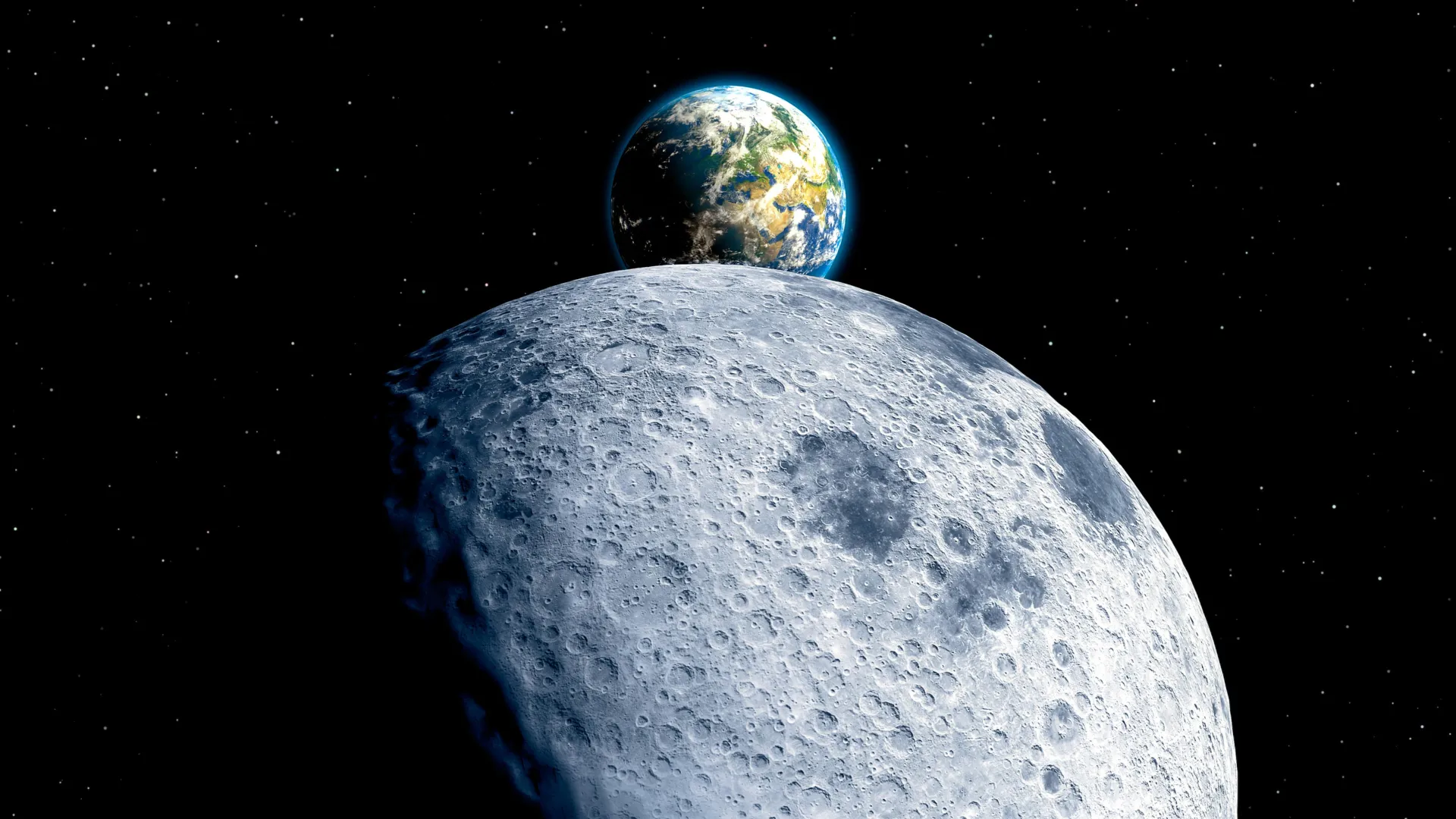
Ancient rocks returned from the Moon’s far side suggest that asteroid impacts in the early solar system declined gradually over billions of years, rather than occurring mainly during one short, catastrophic bombardment. The findings challenge long-standing theories and may help scientists reconstruct the conditions that shaped Earth’s early history.
A lunar record of the early solar system
Earth has lost much of its earliest geological record to erosion, volcanic activity and plate tectonics. The Moon, however, has preserved evidence of asteroid impacts dating back billions of years, making its surface a valuable record of the solar system’s distant past.
Researchers examined small pieces of lunar rock and identified impact events dating from about 4.33 billion years ago to 1.13 billion years ago. The samples therefore provide a record spanning more than 3 billion years.
Instead of supporting the idea of an extremely heavy bombardment concentrated in a relatively brief period, the results point to a long-term decline in the frequency of collisions.
Why the far side of the Moon matters
Study co-author Dr Fred Jourdan, from Curtin University’s School of Earth and Planetary Sciences and the John de Laeter Centre, said lunar rocks preserve information about events that occurred shortly after the solar system and its planets formed.
“The Moon is like a time capsule. It stores a record of events that have been erased from Earth by erosion, plate tectonics, and other geological processes,” Dr Jourdan said.
“Samples taken from the far side of the Moon are particularly important because they will allow us to compare two completely different parts of the Moon for the first time. Until now, most of what we know has come from the side facing Earth.”
The researchers said the far side was less affected by later geological processes than the near side, allowing it to preserve a clearer record of ancient impacts.
“By analyzing these ancient rocks, we can better understand when massive asteroid impacts occurred and how the early solar system evolved,” Jourdan said.
“These samples help rewrite part of the Moon’s history, suggesting that asteroid impacts declined over a long period of time in the early solar system, rather than resulting from one catastrophic impact.”
What the rocks reveal about early Earth
The findings may also help scientists investigate the conditions that affected Earth during its earliest stages. Because Earth and the Moon formed together, impacts recorded in lunar rocks can provide clues about collisions that also occurred in the young Earth-Moon system.
“Although the Moon and Earth have a common history, evidence of early collisions has largely disappeared from Earth,” Dr Jourdan said.
“Because the Earth and the Moon formed together, every major impact recorded on the Moon tells us something about the conditions experienced by the young Earth.”
“Studying lunar rocks allows us to go back billions of years and better understand the events that shaped the environments of both worlds, helping us understand the role that asteroid impacts played in the planet’s evolution and the conditions that may have influenced the emergence of life on Earth.”
Chang’e 6 opens a new era of lunar research
The research comes during a new phase of lunar exploration. China’s Chang’e 6 mission became the first mission to return samples from the far side of the Moon, giving scientists direct access to material from a region that had previously been impossible to sample.
Comparing these rocks with samples from the near side could help researchers build a more complete picture of the impacts that shaped the Moon and the wider solar system.
The research was led by the State Key Laboratory of Deep Earth Processes and Resources at the Guangzhou Institute of Geochemistry, Chinese Academy of Sciences.
The findings were reported in Scientific Progress in a paper titled “History of bombardment on the far side of the Moon revealed by 40Ar/39Ar geochronology of Chang’e 6 impact molten rocks.”
Source: www.sciencedaily.com