


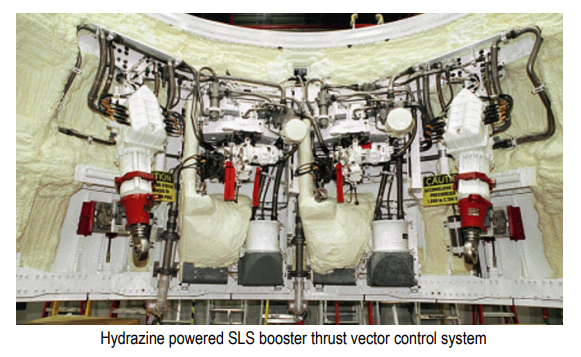
Hydrazine Freeze-Thaw Risks: Prevention, Inspection, and Recovery Guidance
For more information, contact Jonathan E. Jones at the Langley Research Center at [email protected].
Download PDF version
Purpose
This technical bulletin communicates the risks associated with freeze-thaw cycling in hydrazine monopropellant systems. It also provides general recommendations for mitigating damage, operational hazards, and loss of reliability in propulsion and auxiliary hydrazine systems.
Background: Why Hydrazine Freezing Is a Flight-Hardware Risk
Hydrazine (N2H4) freezes at approximately 1.6°C. Its phase transition can pose a significant risk to flight hardware, and multiple NASA programs have historically encountered problems associated with hydrazine freezing.
- Space Shuttle APU hydrazine lines: Freezing caused contraction in the hydrazine lines, followed by excessive expansion during thawing. This condition could cause pipes to burst. Shuttle flight rules allowed only two freeze-thaw cycles before the system was considered degraded or failed.1
- Voyager propulsion system: As hydrazine temperatures approached the freezing and slush-forming range of 0.1–1.6°C, the system faced mission-threatening scenarios. Detailed thermal modeling was required to prevent line freezing, blockages, and thruster malfunctions.2
- Thermodynamic behavior: The thermodynamic properties of hydrazine confirm significant changes in density and pressure during phase transition, demonstrating the sensitivity of propellant lines to freeze-thaw stresses.3
Together, these lessons provide a basis for identifying and mitigating hydrazine freeze-thaw risks.
Major Risks of Hydrazine Freeze-Thaw Cycling
Exposure of hydrazine systems to freezing and thawing can create the following structural, operational, and safety hazards:
- Structural damage: Contraction of hydrazine during freezing can allow additional propellant to enter a confined line, creating a “superfill” condition. Upon thawing, the resulting pressure can rupture the line or fitting.2
- Valve, seal, and diaphragm damage: Elastomeric components and precision valve seats can crack, warp, or lose sealing ability because of differential thermal expansion. Voyager’s thermal evaluation also showed that stainless steel can be susceptible to asymmetrical temperature profiles during extended exposure.2
- Line blockage and slush formation: Partially thawed hydrazine can remain in a slush state, restricting flow and altering mass flow rates. This condition can cause thruster hard starts and misfires.2
- Dangerous leakage: Freeze damage can compromise containment and allow hydrazine to escape, creating significant toxicity, reactivity, and ground-personnel exposure hazards.
- Reduced system reliability: As documented in Shuttle operations, hydrazine systems exposed to freeze-thaw cycles have a limited lifetime, reducing redundancy and mission availability.1
- Thermal-margin uncertainty: Voyager’s experience demonstrated that simple temperature measurements cannot reliably determine the actual temperature of a propellant line. High-fidelity thermal modeling is required.2
Hydrazine Freeze Prevention Recommendations
Maintain Hydrazine Above the Freezing Point
Keep hydrazine systems above the freezing point using heaters, insulation, blankets, or hot-gas purges. Include uncertainty analysis in thermal modeling and testing to confirm that adequate margins against freezing are maintained throughout all stages of operation.
Avoid Uncontrolled Cooling During Ground Operations
Keep tanks, lines, and valve components in an environmentally controlled area until they are installed on the vehicle.
Post-Freeze Response Protocol
If freezing cannot be ruled out, take the following actions:
- Suspend system use: Do not operate the hydrazine system until an engineering evaluation is complete.
- Evaluate the number of freeze-thaw cycles: Treat each cycle as a potential life-limit event. Perform static and fatigue engineering evaluations using conservative estimates of line pressure during and after freeze-thaw cycles to assess possible line and component damage. Apply appropriate margins based on analytical uncertainty and the underlying assumptions.
- Perform integrity verification: Conduct pressure-decay tests, nondestructive examinations (NDEs) if the design allows, and valve-health evaluations.
- Defrost slowly and evenly: Warm the hardware gradually and uniformly to prevent excessive pressure during thawing. The Shuttle’s experience with “superpacking” emphasizes the need for controlled defrosting.
Thruster and Valve Operational Readiness
- Ensure that the catalyst bed and valves have reached appropriate thermal operating conditions before commanding flow rates.
- Conduct a pre-start thermal-stabilization period, particularly when flight-readiness temperatures are critical.
Thermal Modeling and Temperature Monitoring
- Use high-fidelity thermal line modeling that follows the detailed propellant-line modeling approach used for Voyager.2
- Do not rely solely on bulk plate or tank temperature to determine line readiness.
- Use thermal analysis and testing to guide instrument placement on flight systems and to monitor key temperature setpoints.
Documentation and Incident Tracking
- Record all freezing exposures as reportable abnormalities.
- Assign engineering characteristics and track the corresponding reduction in hardware lifetime.
Conclusion
Hydrazine freeze-thaw cycles create significant structural, operational, and safety risks for propulsion and auxiliary systems. Experience from past NASA programs shows that preventing hydrazine freezing is the most effective mitigation strategy. Any suspected freezing exposure requires a formal engineering evaluation, potential adjustment of life limits, and controlled recovery procedures. Following these recommendations can reduce risks to personnel, flight hardware, and mission success.
References
- Space Shuttle Operational Flight Rules, Vol. A. All Flights, Mission Operations Manager, June 20, 2002.
- WC Ledeboer, “Voyager Thermal Model Creation 39 Years into Flight Mission, with Model Correlation and Applications,” July 8, 2018.
- JL Haws and BG Harden, “Thermodynamic Properties of Hydrazine,” November 1965.
Source: www.nasa.gov