


Close Menu
HitechubHitechub
    What's Hot
    Technology

    23andMe Settles for $18 Million in Genetics Data Breach Lawsuit

    Technology

    How We Selected the World’s Top 35 Young Scientists and Engineers

    Science

    Microbial Invasion: What Happens When Glaciers Retreat – Sciworthy

    Important Pages:
    • About Us
    • Privacy Policy
    • Terms & Conditions
    Facebook X (Twitter) Instagram Pinterest
    Facebook X (Twitter) Instagram
    HitechubHitechub
    Friday, November 27
    • Shop
      • Fashion
        • Mens
        • Womens
        • Accessories
          • Handbags
          • Keychain
          • Masks
          • Money clicps
          • Neck Pillow
          • Rings
          • Towels
          • Wallets
        • Jewelry
        • Watches
        • T-shirts
        • Hawaiian shirts
        • Vests
        • Swim trunks
        • Swimsuits
      • Fun
        • Magic cubes
        • Magnifiers
        • Misc
        • Photo books
        • Puzzles
        • Toys
      • Home
        • Cleaning/Care
        • Mailbox covers
        • Mugs
        • Pot Holders
        • Spoon
      • Office and Electronics
        • Chairs
        • Office Supplies
        • IPad cases
        • Laptop stickers
        • Mouse pads
        • Notebooks
        • Pencil bags
        • Pens
        • Phone cases
      • Personalized
      • Pets
      • Sports
        • Cycling
          • Balaclava Mask
          • Bike Bell
          • Bike Computer
          • Bike Fender
          • Bike Grips
          • Bike Kickstand
          • Bike Light
          • Bike Locks
          • Bike Mitts
          • Bike Pumps
          • Bike Repair Stand
          • Bike Seat
          • Bike Trainer
          • Bike Wheels
          • BIKES
            • Folding Bikes
            • Road Bikes
          • Carbon Fiber Bike Products
          • Cycling Mask
          • Kid’ Bike Helmets
          • Inner Tube
          • Motorcycle Bag
          • Nylon Pedals
          • Adult Helmets
          • Photochromic Sunglasses
          • Soft Coolers
          • Suction Cup Bike Rack
          • Tool accessories
          • Winter Cloth
          • Heart Rate Monitor
        • Outdoors/Camping
          • Outdoor Bags
        • Sweatband
    • Technology
      1. AI
      2. Gadgets
      3. View All

      This is the most popular CEO in the world

      Sectors in which “Chat-GPT” is most often used

      Artificial intelligence has begun to “swallow” professions

      The unusual robot conductor of a concert in Seoul

      Here’s how you can tell if your phone is being tapped

      PlayStation 5 becomes a completely silent console and gets more space

      This is the first phone that can be used to park a car

      Best Gaming Laptops 2023: Powerful Portables for PC Games

      Intel Faces Pressure to Give Trump 10% Stake or Risk Consequences

      How AI May Transform the Role of Theoretical Physicists

      SAP Confirms Security Incident Following Suspicious GitHub Activity

      Iranian Hacker Group Discovers New Tactics to Launch Widespread Cyberattacks

    • Science
      1. Space
      2. Wheels
      3. View All

      Space Perspective: A Journey to the Edge of Space

      5 Fascinating Facts About Space

      Space Exploration: Unveiling the Wonders of the Universe

      Toyota wants to make a new generation battery with a range of up to 1,200 km

      Meet Toyota’s lunar “baby” that could make exploring the Moon easier

      What does a night drive look like with one of the most beautiful cars in the world: the Rolls-Royce Ghost

      Postcard from the Grave: Exploring Nature’s Haunting Beauty

      Why the Next U.S. Congress Should Ban Self-Improving AI Development

      Natural Floating Island Installed in Glasgow Park as a Lasting Games Legacy Project

      Extremophile Transgene Enhances Drought Resistance and Yield in Cereal Crops

    HitechubHitechub
    Home » Astronomers Detect First Radio Signal From an Exoplanet—But It’s Not Aliens
    Science

    Astronomers Detect First Radio Signal From an Exoplanet—But It’s Not Aliens

    Share Facebook Twitter Pinterest WhatsApp
    Share
    Facebook Twitter LinkedIn Pinterest WhatsApp

    Astronomers Detect Radio Signals Coming Directly From an Exoplanet for the First Time

    For the first time, astronomers have detected a radio signal coming directly from a planet outside our solar system, according to new preprint research. The discovery is not evidence of aliens, but astrophysicists say it could provide important insight into exoplanets and their magnetic fields.

    “Astronomers have been looking for radio signals from exoplanets for some time,” Suzanne Aigrain, a professor of astrophysics at the University of Oxford who was not involved in the study, told Live Science via email. “While there have been preliminary indirect detections in the past, this is the first truly convincing direct detection, and we hope it will pave the way for many more.”

    The radio signal came from Beta Pictoris b

    Radio signals are an important focus in the search for extraterrestrial intelligence, or SETI. Artificial signals known as technosignatures could potentially reveal technology built by extraterrestrial civilizations. However, radio emissions can also come from natural phenomena, including auroras.

    “There are two natural phenomena that cause radio emissions on exoplanets,” Aigrain said. “One is magnetic reconnection, when a planet orbits very close to a star and its magnetic field interacts directly with the star’s magnetic field.”

    The other is an aurora, similar to the auroras seen on planets such as Earth and Saturn, but potentially much more powerful. Auroras form when high-energy charged particles from a star interact with a planet’s upper atmosphere. According to Aigrain, this second effect is what the researchers believe they detected.

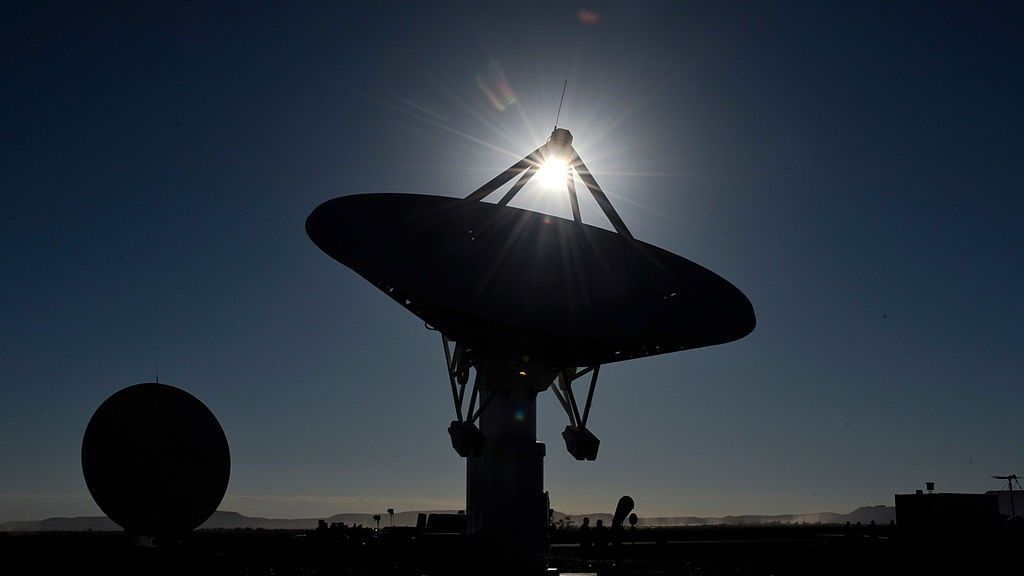
    The study was led by Kevin Ortiz Ceballos, a graduate student at Harvard University and the Smithsonian Center for Astrophysics. Using MeerKAT, a radio telescope array in South Africa, the research team observed the gas giant Beta Pictoris b.

    Beta Pictoris b is an exoplanet about 64 light-years from Earth with a mass roughly 10 times that of Jupiter. The researchers detected rapidly repeating bursts of radio signals associated with the planet.

    How astronomers confirmed the signal’s source

    At first, it was unclear whether the radio signal came from Beta Pictoris b, the star it orbits, or Earth. To identify the source, the researchers compared radio images of the planet and its host star with the positions of distant background quasars.

    Quasars are bright, active galaxies that can serve as fixed reference points. This comparison allowed the team to determine that the radio bursts originated from the gas giant itself rather than from Beta Pictoris or another source.

    “Until now, there have been no radio detections that have been positively localized to an exoplanet rather than its host star,” the researchers wrote in the study, which has not yet been peer-reviewed.

    The exoplanet may have an extremely strong magnetic field

    The signal appears to be consistent with an aurora rather than an artificial transmission. It also allowed the researchers to estimate the strength of Beta Pictoris b’s magnetic field at around 1,250 gauss.

    That would be dramatically stronger than the magnetic fields of planets in our solar system. Jupiter’s magnetic field is about 4.3 gauss, while Earth’s is approximately 0.5 gauss, according to Space.com.

    “This is definitely not an alien!” Aigrain said. Instead, the radio signal offers a new way to study the magnetic environments of distant worlds.

    Magnetic field measurements are important because scientists do not yet fully understand how planetary magnetospheres form or what controls their strength. A magnetic field can help protect a planet’s atmosphere from charged particles carried by stellar winds.

    “For example, on Earth, the magnetic field plays an important role in maintaining the atmosphere and protecting life on Earth from harmful high-energy radiation,” Aigrain said.

    Beta Pictoris b is a massive planet with a thick atmosphere, so it could likely retain an atmosphere even without a strong magnetic field. As a result, the planet is not expected to support life. In the future, however, similar observations of smaller planets could help scientists determine whether magnetic shielding is important for their atmospheres and potential habitability.

    More exoplanet radio signals could be detected soon

    MeerKAT is a pathfinder instrument for the Square Kilometre Array, which is expected to come online within the next few years. The larger observatory will be significantly more powerful, Aigrain said, allowing astronomers to examine many more planetary systems for similar radio signals.

    Those future observations could help researchers learn more about exoplanet magnetic fields, planetary atmospheres and the natural processes that produce radio emissions across the galaxy.

    Source: www.livescience.com

    Share. Facebook Twitter Pinterest LinkedIn WhatsApp
    Previous ArticleMalicious AI Agent Steals 600,000 Credit Cards and Infects More Than 100 Websites With Skimmers
    Next Article How a Small Submarine Volcano Can Cause a Massive Tsunami

    Related Posts

    Science

    Postcard from the Grave: Exploring Nature’s Haunting Beauty

    Science

    Why the Next U.S. Congress Should Ban Self-Improving AI Development

    Science

    Natural Floating Island Installed in Glasgow Park as a Lasting Games Legacy Project

    Science

    Extremophile Transgene Enhances Drought Resistance and Yield in Cereal Crops

    Science

    Black Friday 2026 Telescope Deals: Smart Telescopes and Binoculars

    Science

    NASA Science: Imbued with Sivrich

    Science

    Why Certainty Can Be a Failure in Science

    Science

    Chromosomal Glue May Improve Fertility by Stabilizing Aging Eggs

    Add A Comment
    Leave A Reply Cancel Reply

    Stay In Touch
    • Facebook
    • Twitter
    • Instagram
    • Pinterest
    Top Picks
    Technology

    Texas Emerges as New Epicenter for AI Data Center Construction, with Kapu Potentially Next

    Texas is emerging as a potential new obstacle to the US data center boom. Industry…

    FCC Chairman Warns Media Against ‘Fake Polls’ as President Trump Continues Complaints

    Heathrow Third Runway Should Proceed Only If Airlines Fund Cleaner Flights, Advisers Say

    Amazon Kindle Paperwhite (2026) and Colorsoft (2026) Review: Best Accessories to Buy

    Marmot Joins OnlyFans: Researchers Turn to Creative Funding Methods Amid US Budget Cuts

    Most Popular
    Science

    Thurrock Data Center Could Harm Rare Bees, Essex Charity Warns

    Technology

    Valve Developers Publicly Mention “HLX,” Sparking Fan Panic and Half-Life Speculation

    Categories
    • AI (9)
    • Gadgets (6)
    • Science (3,613)
    • Space (3)
    • Technology (3,044)
    • Wheels (3)
    Our Picks
    Technology

    NASA Orion Heat Shield Performs Exceptionally Well Despite Earlier Criticism

    Technology

    Google Home Speaker Using Too Much Wi-Fi Data? Here’s Why

    © 2026 Hitechub.
    • Home
    • About Us
    • Privacy Policy
    • Terms & Conditions

    Type above and press Enter to search. Press Esc to cancel.

    GDPR Cookie Banner

    We are using cookies to give you the best experience on our website.

    You can find out more about which cookies we are using or switch them off in .

    Ad Blocker Enabled!
    Ad Blocker Enabled!
    Our website is made possible by displaying online advertisements to our visitors. Please support us by disabling your Ad Blocker.