


Astronomers Detect Radio Signals Coming Directly From an Exoplanet for the First Time
For the first time, astronomers have detected a radio signal coming directly from a planet outside our solar system, according to new preprint research. The discovery is not evidence of aliens, but astrophysicists say it could provide important insight into exoplanets and their magnetic fields.
“Astronomers have been looking for radio signals from exoplanets for some time,” Suzanne Aigrain, a professor of astrophysics at the University of Oxford who was not involved in the study, told Live Science via email. “While there have been preliminary indirect detections in the past, this is the first truly convincing direct detection, and we hope it will pave the way for many more.”
The radio signal came from Beta Pictoris b
Radio signals are an important focus in the search for extraterrestrial intelligence, or SETI. Artificial signals known as technosignatures could potentially reveal technology built by extraterrestrial civilizations. However, radio emissions can also come from natural phenomena, including auroras.
“There are two natural phenomena that cause radio emissions on exoplanets,” Aigrain said. “One is magnetic reconnection, when a planet orbits very close to a star and its magnetic field interacts directly with the star’s magnetic field.”
The other is an aurora, similar to the auroras seen on planets such as Earth and Saturn, but potentially much more powerful. Auroras form when high-energy charged particles from a star interact with a planet’s upper atmosphere. According to Aigrain, this second effect is what the researchers believe they detected.
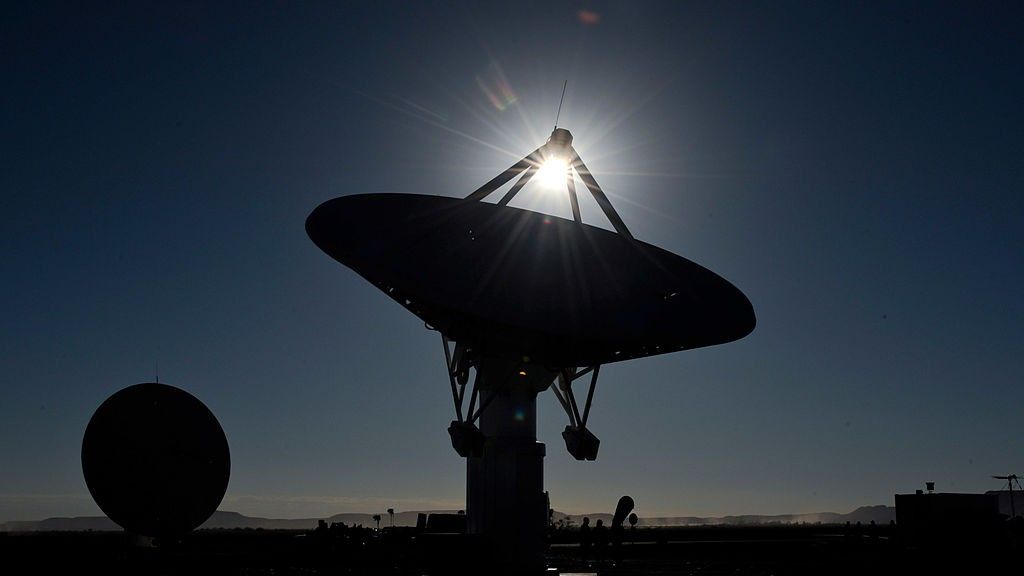
The study was led by Kevin Ortiz Ceballos, a graduate student at Harvard University and the Smithsonian Center for Astrophysics. Using MeerKAT, a radio telescope array in South Africa, the research team observed the gas giant Beta Pictoris b.
Beta Pictoris b is an exoplanet about 64 light-years from Earth with a mass roughly 10 times that of Jupiter. The researchers detected rapidly repeating bursts of radio signals associated with the planet.
How astronomers confirmed the signal’s source
At first, it was unclear whether the radio signal came from Beta Pictoris b, the star it orbits, or Earth. To identify the source, the researchers compared radio images of the planet and its host star with the positions of distant background quasars.
Quasars are bright, active galaxies that can serve as fixed reference points. This comparison allowed the team to determine that the radio bursts originated from the gas giant itself rather than from Beta Pictoris or another source.
“Until now, there have been no radio detections that have been positively localized to an exoplanet rather than its host star,” the researchers wrote in the study, which has not yet been peer-reviewed.
The exoplanet may have an extremely strong magnetic field
The signal appears to be consistent with an aurora rather than an artificial transmission. It also allowed the researchers to estimate the strength of Beta Pictoris b’s magnetic field at around 1,250 gauss.
That would be dramatically stronger than the magnetic fields of planets in our solar system. Jupiter’s magnetic field is about 4.3 gauss, while Earth’s is approximately 0.5 gauss, according to Space.com.
“This is definitely not an alien!” Aigrain said. Instead, the radio signal offers a new way to study the magnetic environments of distant worlds.
Magnetic field measurements are important because scientists do not yet fully understand how planetary magnetospheres form or what controls their strength. A magnetic field can help protect a planet’s atmosphere from charged particles carried by stellar winds.
“For example, on Earth, the magnetic field plays an important role in maintaining the atmosphere and protecting life on Earth from harmful high-energy radiation,” Aigrain said.
Beta Pictoris b is a massive planet with a thick atmosphere, so it could likely retain an atmosphere even without a strong magnetic field. As a result, the planet is not expected to support life. In the future, however, similar observations of smaller planets could help scientists determine whether magnetic shielding is important for their atmospheres and potential habitability.
More exoplanet radio signals could be detected soon
MeerKAT is a pathfinder instrument for the Square Kilometre Array, which is expected to come online within the next few years. The larger observatory will be significantly more powerful, Aigrain said, allowing astronomers to examine many more planetary systems for similar radio signals.
Those future observations could help researchers learn more about exoplanet magnetic fields, planetary atmospheres and the natural processes that produce radio emissions across the galaxy.
Source: www.livescience.com