


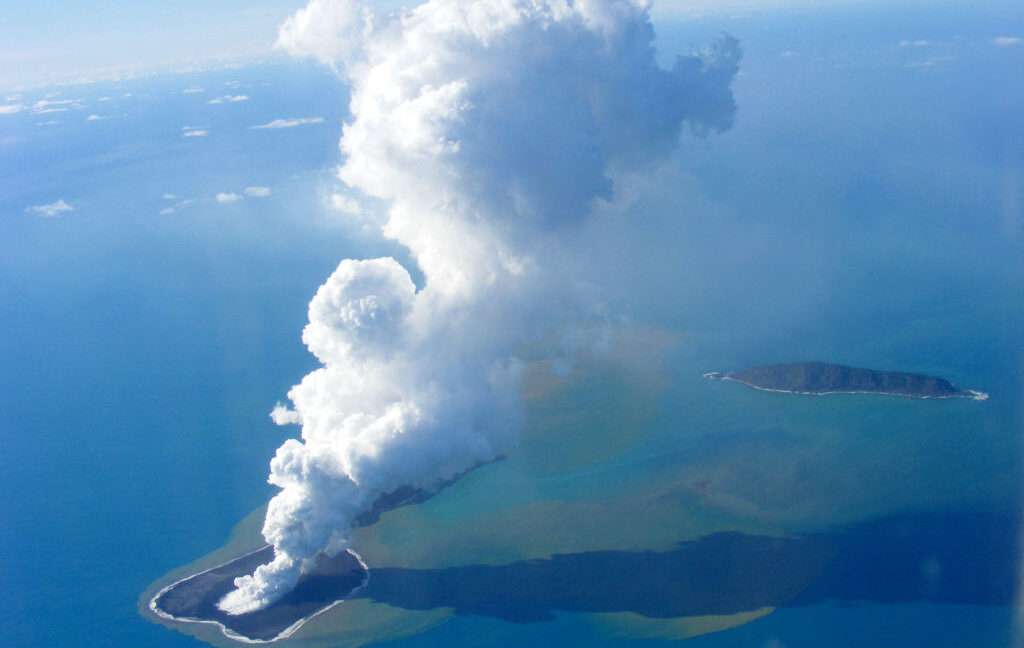
How the 2022 Hunga Eruption Triggered a Massive Tsunami
When Krakatoa erupted in Indonesia in 1883, more than 30,000 people died. Although volcanic debris posed a serious threat, many victims were killed by the tsunami generated by the eruption.
Underwater volcanoes can create hazards that differ sharply from those produced by volcanoes on land. The effects depend on how volcanic activity interacts with seawater. In the deep ocean, intense water pressure suppresses explosive activity and can reduce the damage caused by an eruption. Closer to the surface, however, pressure drops while the temperature of volcanic material remains extremely high, creating conditions for violent explosions.
Scientists still do not fully understand when submarine volcanic activity can trigger a tsunami. To investigate the risks, an international research team studied the 2022 Hunga eruption in Tonga, focusing on the rapid collapse of its caldera—a large volcanic depression that forms when the ground above a magma chamber collapses as magma escapes.
By comparing submarine topography recorded before and after the eruption, the researchers found that Hunga’s approximately 4-kilometer-wide caldera sank by about 1 kilometer during the event.
The researchers argue that the sudden collapse of the entire caldera may have amplified the powerful tsunami. Their findings suggest that even a relatively small submarine caldera can generate a dangerous tsunami, depending on how quickly and in what manner it collapses.
This also raises concerns about other underwater volcanoes. However, the paper warns that “the dynamics of eruptions that form submarine calderas, and the risks they pose, are not fully understood due to the relative inaccessibility of the resulting calderas and ejecta.”
Why Hunga’s caldera collapse mattered
The Hunga eruption on January 15, 2022, ranks among the most powerful volcanic events of this century. Its eruption column rose more than 55 kilometers, sending evaporated seawater into the stratosphere. Pressure waves from the explosion were detected around the world.
The resulting tsunami is estimated to have reached a height of 40 meters within approximately 100 kilometers of the eruption’s epicenter. It was the largest tsunami ever recorded as a result of an undersea volcanic eruption.
Source: arstechnica.com