


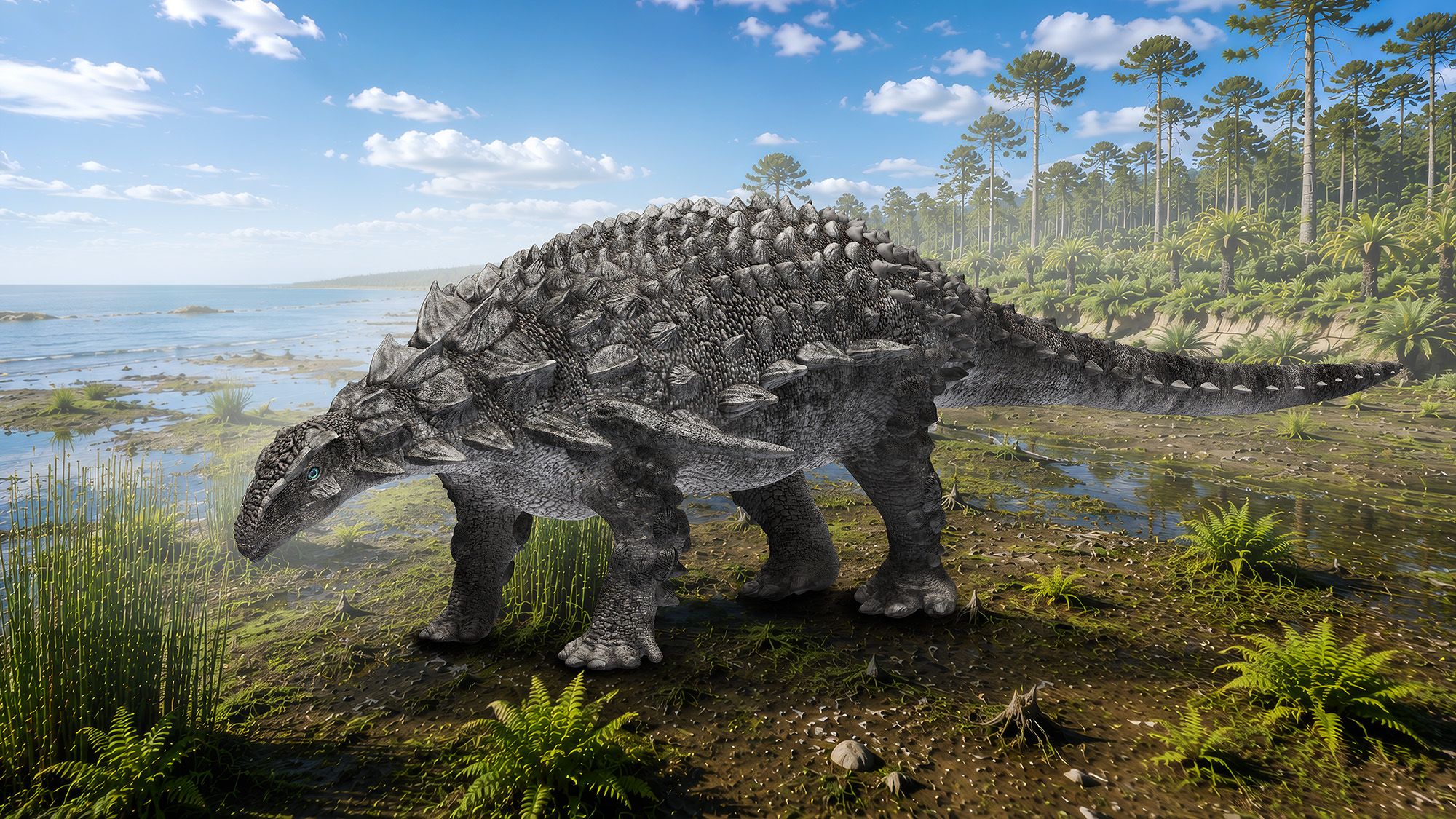
New Armored Dinosaur Species Discovered in Japan May Reveal How Dinosaurs Reached Asia
Rare fossils discovered in Japan more than 30 years ago belong to a previously unknown species of armored dinosaur. A new study suggests that the dinosaur’s ancestors may have reached Asia from North America by crossing the ancient Bering Land Bridge.
The newly named dinosaur was a member of the nodosaur family and is only the third nodosaur ever discovered in Asia. Its anatomical similarities to North American nodosaurs suggest that the species may have migrated across the land bridge that once connected modern-day Alaska and Russia.
The research appears in the February 2027 issue of the journal Cretaceous Research.
“It’s super cool to see. We’ve got a new look and a new name,” said Victoria Arbor, manager of research and collections at the Royal BC Museum in Canada. Arbor was not involved in the new study.
What are nodosaurs?
Nodosaurs were armored dinosaurs covered with bony plates. They were closely related to ankylosaurids, but unlike their relatives, they lacked the heavy tail clubs ankylosaurids used to defend themselves against predators.
Nodosaur fossils are most common in North America. Some have also been found in Europe and Asia, but they remain rare on the Asian continent.
CT scans reveal a new dinosaur species
Researchers reexamined a nodosaur fossil originally discovered in 1995 in Hokkaido, Japan’s northernmost main island. The fossil is between 93 million and 100 million years old and includes part of the back of the skull, a portion of the lower jaw, several teeth and bony plates.
Using computed tomography, or CT, scans, the scientists created detailed digital 3D models of the fossil. This allowed them to examine the specimen’s internal structure without damaging it.
Based on the CT scans and anatomical analysis, the team determined that the fossil represents a new nodosaur species, which they named Nipponoperta ezoensis.
The name combines “Nippon,” a name for Japan, with “pelta,” the Greek word for “shield.” “Ezo” is the traditional name for Hokkaido.
How did this armored dinosaur reach Japan?
Nipponoperta ezoensis appears to be closely related to North American nodosaurids. The researchers suggest that its ancestors may have migrated from North America to Asia between 100 million and 110 million years ago.
At that time, a land bridge existed in the region of the modern Bering Strait. The dinosaurs may have crossed this connection before dispersing through Asia.

Did the dinosaur live along the coast?
Scientists first found N. ezoensis in marine sediments, or rocks formed under ancient oceans. Because nodosaurs did not live in the sea, the fossil’s location suggests that the dinosaur may have died on land before its carcass was carried into the ocean by rivers or estuaries.
Several other nodosaur fossils have also been found in similar marine sediments. This pattern suggests that the animals may have lived near coastlines. Coastal habitats may have helped nodosaurs migrate along the Bering Land Bridge and disperse along the shore, according to the study’s authors.
However, the discovery does not prove that nodosaurs were restricted to coastal environments. Highlands and mountainous areas tend to produce fewer fossils because erosion can destroy the rock that preserves them. The animals may have lived farther inland even if their fossils have not yet been discovered there.

Why are nodosaurs so rare in Asia?
The fossil record does not yet explain why nodosaurs are much rarer in Asia than in North America. Several ankylosaurid species have been discovered in the interior of Asia, but relatively few nodosaur fossils have been found across the continent.
The difference could reflect gaps in the rock record. It is also possible that nodosaurids did not diversify as much in Asia as they did in North America.
Researchers hope to find more fossils of N. ezoensis and test their ideas about the dinosaur’s appearance, habitat and migration history.
Study: S. Oyabu et al. (2026), “A new nodosaurid anhydrosaur (Dinosauridae: Ornithischian order) discovered from the Upper Cretaceous Hikagenosawa Formation in Japan reveals the dispersal pattern of Asian nodosaurids,” Cretaceous Research.
Source: www.livescience.com