


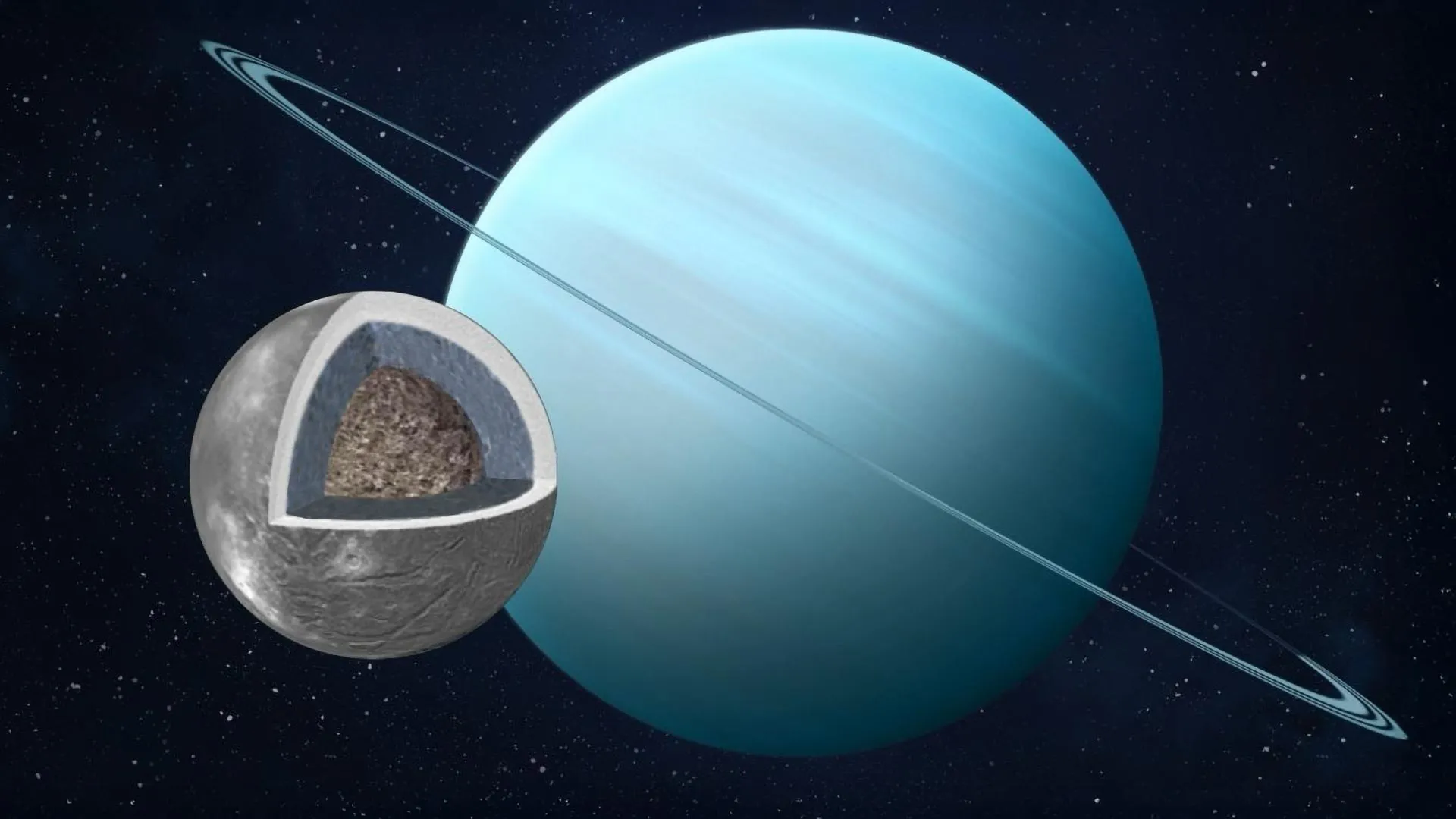
Uranus’ Moon Ariel May Once Have Held an Ocean More Than 100 Miles Deep
Evidence is mounting that Ariel, one of Uranus’ icy moons, may once have contained a vast underground ocean beneath its frozen exterior. Research published in Icarus examines how that hidden ocean may have changed over time and suggests it could once have been more than 100 miles (170 kilometers) deep. By comparison, the Pacific Ocean has an average depth of about 2.5 miles (4 kilometers).
Ariel’s surprising and violent past
“Ariel is quite unique in that it’s an icy moon,” said study co-author Alex Putthoff, a senior scientist at the Planetary Science Institute.
Ariel is the brightest of Uranus’ moons and the second closest to the planet. With a diameter of 720 miles (1,159 kilometers)—roughly the distance from the Planetary Science Institute in Tucson to Salt Lake City, Utah—it is the fourth-largest moon in the Uranus system.
Despite its relatively small size, Ariel has an unusually complex surface. Caleb Strom, lead author of the study and a recent graduate of the University of North Dakota, said ancient features such as impact craters exist alongside much younger formations.
Some smooth regions may have formed through cryovolcanism, a process in which water, ice or other volatile materials erupt from an icy world instead of molten rock.
Ariel is also covered in cracks, ridges and grabens—areas where parts of the crust have sunk beneath the surrounding terrain. Some of these structures are larger than similar features found in most other places across the solar system.
How Ariel’s surface reveals its hidden interior
These enormous surface features motivated the new investigation. Researchers wanted to determine what Ariel’s interior and orbit may have been like in the past to produce the cracks visible today.
One important factor is orbital eccentricity, which measures how much an orbit deviates from a perfect circle. Changes in Ariel’s internal structure and orbital eccentricity could have affected the tidal forces acting on its icy crust.
As Ariel orbits Uranus, the planet’s gravity repeatedly stretches and compresses the moon. Over time, those forces could generate enough stress to fracture its surface.
“First, we mapped the larger structures seen on the surface, and then used computer programs to model the tidal forces on the surface, which are caused by the distortions caused by Ariel’s soccer-ball shape to a slight football shape and back again as it moves toward and away from Uranus during its orbit,” Putthoff said.
“By combining this model with what we see on the surface, we can make inferences about Ariel’s past anomalies and the thickness of the ocean.”
Ariel may once have had a far more eccentric orbit
The researchers found that Ariel may once have had an orbital eccentricity of about 0.04—roughly 40 times its current value.
Although an eccentricity of 0.04 would still produce an orbit that appeared approximately circular, it would have greatly amplified the tidal forces acting on Ariel. The moon’s orbit would have been about four times more eccentric than the orbit of Jupiter’s moon Europa, whose icy shell has been extensively fractured by repeated gravitational stretching and compression.
Those forces may have played a major role in shaping Ariel’s dramatic landscape.
“For these cracks to form, you either need very thin ice on a very large ocean, or you need a small ocean with high eccentricity,” Putthoff said. “But in any case, we need an ocean to create the kind of cracks we see on Ariel’s surface.”
Uranus may have had two ocean worlds
The study of Ariel is the second in a series examining what may once have existed beneath the surfaces of Uranus’ moons. Last year, the same research team reported similar results for Miranda, another icy moon orbiting Uranus.
Taken together, the findings raise the possibility that multiple moons in the Uranus system once contained substantial underground oceans.
“We find evidence that there may be a twin ocean world in the Uranus system,” said co-author Tom Nordheim of the Johns Hopkins University Applied Physics Laboratory and principal investigator on the NASA Solar System Working Grant that funded the Miranda and Ariel research.
“Unfortunately, we’ve only seen Ariel and Miranda’s southern hemisphere. But our results can give us predictions of what future spacecraft will see in the moon’s unimaged northern hemisphere, including the location of cracks and ridges there. Eventually, we’ll need to return to the Uranus system to see for ourselves.”
Future Uranus missions could test the ocean theory
Scientists still do not know exactly when Ariel’s deep ocean existed or how long it lasted. However, the new findings provide an important foundation for future studies of how underground oceans on distant icy worlds form, evolve and eventually disappear.
Future spacecraft missions to Uranus could test the researchers’ predictions by imaging the unexplored northern hemispheres of Ariel and Miranda. Scientists could search for the cracks and bulges predicted by the models.
This research also received funding from the North Dakota Space Grant Consortium.
Source: www.sciencedaily.com