


NASA’s Curiosity Rover Resumes Climb Up Mount Sharp on Mars
By Allison Dries-Padilla, Mission Operations Specialist, Malin Space Science Systems
Earth Plan Date: Friday, August 14, 2026
This week, NASA’s Curiosity Mars rover returned to its regular exploration route after a brief detour to investigate the “erosion surface.” The rover is once again climbing Mount Sharp in Gale Crater, studying the rocks and layers that reveal Mars’ geological history.
As autumn approaches at Gale Crater, temperatures are beginning to fall and the likelihood of sandstorms is decreasing. However, Curiosity continues monitoring the final local and regional dust activity of the season while carrying out contact science, remote sensing, and driving operations.
Curiosity Studies Unique Rocks Near the Erosional Surface
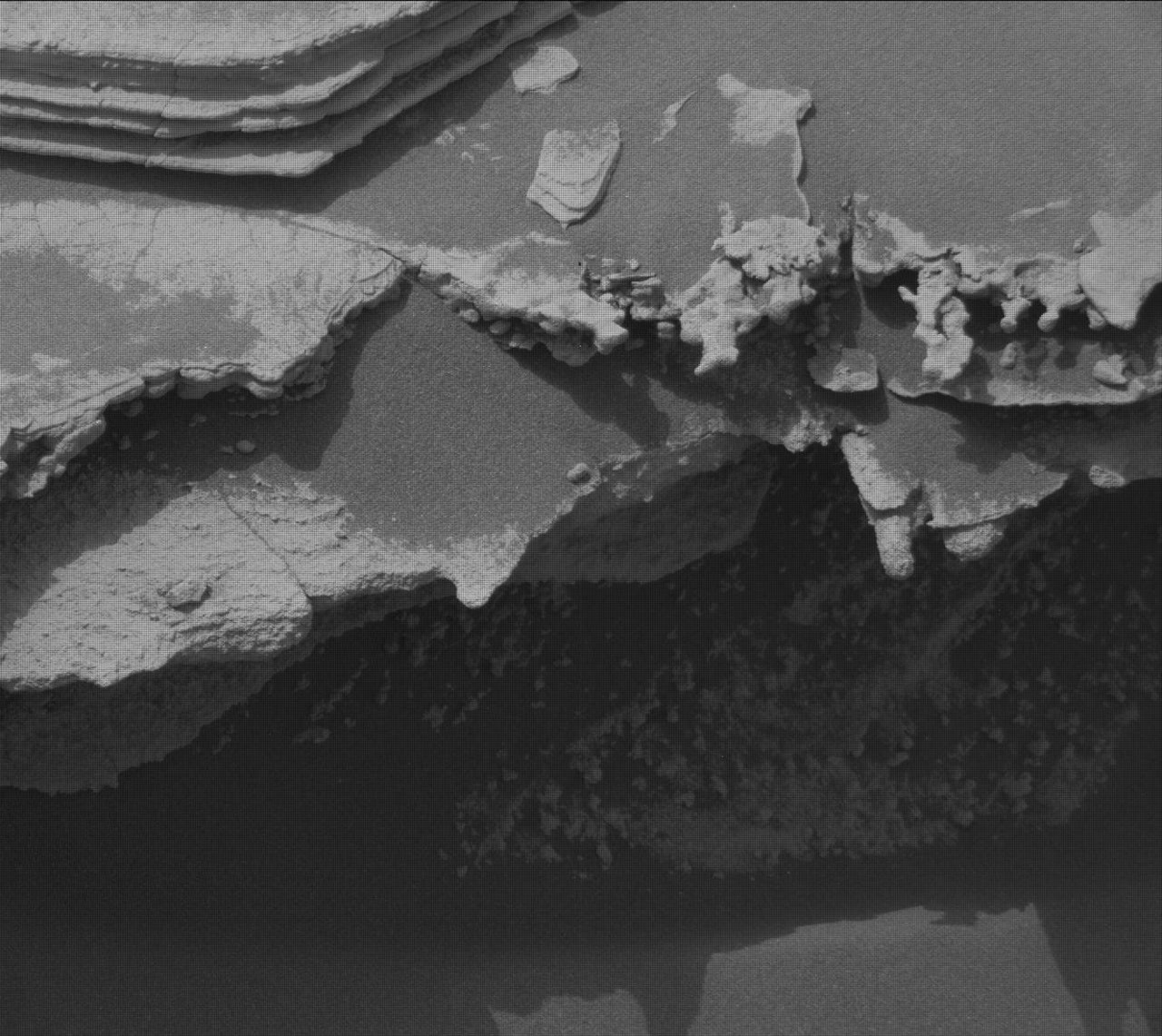
Monday’s plan for Sols 4982 through 4985 began with Curiosity positioned directly in front of a unique geological feature located just above the eroded supersurface contact. As noted in a previous mission update, the rover team was fortunate to spend two planning cycles investigating this scientifically important location.
The Mars Hand Lens Imager, or MAHLI, reacquired images selected for the “Tres Morros” mosaic. These images will help scientists examine the feature in greater detail and better understand its structure and formation.
After the Dust Removal Tool, or DRT, brushed the rock surface, the Alpha Particle X-ray Spectrometer, known as APXS, analyzed the target “El Motaxar.” APXS also conducted a second measurement on the undisturbed rock target “Alto de Carmen.” MAHLI documented both APXS targets with high-resolution images.
Curiosity’s ChemCam instrument performed laser-induced breakdown spectroscopy, or LIBS, on the rock targets “Lagunas Bravas” and “Parkkucha.” ChemCam also captured remote micro-images of “Miche Mokwa.” Mastcam photographed a nearby mosaic of the erosional ridge, named “Los Tordos,” along with a more distant rock outcrop on the erosional surface called “Los Ladrilos.” Additional Mastcam color images documented ChemCam remote imaging and earlier LIBS activities in the Cordillera.
Rover Navigates Rocky Terrain During Contact Science
Curiosity then drove approximately 100 feet (30 meters) to its next planned location during Sols 4985 through 4987. The site contained several areas of flat rock, but the rover’s robotic arm could not be positioned safely to use the Dust Removal Tool.
The rover’s front-left wheel was resting on a small rock, creating a risk that Curiosity could slide if the arm was moved. Despite this limitation, MAHLI and APXS safely conducted contact science on two rock targets, “Mamorecillo” and “Aguas Claras.” MAHLI also completed additional housekeeping observations of the rover’s calibration targets.
ChemCam will use its laser spectrometer to study the composition of three nearby targets, followed by Mastcam documentation. One of the planned LIBS targets is “Yuragasa,” a dark, resistant layer within the bedrock. Mastcam will also capture a series of mosaics to continue documenting the stratigraphy of the geological unit above the erosional contact.
Curiosity Monitors Dust and Sandstorms on Mars
The latest plan also included extensive environmental monitoring to track a nearby sandstorm. Mastcam captured a series of images of airborne dust to measure the atmosphere’s optical depth, known as tau. A higher tau value indicates a greater concentration of dust in the atmosphere.
APXS planned nighttime atmospheric measurements, while Navcam conducted most of the rover’s dust and sandstorm monitoring. These observations included multiple large-scale dust devil surveys, skyward observations, line-of-sight imaging across Gale Crater, and videos of clouds above the horizon.
Curiosity Continues Toward Mount Sharp’s Higher Slopes
Curiosity’s next drive is planned to cover approximately 150 feet (47 meters) toward the southwest. The rover will continue climbing Mount Sharp while searching for clues about Mars’ ancient environments and the geological processes that shaped Gale Crater.
The mission team will return Monday to begin another week of exploration featuring contact science, remote sensing, environmental monitoring, and rover drives across the Martian surface.
Source: science.nasa.gov