


NASA’s Curiosity Rover Captures a Stunning Two-Time-of-Day View of Mars After 5,000 Sols
NASA’s Curiosity rover captured a surprising new perspective of Mars after reaching a major mission milestone: 5,000 days on the Red Planet.
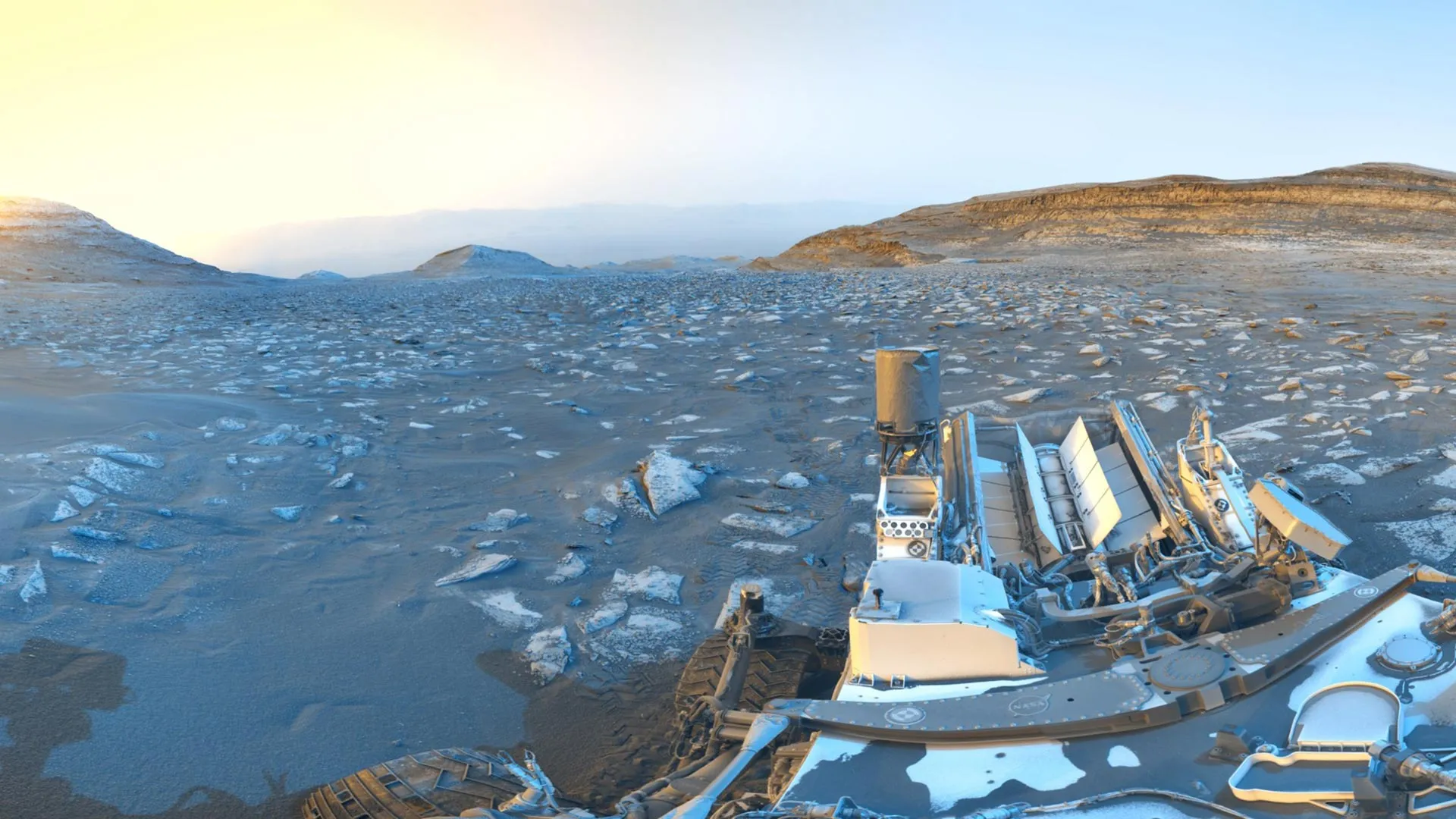
While perched on a sandy ridge called Chocolatal, Curiosity used its navigation camera to photograph the surrounding landscape at two different times of day. The camera typically captures images in black and white.
The first panorama was recorded at 9:56 a.m. Mars local time on August 30, 2026, commemorating Curiosity’s 5,000th Martian day, or sol. The second panorama was taken on September 2, 2026, at 5:39 p.m. local Mars time during the rover’s 5,003rd sol.
One Mars panorama combines morning and evening views
After the images arrived on Earth, the two panoramas were combined into a single scene. Color was later added as an artistic interpretation, with blue representing the morning view and yellow representing the afternoon view.
The completed “postcard” follows the style of similar Curiosity images created in the past, including one photographed in November 2021.
Parts of the spacecraft are visible in the foreground. They include Curiosity’s cylindrical UHF antenna, which transmits data to spacecraft orbiting Mars, and the rear finned Multi-Mission Radioisotope Thermoelectric Generator (MMRTG), which serves as the rover’s nuclear power source.
Curiosity’s footprints can also be seen stretching across the Martian landscape.
Curiosity’s view of Gale Crater
The rover is currently exploring the base of Mount Sharp, a 3-mile-high (5-kilometer) mountain in Gale Crater. From Curiosity’s position, the panorama appears to slope down toward the crater floor, while the distant rim of Gale Crater is only faintly visible along the horizon.
Curiosity was built by NASA’s Jet Propulsion Laboratory, which is managed by the California Institute of Technology in Pasadena, California. JPL operates missions for NASA’s Science Mission Directorate in Washington as part of NASA’s Mars Exploration Program portfolio.
Source: www.sciencedaily.com