


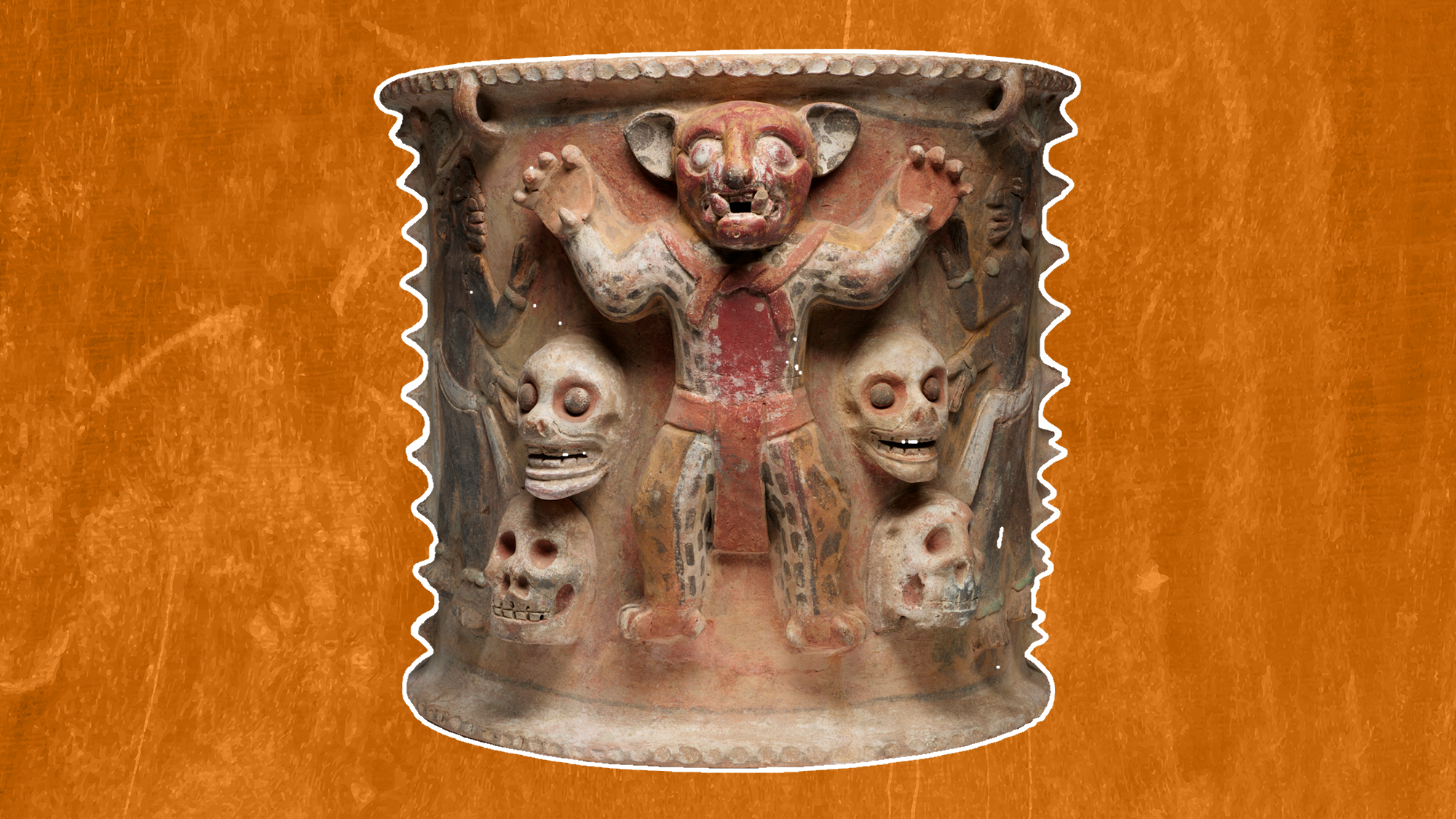
Maya Burial Urn Shows Jaguar-Clad Figure Entering the Underworld
This burial urn depicts a figure being welcomed into the Maya underworld with a skull.
Jar with Jaguar and Skull: Key Facts
What it is: Ceramic burial urn
Where it comes from: Guatemala
When it was created: Around AD 600 to 900
Likely makers: The K’iche’ Maya
Height: About 17.5 inches (44.5 centimeters)
This colorful Maya ceramic urn depicts a figure in a jaguar costume surrounded by human skulls, apparently being welcomed into the underworld. Urns like this one held the bones of ancestors, allowing their descendants to honor and worship them.
The urn was donated anonymously and is now associated with the Walters Art Museum. The museum says it was probably made in Guatemala by the K’iche’ Maya more than 1,000 years ago.
The vessel originally likely had an elaborate lid. A string would have passed through a ring near the rim to secure it, but the lid is now missing.
A Jaguar-Clad Figure Enters the Underworld
The urn’s decoration is both vivid and unsettling. At its center, a figure wearing a blood-splattered jaguar costume stares outward with exposed claws and teeth. The figure may represent a lord of the dead entering the world of the deceased.
Two pairs of human skulls symbolize the underworld, while two dark figures may represent Maya gods. Behind them are tall spikes that appear to depict the thorns of the tropical kapok tree, Ceiba pentandra.
Why the Kapok Tree Mattered to the Maya
The Maya considered the kapok tree a world tree, sometimes called “Mayan” or Jaszce. According to the Walters Art Museum, its roots reached into the aquatic underworld, making the tree a possible conduit between different realms. The tree’s symbolism may explain its appearance behind the figures on the urn.
The Maya also assigned important spiritual meaning to jaguars. They were believed to move between three realms: the sky, the earth and the underworld. As a result, depictions of deceased rulers entering the underworld in jaguar costumes may suggest that they served as intermediaries between the mortal world and the Maya gods.
Death as Transformation
The urn’s colorful imagery suggests that death was not viewed as an absolute ending. Instead, the dissolution of the body could transform a beloved ancestor into an honored spirit who continued to guide the living.
In that sense, the “Jar with Jaguar and Skull” was more than a container for human remains. Its imagery presented death as a transition between realms and reinforced the enduring relationship between ancestors, descendants and the Maya supernatural world.
Explore more: Learn about the Maya world tree and discover more Maya jaguar symbolism.
Topics
Source: www.livescience.com