


Supreme Court Boulder Climate Lawsuit Could Shape Oil Companies’ Liability
During arguments in Boulder’s climate lawsuit, Russell argued that the city’s case does not seek to regulate or limit pollution directly. He said nothing in the Clean Air Act or the Constitution prevents states and local governments from taking actions that have the secondary effect of reducing pollution, such as imposing a gasoline tax or requiring oil companies to pay damages.
Justice Alito’s absence raises the possibility of a tie
Justice Samuel Alito did not attend the subsequent hearing. Alito has not explained his absence, but he faced pressure to recuse himself because he owns stock in oil companies involved in other lawsuits that could be affected by the Supreme Court’s decision.
Alito’s absence leaves open the possibility of a tie vote, which would allow the case to move forward.
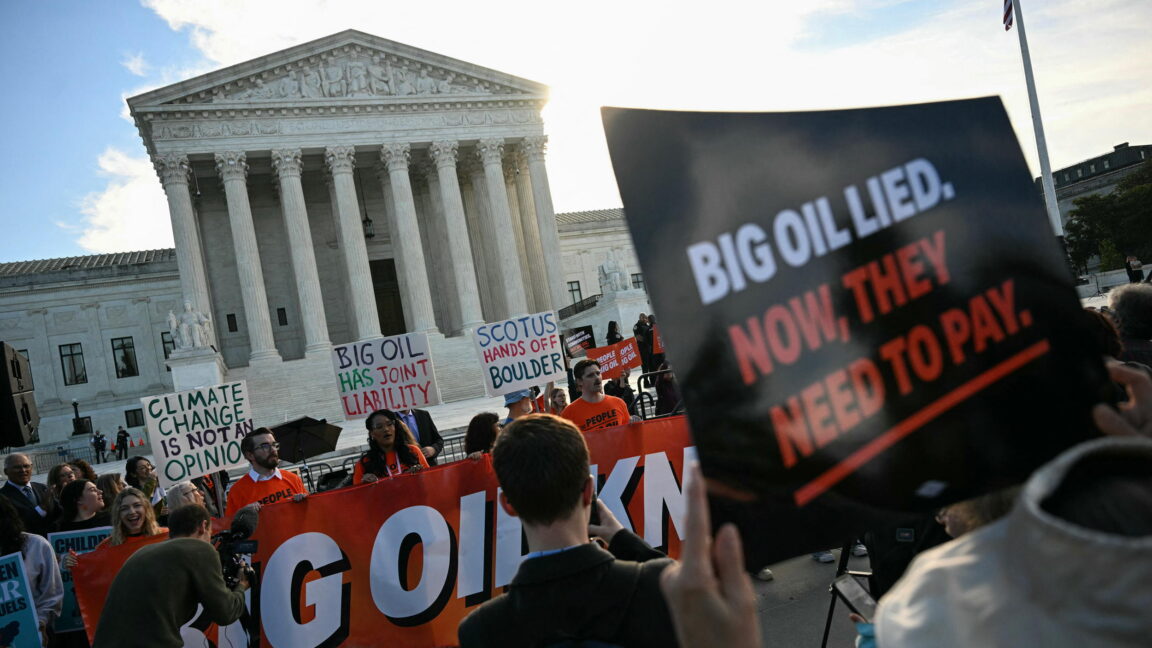
Supporters of Boulder’s lawsuit rallied outside the courtroom and urged the justices to proceed with the case.
“The City of Boulder, like other cities and counties across the country, faces the realities of climate change every day, from wildfires and flooding to drought, extreme heat, and increased pressure on water and infrastructure,” Boulder City Manager Nuria Rivera Vandermeyde said in a statement after the hearing.
“The legal question before the court is whether the taxpayer must bear these costs alone, or whether the defendant must also pay a proportionate share of the damage caused.”
Oil companies receive support from conservative groups
A number of conservative groups and politicians filed briefs supporting the oil companies. The Trump administration also filed a rebuttal with the justices on Monday.
Boulder received supportive briefs from climate change advocates and Democrats, as well as academics and former Environmental Protection Agency officials, including some appointed by Republican presidents.
Supreme Court decision could affect climate lawsuits nationwide
Many lawsuits brought by state and local governments have been suspended pending the Supreme Court’s decision in Boulder. The ruling, expected by the end of the court’s term in June, could bring these claims to an abrupt halt or set the stage for a trial to finally begin.
Nicholas Kusnetz is a reporter for Inside Climate News. Before joining ICN, he worked at the Center for Public Integrity and ProPublica. His work has received numerous awards and citations from the Society of Professional Journalists, the Society of Environmental Journalists, the Overseas Press Club, and the Business Editors and Writers of America, among others. His articles have appeared in more than a dozen publications, including Wired, The Washington Post, Businessweek, The Nation, and The New York Times. Nicholas can be reached on Signal at nkusnetz.15.
This story was originally published by Inside Climate News.
Source: arstechnica.com