


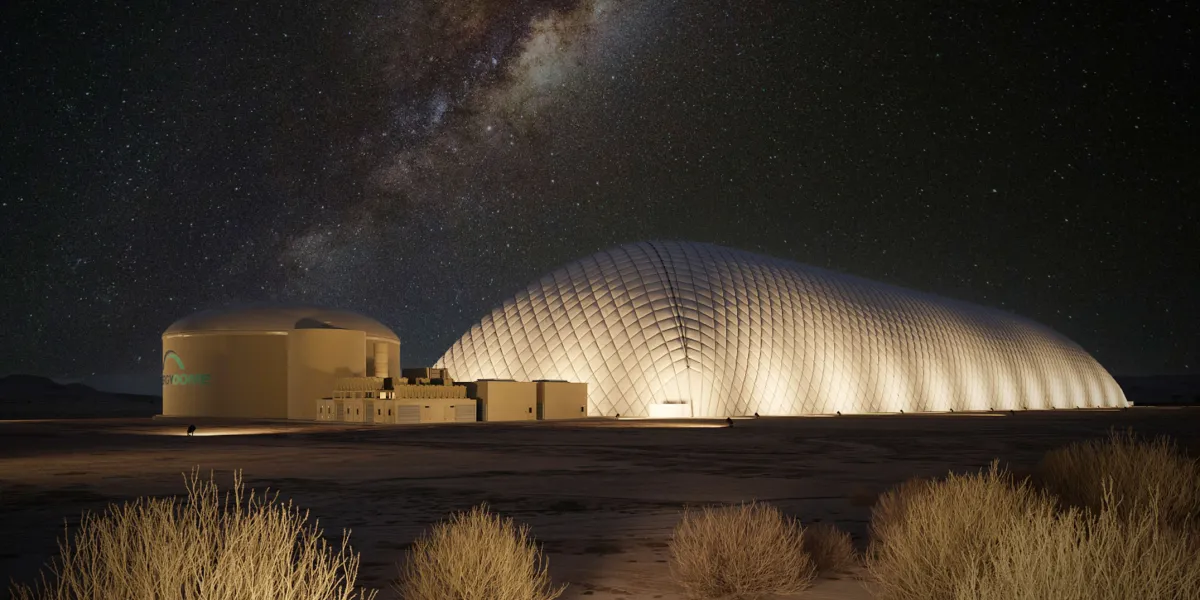
Energy Dome’s CO₂ Battery: Could Long-Duration Energy Storage Support Renewable Power?
Compressed gas has been used to store energy for decades. Power companies have traditionally relied on underground caverns to store compressed air and secure electricity reserves. Energy Dome is taking a different approach: its energy storage system does not require specific geological conditions, potentially making it easier to scale for power grids around the world.
Energy Dome opened its first commercial plant on the Italian island of Sardinia in 2025. The facility has a storage capacity of 200 megawatt-hours (MWh), enough to power approximately 18,000 Italian households for 10 hours.
Energy Dome: Key Facts
- Industry: Energy storage
- Established: 2020
- Headquarters: Milan, Italy
- Notable fact: Energy Dome has approximately 30 gigawatt-hours (GWh) of projects planned across five continents.
Why Long-Duration Energy Storage Matters
Lower-cost energy storage could help wind and solar power supply a larger share of the world’s electricity. Storage is particularly important when renewable generation does not match demand.
Lithium-ion batteries are now widely used for short-duration applications of up to four hours. However, their economics become less competitive over longer periods. A lithium-ion system providing eight hours of storage at the same output would require twice as many cells as a four-hour system.
How Energy Dome’s CO₂ Battery Compares With Lithium-Ion
Energy Dome estimates that its technology is approximately 10% to 15% cheaper than lithium-ion batteries for eight-hour systems. The company says the economics improve further for long-duration systems of up to 24 hours.
Energy Dome attributes its ability to scale larger and faster than lithium-ion systems to its use of existing, commercially available equipment, including compressors and storage tanks. Plants in operation or under contract have operating durations of eight or 10 hours.
Energy Dome’s Technology: Limitations and Precautions
Only one commercial Energy Dome project is currently operating. Additional storage capacity will need to be built to deliver the company’s planned 30 GWh pipeline.
The technology is also less efficient than lithium-ion batteries. Energy Dome’s process can return approximately 70% of the stored electricity to the grid, a measurement known as round-trip efficiency. Lithium-ion batteries average around 90%. However, some other long-duration storage technologies have even lower round-trip efficiency. For example, certain iron-air batteries are around 50%.
Not all Energy Dome plants are emissions-free. The company offers a version that combines a carbon dioxide battery with a natural gas turbine. This design replaces internal heat storage with waste heat from the gas turbine to help evaporate carbon dioxide. While the configuration increases operating efficiency, it also produces greenhouse gas emissions from the natural gas turbines.
What’s Next for Energy Dome?
Energy Dome has a pipeline of approximately 30 GWh of power plants under construction around the world, with many projects potentially becoming operational by the end of the decade.
Because the company uses off-the-shelf components, Energy Dome says the time from signing a contract to delivering capacity is approximately two years. In June 2026, the company signed a contract with Google to build a 200 MWh power plant in Ireland. The facility is expected to become operational in 2028.
If Energy Dome can deliver its planned projects, its CO₂-based energy storage system could become a scalable option for storing renewable electricity over eight to 24 hours. Its progress will depend on building more commercial plants while addressing its lower efficiency and, in some configurations, continued reliance on natural gas.
Source: www.technologyreview.com