


A Fascinating Fossil Discovery: The Hatchling of a Crocodile-Like Creature and What It Means for Evolution
:focal(1376x1035:1377x1036)/https://tf-cmsv2-smithsonianmag-media.s3.amazonaws.com/filer_public/77/df/77df2952-db82-4627-80ba-c8bd8ba4ad0c/illustration_by_berit_goding.jpg)
Berrit Gording
Richard Locke, a Vietnam War veteran and passionate fossil collector, has dedicated 66 years to exploring Mason Creek, a fossil-rich site around 110 miles southwest of Chicago. This area is renowned not only for its geological treasures but also for its enthusiastic community of amateur scientists who persevere through harsh conditions to uncover paleontological wonders.
In 2023, rock collector Andrew Young sought permission to photograph Locke’s extensive collection. Locke’s study is filled with meticulously displayed specimens, including one labeled “Baby Lamprey.” However, this fossil would turn out to be significantly more important.
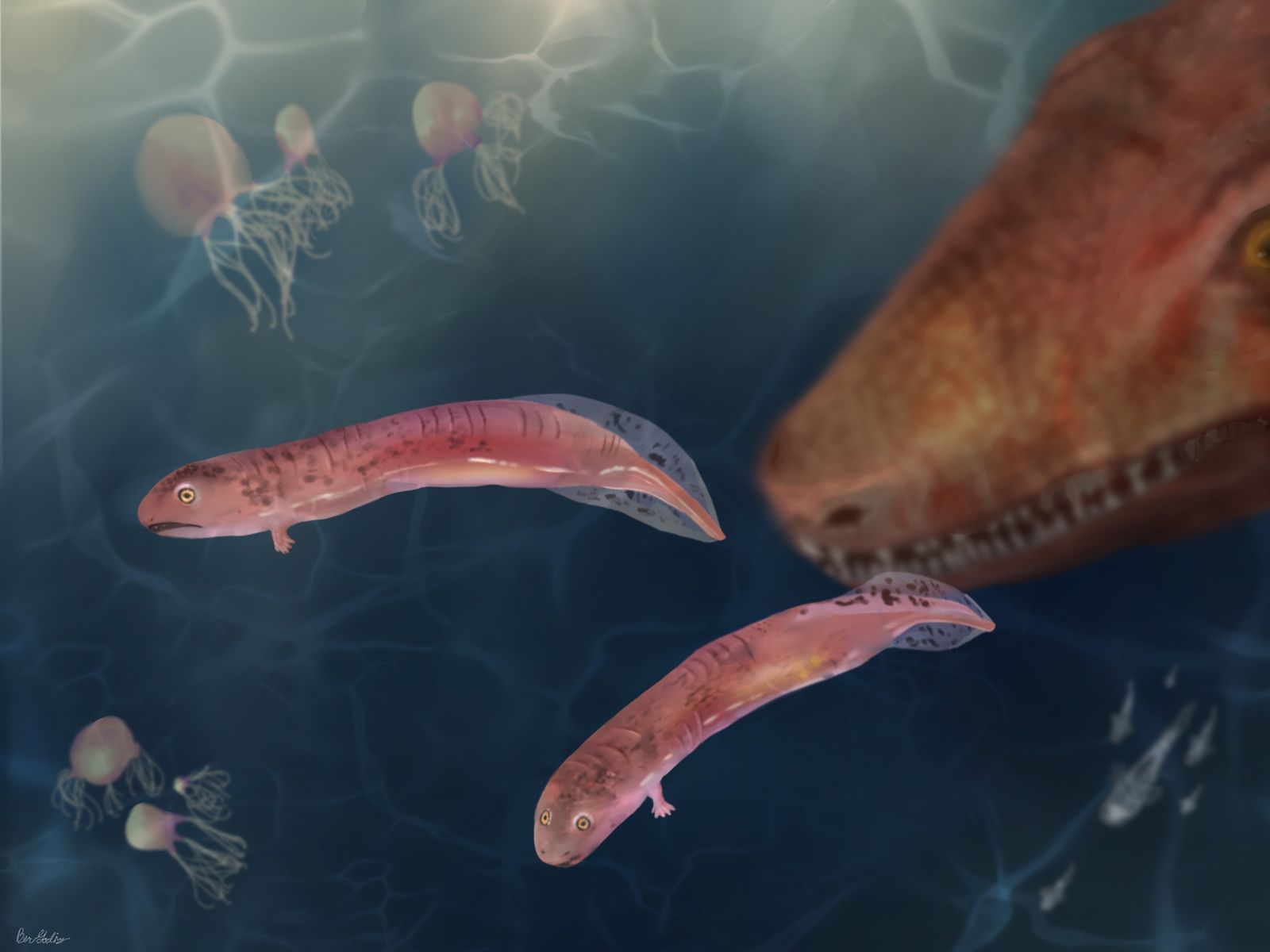
In a groundbreaking study published in the journal Science, researchers from the Field Museum, Arjun Mann and Jason Pardo, identified the specimen as a newly-hatched juvenile tetrapod, revealing insights into the evolutionary lineage leading to modern amphibians, reptiles, birds, and mammals. This research challenges the long-held belief that metamorphosis was necessary for early land-dwelling vertebrates to evolve from aquatic life.
Did You Know? The Oldest Quadruped
Images of ancient quadrupeds, resembling modern lizards, often depicted them as the earliest terrestrial vertebrates transitioning from aquatic habitats. For decades, scientists assumed this transition involved metamorphosis, much like contemporary frogs, which undergo significant physical changes during their life cycle.
While it was believed that the method of metamorphosis was necessary due to the similarities to modern salamanders, Florian Witzmann, a curator at the Natural History Museum in Berlin, argues that this analogy has always been misguided and that metamorphosis may have evolved later.
Before discovering Rock’s fossil, Mann and Pardo spent years analyzing other specimens in the Field Museum’s collection. Late-night lab work led Mann to observe tiny budding limbs on the fossil. Through meticulous morphological comparison, they identified the animal as an Embolomere, a crocodile-like predator that existed 280 to 350 million years ago.
Significantly, these hatchlings displayed no signs of a tadpole stage. For instance, the Embolomere represented by Rock’s fossil possessed small legs and lacked external gills, which are typical in salamander larvae. Instead, these specimens served as miniature versions of adults, growing larger over time, similar to reptiles and mammals today.
This discovery suggests that early tetrapods did not rely on metamorphosis for transitioning from water to land, provided insights into evolutionary processes. Nadia Frobisch notes that experts in quadrupedal evolution had anticipated these findings, stating, “We’ve all been waiting for it…now Arjun Mann and Jason Pardo have found direct evidence.”
/https://tf-cmsv2-smithsonianmag-media.s3.amazonaws.com/filer_public/64/ae/64ae5919-747f-448a-bfd7-0d766d50023d/2a_ayoung_mazon_creek_hatchling_tetrapod_2cm_photographed_3-4-23.jpg)
Andrew Young
Despite the compelling evidence, these findings did not conclusively rule out metamorphosis across all tetrapods. Mann and Pardo examined thousands of juvenile fossils from early tetrapod relatives but found no metamorphic traits in any of them. “It’s not limited to a single species,” Pardo asserts. “We can investigate all tetrapods related to the fin-to-limb transition, and none of them indicate metamorphosis.”
Frobisch maintains that there is consensus on Mann and Pardo’s conclusions: “I can’t think of anyone who would contest this theory. It doesn’t align with the broader evolutionary narrative.” Witzmann echoes this sentiment, praising the exquisite preservation of soft tissues in the fossils.
Such remarkable fossil preservation is uncommon. The area known as Mason Creek provided ideal conditions, as its rich sedimentary environment from around 309 million years ago facilitated unique fossilization processes that safeguarded juvenile remains.
/https://tf-cmsv2-smithsonianmag-media.s3.amazonaws.com/filer_public/e0/12/e012eeb7-065d-44df-af8d-aee3c51799ab/gettyimages-2216687732.jpg)
Audrey Richardson/Chicago Tribune/Tribune News Service (via Getty Images)
Mason Creek has long been a hotspot for collectors and citizen scientists, with its proximity to urban areas and coal mining sites enhancing accessibility. Over the years, this gathering of enthusiasts has continued to thrive as they share knowledge and resources with professional researchers, including those at the Field Museum.
/https://tf-cmsv2-smithsonianmag-media.s3.amazonaws.com/filer_public/3d/6b/3d6bdef2-a40a-4c20-be2f-5d547cc8b45b/5_ayoung_field_museum_richard_rock_and_family_6-14-24.jpg)
Andrew Young
Locke, an esteemed member of the citizen scientist community since 1960, inspired by fossils at a science fair, began collecting fossils from Mason Creek as a child. His passion for paleontology blossomed, leading to the discovery of extensive collections over the decades.
Though Locke doesn’t recall the moment he collected the baby tetrapod, he recognized its importance after hearing from Mann and Pardo. “We quickly realized this was a significant fossil,” Locke stated, expressing his hope that it would enhance our understanding of evolutionary history.
This study represents a seismic shift in our understanding of how early tetrapods adapted to terrestrial life. As Mann puts it, “Sometimes we need to dismantle established beliefs to foster new understanding. We’ve questioned long-standing assumptions, and now we must explore new possibilities.”
Ultimately, Locke’s fossil discovery, though small—”about the size of a dime”—holds the potential to reshape our insights into vertebrate evolution. “I collect everything because you never know what hidden secrets lie within,” he shared.
Source: www.smithsonianmag.com