


Diet Drinks May Support Weight Loss as Effectively as Water, Two-Year Trial Finds
People who drank diet beverages while trying to lose weight lost about as much weight as those who drank only water, according to a long-term British randomized controlled trial.
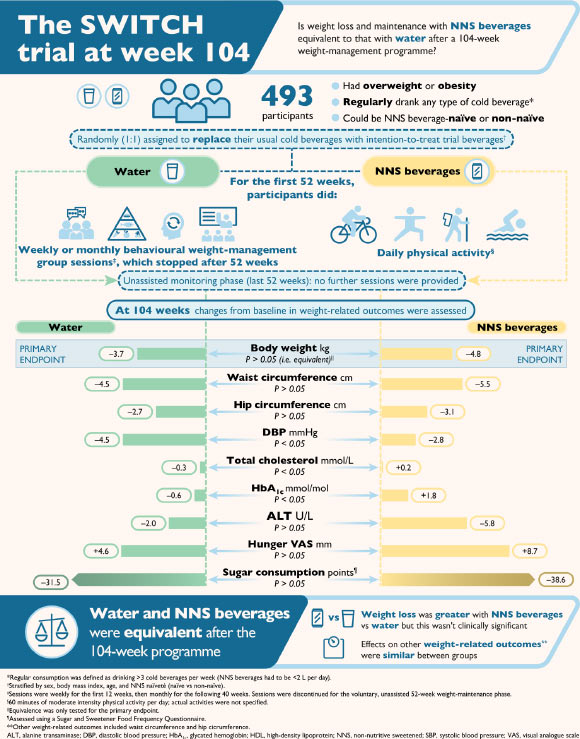
The SWITCH study evaluated non-nutritive sweetened beverages containing aspartame, acesulfame potassium and sucralose versus water for weight loss and long-term weight management over 104 weeks. Image credit: Harrold et al., doi: 10.1017/S0007114526108150.
Diet drinks and water produced similar weight-loss results
The study followed 493 overweight or mildly obese adults with a body mass index (BMI) of 27 to 35 who lived in the Liverpool area.
Participants were randomly assigned to drink at least two 330 mL servings per day of either water or a beverage containing non-nutritive sweeteners (NNS). The diet beverages included diet cola, diet carbonated soft drinks, diet fruit drinks and still or carbonated diet fruit-flavored water.
All participants took part in a behavioral weight-management program. They attended weekly group meetings for 12 weeks, followed by monthly meetings for 40 weeks. During the final 52 weeks, participants who chose to continue were monitored without support sessions.
After two years, both groups remained significantly lighter than they were at the start of the trial. Among the 220 participants who completed the study, the water group lost an average of 3.7 kilograms (about 8 pounds), while the diet-drink group lost an average of 4.8 kilograms (about 10.6 pounds).
Although the diet-drink group lost slightly more weight on average, the difference was not statistically significant. The researchers therefore concluded that the two approaches were equivalent for weight loss.
Waist and hip measurements also decreased in both groups, with no significant differences between them.
Weight loss peaked during the first year
Participants in both groups lost the most weight during the first 12 weeks and reached their lowest average weight during the first year. They then gradually regained some weight. Weight recovery was slightly slower among participants who drank diet beverages.
“Our latest findings show that concerns that sweeteners suppress appetite or cause weight gain are not borne out when tested in rigorous long-term randomized trials,” said the study’s lead author, Professor Joanne Harrold of the University of Liverpool.
“We hope this evidence will inform future World Health Organization (WHO) guidance and public health policy.”
Findings address debate over non-sugar sweeteners
In 2023, the WHO recommended against using non-sugar sweeteners for weight management, citing uncertainties from observational studies that linked diet drinks with weight gain.
The study authors argue that observational findings can be affected by reverse causation. For example, people who are already gaining weight may be more likely to switch to diet drinks. Other confounding factors may also influence the results of such studies.
“This study provides long-term clinical evidence that has been missing from the international debate,” Professor Halford said.
“For people trying to manage their weight, NNS drinks are an effective alternative to sugary drinks and perform as well as water for up to two years.”
The results were published on August 4, 2026, in the British Journal of Nutrition.
_____
Joan A. Harrold et al. 2026. Effects of non-nutritive sweetened beverages versus water on body weight: Long-term results of a randomized controlled trial. British Journal of Nutrition 136 (4): 482–493. doi: 10.1017/S0007114526108150.
Source: www.sci.news