


James Webb Telescope Finds Strong Evidence of an Atmosphere on Rocky Lava World HD 3167 b
Rocky planets with atmospheres are among the most promising targets in the search for life beyond Earth. An atmosphere can help maintain liquid water on a planet’s surface. Yet of the more than 6,300 exoplanets cataloged to date, most are not rocky, and only a small number of known rocky planets appear to have atmospheres.
Researchers have now added another candidate to that list. In a study published in Astrophysical Journal Letters, a team led by University of Chicago scientist Brandon Park Coy reports evidence of an atmosphere surrounding HD 3167 b, a rocky super-Earth located 154 light-years away in the constellation Pisces.
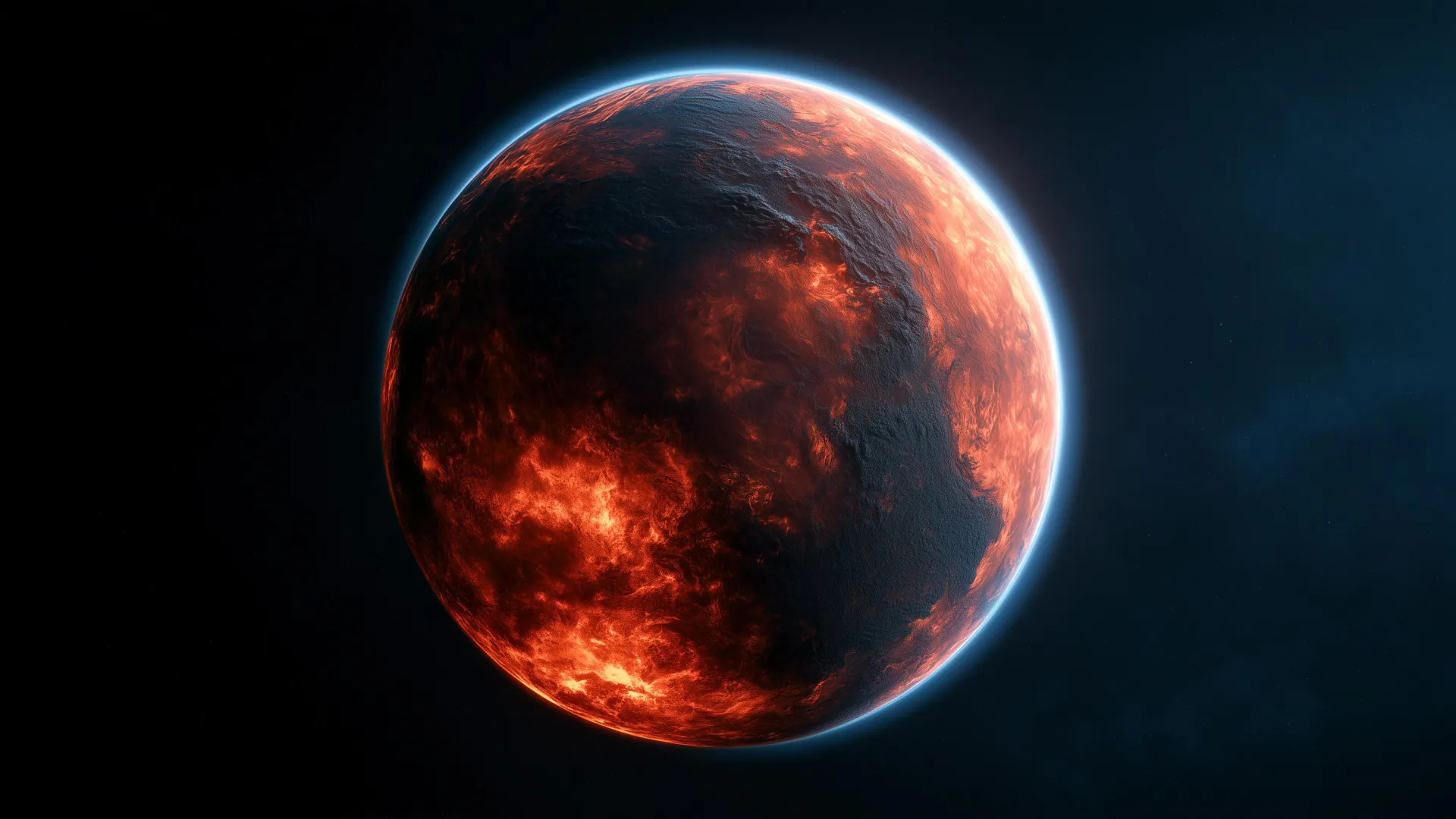
Classified as a “lava world,” HD 3167 b is extremely hot and completes an orbit around its star in just one Earth day. Although the planet is far too hot to support life, its atmosphere could provide valuable clues about how rocky planets form and evolve.
“What’s quite surprising is that the more a rocky planet orbits its star, the less likely it should have an atmosphere, because the planet is exposed to the stellar wind and receives more high-energy photons from the star. But it seems like many of these lava worlds do,” explained Edwin Kite, associate professor of geophysical sciences at the University of Chicago and co-author of the study. “These planets are too hot for life to exist, but studying them can tell us something about processes that are important to other rocky worlds.”
In the Q&A below, Coy, a graduate student in Kite’s group and the study’s lead author, explains why lava-world atmospheres are scientifically valuable, how researchers found evidence of the atmosphere around HD 3167 b, and what they hope to learn from future observations.
Why did researchers study HD 3167 b?
One of the key questions being investigated with the James Webb Space Telescope is whether planets orbiting stars much smaller than the Sun can retain atmospheres. Many of these terrestrial planets appear to be little more than bare rock.
However, researchers have found evidence that a substantial atmosphere may surround HD 3167 b. Including this planet, five terrestrial planets with detected atmospheres are extremely hot.
HD 3167 b is particularly interesting because it is the coldest lava world known to have evidence of an atmosphere. Studying it may help scientists understand how temperature affects whether rocky planets retain atmospheres.
The finding is the first result from a program led by Dr. Megan Weiner Mansfield (PhD ’21), currently at the University of Maryland. The program is examining 10 ultra-hot lava worlds to determine whether there is a critical temperature at which planetary atmospheres become detectable.
“We’re interested in studying these types of planets because we think early Earth may have looked a lot like a lava world.” — Brandon Park Coy, study author
How can scientists tell whether an exoplanet has an atmosphere?
It is currently impossible to directly observe Earth-like planets for signs of life. Instead, the James Webb Space Telescope can measure light at mid-infrared wavelengths and estimate an exoplanet’s temperature. Those measurements can reveal whether a planet may have an atmosphere.
There are two main ways to study exoplanets. During a transit, a planet passes in front of its host star. The method used in this study is called a secondary eclipse, which occurs when a planet passes behind its star. By measuring how much light disappears, researchers can estimate how much mid-infrared radiation the planet emits and determine its temperature.
If a planet has no atmosphere, its star-facing side should reach the maximum temperature expected from its surface reflectivity and distance from the star. An atmosphere can redistribute heat from the dayside to the nightside. Venus provides an example of this process: its surface temperatures vary little between day and night or between the poles and equator.
An atmosphere may also contain clouds that reflect incoming starlight and cool the planet’s dayside. Therefore, if a planet’s dayside is cooler than the expected maximum, it may have an atmosphere.
HD 3167 b is significantly cooler than that expected maximum, providing strong evidence that the rocky planet has an atmosphere.
What could HD 3167 b’s atmosphere be made of?
Lava worlds are named for their star-facing surfaces, which are likely covered in molten rock. HD 3167 b may have a silicate-rich composition similar to the mixture of minerals found in Earth’s mantle.
Until recently, scientists expected the atmospheres of superhot rocky planets to consist mainly of evaporated rock. However, evidence is emerging that some of these worlds may also have heavier gases, including carbon dioxide, carbon monoxide and water.
The precise composition of HD 3167 b’s atmosphere remains unknown. Determining its makeup is one reason researchers are seeking additional observations.
Why is the atmosphere on this lava world important?
The other four lava worlds known to have atmospheres are extremely hot. This raises the possibility that there is a critical transition temperature at which silicate atmospheres become especially thick.
Scientists also want to know whether some lava worlds form silicate cloud layers that reflect radiation back into space and cool their daysides. Because HD 3167 b is comparatively cool, it could help researchers identify and characterize this transition between rocky planets with and without detectable atmospheres.
The planet may also offer clues about Earth’s earliest history. Soon after the solar system formed, terrestrial planets are thought to have been extremely hot because of energy released by planetesimal collisions. Earth likely passed through a magma ocean phase in which its surface was completely liquid.
Although HD 3167 b is far too hostile for life, studying its atmosphere may help scientists understand the conditions on Earth during the first few million years of the solar system—and improve our knowledge of how rocky planets evolve.
Source: www.sciencedaily.com