


Ancient Capybara Tooth Suggests the Atacama Desert Was Once Wet and Lush
A nearly 9-million-year-old fossil tooth discovered in northern Chile is offering new clues about the Atacama Desert’s surprisingly watery past.
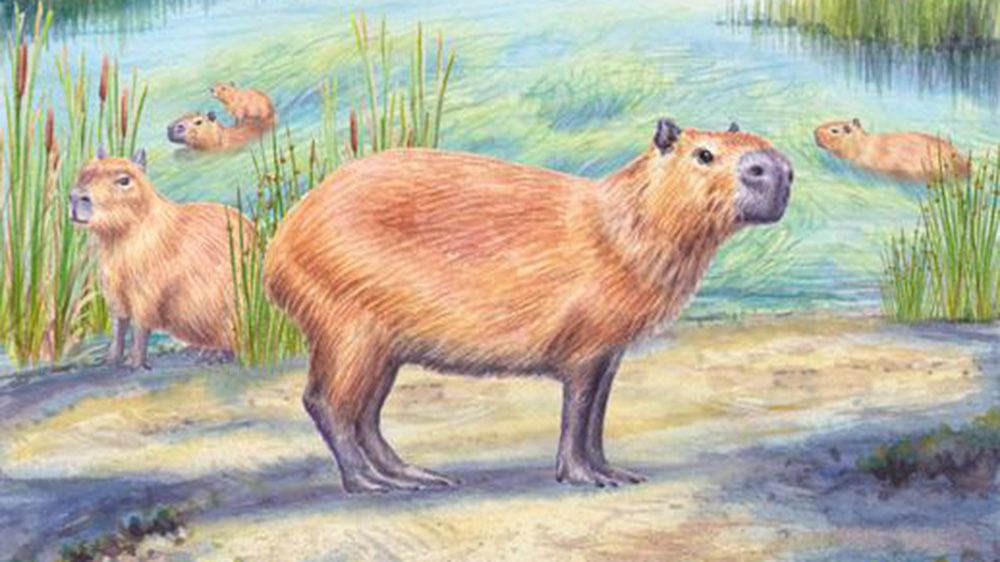
An illustration of an ancient capybara in a coastal wetland that may have resembled the Atacama Desert about 9 million years ago.
Image credit: Mauricio Alvarez
Researchers have discovered a nearly 9-million-year-old tooth belonging to an extinct, water-loving relative of modern capybaras in Chile’s Atacama Desert. The fossilized molar provides new evidence that the Atacama, one of the driest places on Earth, was not continuously dry during the past 40 million years.
The discovery is especially striking because modern capybaras are semiaquatic animals that live near reliable freshwater sources. Their diet consists largely of plants that require water to grow, making the fossil tooth an unlikely find in the hyperarid Atacama.
A capybara fossil in one of Earth’s driest deserts
The Atacama Desert occupies the northern third of Chile. The Chilean Coast Mountains block moisture from the Pacific Ocean, while the Andes Mountains block moisture moving west from the Atlantic. In the driest part of the desert, monthly precipitation is typically less than 2 millimeters.
Recent research suggests that the Atacama’s hyperarid core may have begun forming between 47.8 and 33.9 million years ago, during the mid-to-late Eocene—roughly 20 million years before the Andes reached their present form. That finding suggests the mountains may have intensified the desert’s dryness rather than caused it outright.
The new fossil adds another complication to the idea of an uninterruptedly dry Atacama.
“It is truly bizarre that capybara teeth can be found in marine sediments in one of the driest regions on Earth today,” Priscilla Martinez, a geoscientist at the University of Arizona and co-author of the study, said in a statement.
Evidence of wetlands, forests and freshwater
Modern capybaras are native to South America, but they have not been found in Chile. The fossil tooth belongs to a close extinct relative, identified as Hydrocoelus cardiatherium.
Researchers found the tooth in a geological layer containing evidence of a shallow marine environment that existed between 7 million and 10 million years ago. The same layer contained microscopic plant fragments called phytoliths. These remains point to palm trees, grasses, ginger and other flowering plants that may have grown in a subtropical forest.
Other discoveries have also suggested that parts of the Atacama were once periodically wet. Evidence of crocodiles, freshwater fish and palm trees indicates that rivers, wetlands or other sources of freshwater existed in the region during the late Miocene.

Valle de la Luna, or Moon Valley, is named for its resemblance to the lunar surface.
Image credit: Piero Damiani, Getty Images
How did ancient capybaras reach the Atacama?
Researchers are not sure how the capybaras reached the area. During the late Miocene, the Andes formed an approximately 18,000-foot (5,500-meter) barrier between the fossil site and the animals’ more familiar habitat.
Instead of crossing the mountains, the ancient capybaras may have moved along South America’s western coast, following wetlands, rivers and other sources of water.
That explanation would fit the fossil evidence. Samantha Hopkins, a geosciences professor at the University of Oregon who was not involved in the study, said it is unlikely that the tooth would have reached the site unless capybaras had actually lived there.
“If you want to figure out how this capybara could get here while the Atacama is still as dry as it is today, it’s going to be hard to dig with a hoe,” Hopkins told Live Science in an email. Desert winds could not transport the tooth such a distance, while a large carcass floating down a waterway would still require waterways substantial enough to show that the Atacama was not as dry as it is today.
The study, which describes late Miocene capybaras in the Atacama Desert and their possible dispersal routes, was published in Scientific Reports. Together with the fossil plants and other animal remains, the discovery strengthens the case that the Atacama was once intermittently wet—a very different environment from the desert seen today.
Source: www.livescience.com