


Gut Bacteria Produce Molecule That Lowers Cholesterol and Shrinks Artery Plaque in Mice
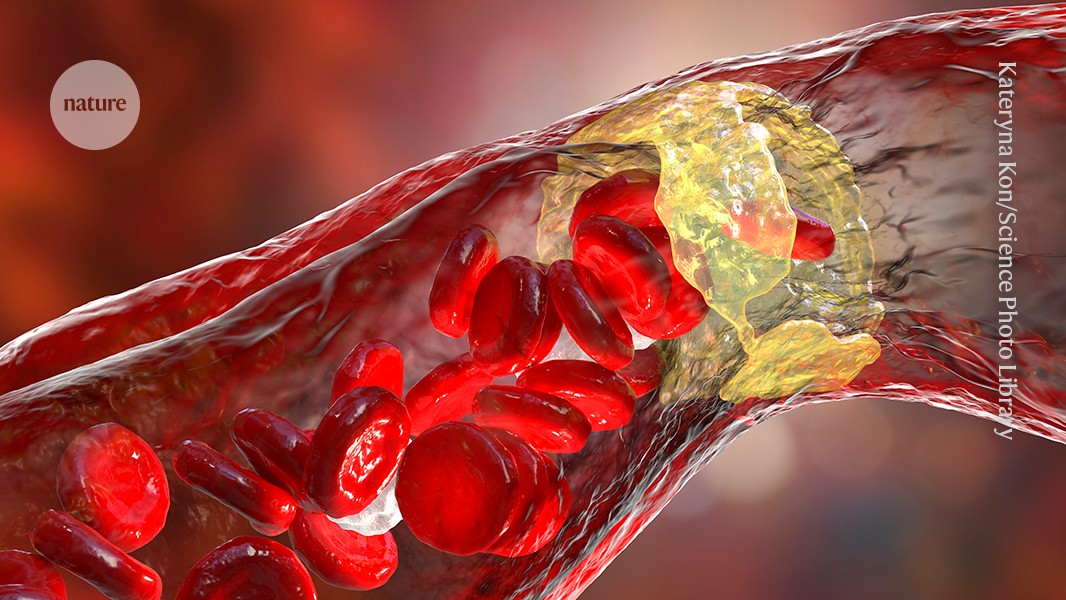
In atherosclerosis, fatty plaques (yellow) build up on arterial walls, restricting blood flow. Red blood cells are shown.
Credit: Kateryna Kon/SPL
A study published today suggests that common gut bacteria can manufacture molecules that lower cholesterol levels and shrink arterial plaque. Nature1
Administration of intestinal bacteria alleviates mysterious chronic pain
When mice were given compounds obtained from intestinal bacteria, their arterial plaques were substantially reduced. Researchers found that the compounds produced effects similar to those of statins, drugs prescribed to hundreds of millions of people worldwide to help prevent cardiovascular disease.
The findings highlight a potential way to harness the gut microbiome—the collection of microorganisms living in the human body—to protect cardiovascular health, said study co-author Wenjing Chao, a microbiologist at Sun Yat-sen University in Shenzhen, China.
The study provides “valuable evidence that the gut microbiome can influence vascular health”, moving beyond a simple association between heart disease and the microbiome toward “evidence of potentially causative biological mechanisms,” said Ben Chen, a cardiovascular expert at the Monash Victorian Heart Institute in Melbourne, Australia.
How gut bacteria may affect heart health
Atherosclerosis is the progressive buildup of inflammatory plaques on artery walls and remains the leading cause of death worldwide. Daily statin treatment has reduced deaths from cardiovascular disease, but it does not lower cholesterol sufficiently in nearly half of people with advanced heart disease. Some people also cannot tolerate high doses of statins.
Gut microbes promote memory loss in aging mice
To investigate alternatives, the researchers analyzed gut microbiota in stool samples from people with and without cardiovascular disease. One species, Bacteroides uniformis, stood out: people with heart disease often had lower levels of the bacterium than healthy people.
The team then genetically engineered mice to develop atherosclerosis and fed them a high-fat diet to mimic features of heart disease. When the animals received live B. uniformis, plaques in their main arteries shrank by about one-third compared with untreated mice.
The treatment also lowered levels of fatty substances in the blood, including total cholesterol and low-density lipoprotein (LDL), often called “bad cholesterol”. It also reduced the number of inflammatory immune cells entering the animals’ arterial walls.
Pentadecanoic acid acts like a statin
The researchers isolated the molecule responsible for the protective effects: pentadecanoic acid. Further analysis showed that this molecule inhibits a liver enzyme involved in cholesterol production—the same enzyme targeted by statin drugs.
Blocking the enzyme causes the liver to produce more LDL receptors, which remove excess cholesterol from the bloodstream.

3D and line structures of pentadecanoic acid. Carbon is shown in gray, oxygen in red and hydrogen in white.
Credit: Chromatos/Shutterstock
Human samples point to a possible link
To examine whether the findings in mice might also apply to humans, the researchers tested blood and stool samples from more than 200 donors. People with abnormally high blood levels of fatty molecules such as cholesterol had lower levels of pentadecanoic acid than healthy participants.
Stool analysis also showed that people with heart disease carried fewer bacterial genes specialized in producing pentadecanoic acid than people in the control group.
Source: www.nature.com