


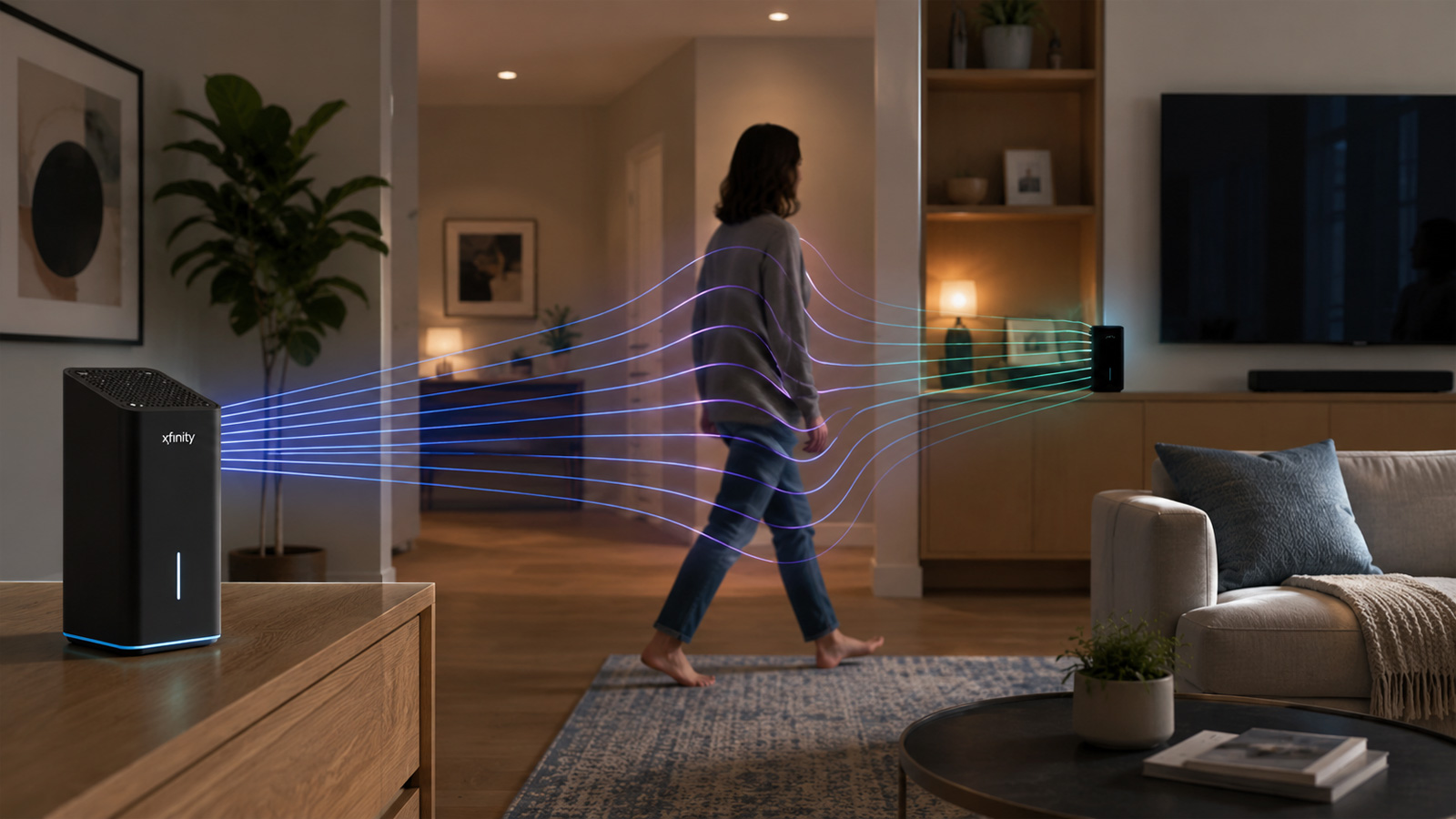
Comcast is promoting Xfinity WiFi Motion as a camera-free home security feature within its new Xfinity Shield protection platform. The technology uses WiFi signals from an Xfinity gateway and connected wireless devices to detect movement inside a home without requiring cameras or dedicated motion sensors.
The feature is part of Xfinity Shield, a new suite of home protection tools that combines network security, physical home monitoring, and family safety features through Xfinity WiFi and the Xfinity app.
Xfinity Shield includes WiFi Shield at no additional charge for Xfinity Internet customers with a compatible gateway. The service combines Comcast’s CyberSecure network protection, Family Settings, and WiFi Motion with Home Watch, Away Watch, and Dark Watch modes, which control when security notifications are generated.

Comcast is also offering Shield Select for $15 per month. The upgraded plan includes indoor cameras, door and window sensors, cloud video storage, and 24/7 emergency response features.
Although Comcast is now making WiFi Motion a central part of its home security offering, the motion detection technology itself is not new.
A Reddit post from August 21, 2024 includes a photo of an email sent to Xfinity customers introducing WiFi Motion.
The email describes a feature that detects interruptions in the WiFi signal between an Xfinity gateway and devices connected to the network. When movement is detected, the system sends a notification through the Xfinity app.
One customer who used WiFi Motion in 2024 wrote, “It also works. Detects movement up to where I raise my hand to change the channel on the remote. Detects my cat walking in the living room.”
WiFi NOW reported in February that Comcast had offered WiFi Motion “for a long time” and was increasing its marketing efforts, including promoting the feature during Olympic hockey broadcasts.
How Xfinity WiFi Motion detects movement
Xfinity WiFi Motion turns the wireless connection between an Xfinity Gateway and fixed WiFi devices into a virtual motion sensor.
According to Comcast’s support documents, customers can select stationary WiFi devices placed throughout their homes, such as smart speakers or thermostats. When a person moves between the gateway or an extender and one of those devices, their body changes how the WiFi radio signal travels through the environment.
Comcast says WiFi Motion analyzes changes in the home’s radio-frequency signals to determine whether movement has occurred. Customers can then receive alerts in the Xfinity app without installing cameras or standalone motion detectors.
Xfinity says WiFi Motion cannot identify who is moving or determine the exact location of the movement. The feature is opt-in and disabled by default.
“It is designed to detect movement and does not identify a specific person or track the exact location of movement. You will receive a notification when movement is detected between your connected device and your Xfinity Gateway,” Xfinity’s support documentation states.
WiFi Motion includes multiple sensitivity levels to help filter out movement from small pets weighing approximately 40 pounds or less. However, Comcast warns that the system does not use visual information and may not always distinguish between small pets and similarly sized children.
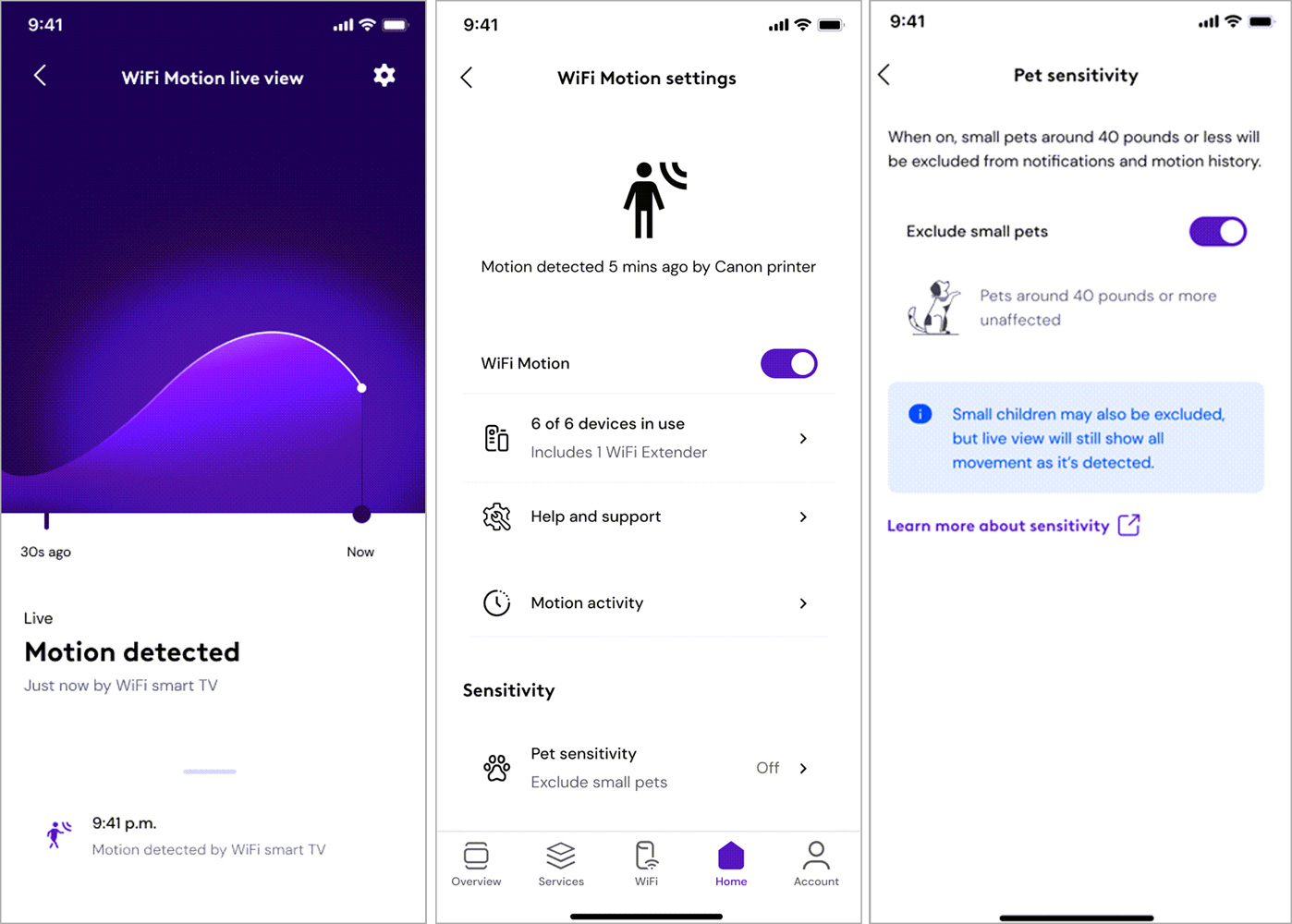
Source: Xfinity
Comcast also advises customers who live in apartments or buildings with shared walls to lower the sensitivity setting. This can help prevent movement outside the intended sensing area from triggering unwanted alerts.
Comcast patent explains WiFi motion sensing
A Comcast patent application provides additional insight into how WiFi-based motion detection systems can work.
The pending patent, titled “Methods, systems and devices for presence detection,” was filed by Comcast Cable Communications in September 2023 and published in April 2025.
The patent describes using fixed network devices to detect motion by analyzing changes in wireless signals and other radio-frequency characteristics. WiFi signals can travel along multiple paths as they reflect or scatter off walls, people, and other objects.
When an object or person moves, those signal paths change. Software can analyze the resulting variations to determine whether movement has occurred in a particular area.
Comcast’s patent also cites previous Cognitive Systems patents covering WiFi motion detection, including methods for detecting movement from repeated wireless transmissions and techniques for motion detection across mesh networks.
Privacy concerns surrounding Xfinity WiFi Motion
Using WiFi as an invisible motion sensor raises questions about what data is generated when people move around their homes and how that information is handled.
As TechCrunch first reported, Comcast’s WiFi Motion documentation states that the company may disclose information generated by the feature to third parties “without further notice to you” in connection with a law enforcement investigation or proceeding, a dispute involving Comcast, or a court order or subpoena.
Comcast has separately stated that it does not monitor motion activity or notifications generated by WiFi Motion.
However, the company’s documentation does not explain what WiFi Motion data Comcast retains, how long it keeps that information, or what data may be provided in response to legal requests.
BleepingComputer contacted Comcast with questions about the data generated by WiFi Motion. This article will be updated if the company provides additional information.

The overall prevention score can hide what happens after the initial access. If an attacker uses valid credentials, your defenses drop sharply.
Blue Report 2026 measures defense techniques by technology across 338 million simulations run in customer production environments.
Source: www.bleepingcomputer.com