


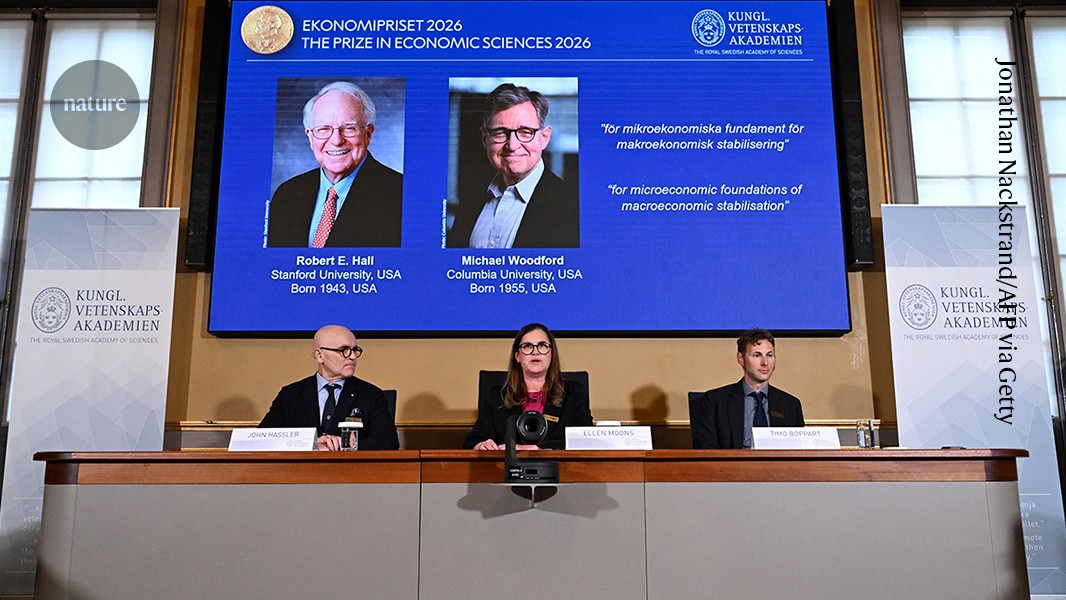
2026 Nobel Prize in Economics Awarded to Robert E. Hall and Michael Woodford
Credit: Jonathan Knackstrand/AFP via Getty
The 2026 Sveriges Riksbank Prize in Economic Sciences in Memory of Alfred Nobel has been awarded to economists Robert E. Hall and Michael Woodford for research on how to stabilize economies and reduce harmful fluctuations in inflation, economic growth and employment.
The Nobel Prize committee said their work has caused “a paradigm shift in stabilization policy” and is now used by central banks and treasuries around the world. Read the award committee’s explanation of the research.
“This is a wonderful award that recognizes two outstanding and highly influential economists,” said John Cochran, an economist at the Hoover Institution, a think tank based at Stanford University. Olivier Blanchard, former chief economist at the International Monetary Fund, said the winners “dramatically changed the conduct of monetary policy.”
Cochran said the award was shared among “at least a dozen strong candidates” in the field. “I don’t want to be on the Nobel Prize committee deciding which two or three people should get the award,” he said, adding that Hall and Woodford “were the frontrunners on everyone’s list.”
Woodford said by phone during the award presentation that he was “thrilled” by the honor. He added that his theory is intended not only to guide economic policy, but also to explain to the public why governments intervene in the economy and “tell people why things are being done.”
“Together, Mr. Hall’s and Mr. Woodford’s contributions provide a new foundation for the theory of macroeconomic change, allowing us to gain a deeper understanding of the causes and transmission mechanisms behind recessions and booms,” the Nobel Prize committee said.
How the 2026 Nobel economics research builds on Keynes
Hall and Woodford will share a prize of 12 million Swedish kronor, approximately $1.2 million. Their research builds on the ideas of 20th-century British economist John Maynard Keynes.

Credit: Tim Gidal/Picture Post/Hulton Archive/Getty
Keynes argued that large-scale government intervention was necessary during periods of economic instability to prevent the collapse and mass unemployment seen during the Great Depression of the 1930s. In his book How to Pay for the War, published shortly after Britain declared war on Nazi Germany, he argued that market forces alone could not provide economies with enough flexibility to respond to such crises (Macmillan, 1940).
Keynesian ideas have remained highly influential since the mid-20th century. They were relevant during the COVID-19 pandemic, when governments around the world provided funding to businesses to help them retain employees during lockdowns. However, these ideas did not prevent the economic rollercoaster of booms and busts seen during events such as the oil crisis of the 1970s and the financial crisis of 2008.
How Hall and Woodford changed macroeconomic theory
Hall and Woodford’s research helped address what Keynes’s macroeconomic framework lacked by adding a microeconomic perspective. Macroeconomics studies the economy as a whole, while microeconomics examines how decisions by individual households and businesses affect prices, income and spending.
Hall, who is based at Stanford University in California, recognized that consumption decisions depend not only on measurable factors such as income, but also on what Keynes called “animal spirits”—psychological factors that influence economic choices, including expectations about the future.
In two important papers, published in 1978 and in 1982, Hall showed that it was possible to estimate the proportion of consumers who hold a rational view of how future monetary and fiscal policy might change.
He contrasted those forward-looking consumers with people who make spending decisions based mainly on the immediate prospect of being unable to save or borrow. In effect, this approach estimates the proportion of the population that makes forward-looking spending decisions and the proportion that does not. Hall tested his predictions against real-world consumption data.
Woodford, who is based at Columbia University in New York, developed a “New Keynesian” microeconomic theory based on this research. His work culminated in the book Interest Rates and Prices: The Basis of Monetary Policy Theory (Princeton University Press, 2003).
Source: www.nature.com