


NVIDIA Launches Nemotron 3.5 Super VL, a 120B Open Model for Faster Multimodal AI Agents
NVIDIA has released Nemotron 3.5 Super VL, an open 120-billion-parameter model designed for professional, always-on AI agents. The multimodal model is built to combine high accuracy with fast task completion across enterprise workflows.
NVIDIA also introduced two edge models: Nemotron 3.5 Bolt 74B-A9B 24GB, optimized to balance intelligence and speed per gigabyte for local agent workloads, and Nemotron 3.5 Bolt E4B 4GB, optimized for intelligence per gigabyte and fast conversational agents.
Nemotron 3.5 Super VL and Bolt 74B-A9B are available now. Bolt E4B is scheduled to become available on October 23.
These three open models cover a broad range of AI agent deployments, from large enterprise servers to edge devices and local hardware. Organizations running agents on NVIDIA infrastructure can choose a model optimized for their deployment tier without giving up functionality or deployability.
Nemotron 3.5 brings frontier AI to enterprise and edge deployments
Nemotron 3.5 Super VL and Bolt join the Nemotron family alongside Lightning and Ultra. Lightning, released in August, is designed for high-throughput workloads. Ultra handles the most difficult inference tasks, while Bolt brings agent intelligence to edge devices.
Nemotron 3.5 Super VL delivers frontier-level multimodal accuracy
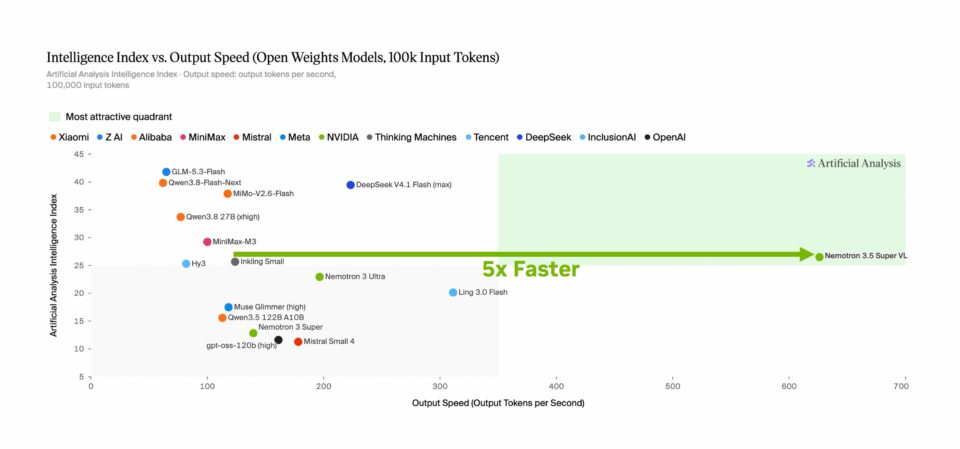
Nemotron 3.5 Super VL is part of the Nemotron Union. With approximately one-fifth the number of parameters of NVIDIA’s largest inference models, it delivers comparable accuracy on multimodal agent tasks, including instruction following, tool use, multistep business workflows and visual understanding.
NVIDIA describes Super VL as the fastest open agent model in its class, with performance up to five times faster than the next-best model. That speed is designed to help enterprise agents complete high-volume tasks more quickly, including workflows that span days or weeks.
Unlike closed frontier models, organizations can post-train Super VL on their own data, deploy it on their own infrastructure and monitor the systems they build.
Nemotron 3.5 Bolt brings agent intelligence to local hardware
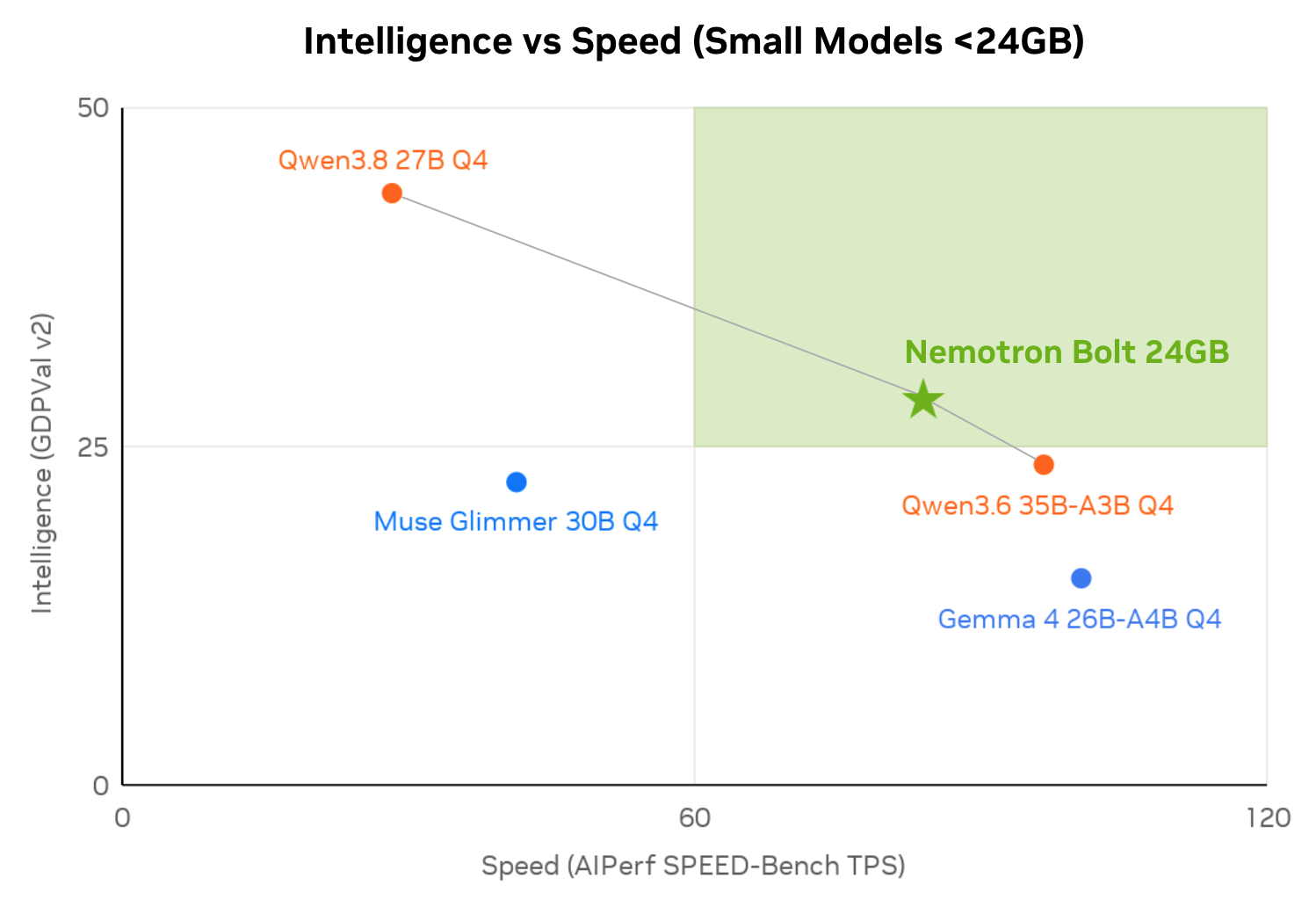
Nemotron 3.5 Bolt 74B-A9B 24GB is designed to run everyday agent tasks locally on NVIDIA RTX systems and DGX Spark. Its native 2-bit quantization allows it to fit into 24GB of memory while running alongside other applications.
Compared with models that use a similar amount of memory, Bolt 74B-A9B is designed to balance intelligence and speed. It is intended to handle a wide range of tasks while running faster than larger, more capable models.
Bolt 74B-A9B enables users to delegate tasks such as web exploration, code writing and debugging to a local agent harness without sending workloads to the cloud. NVIDIA identifies it as the No. 1 open model in its class on PinchBench and the No. 2 open model on BrowseComp.
Nemotron 3.5 Bolt E4B 4GB is designed for physical and conversational agents running on GeForce RTX, Jetson and RTX/DGX Spark. It combines natural conversation with mult turn agent capabilities for local voice assistants, interactive characters and built-in interfaces.
Organizations are customizing Nemotron 3.5 for specialized AI agents
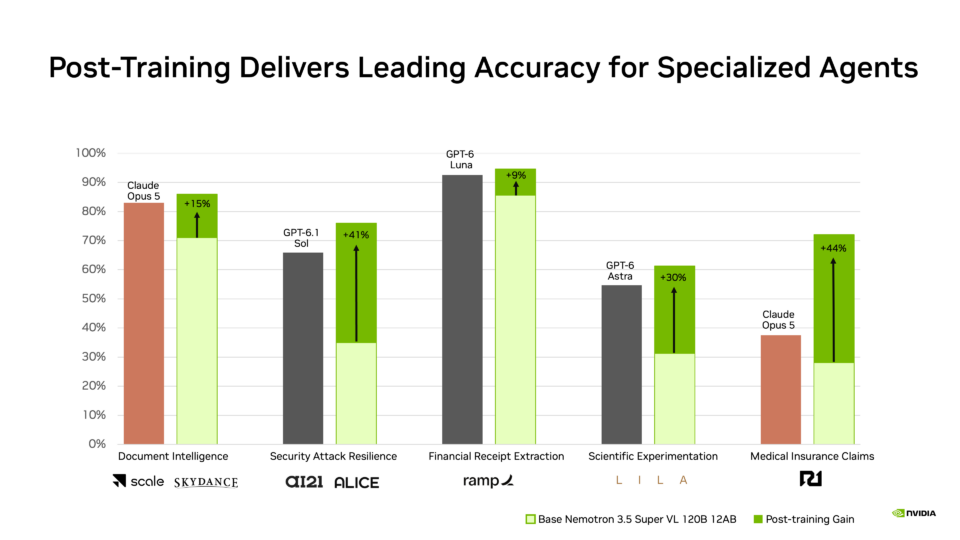
Organizations across multiple industries are post-training Super VL on their own data, tools, policies and workflows. The goal is to improve performance on specialized tasks that define enterprise agent deployments.
Scale AI has post-trained models for Skydance’s vendor credit finance agents and EY’s mergers-and-acquisitions due diligence agents. AfterQuery customized Hebbia’s model for credit contract analysis. AI21 and Alice post-trained a model to improve resilience against cybersecurity attacks. Melkor post-trained the model on the APEX-SWE coding benchmark for coding agents that plan, write and debug code.
ModelScope supports model fine-tuning, while ms-swift provides a framework for specialized multimodal applications.
Other organizations customizing Nemotron 3.5 Super VL include:
- Lamp for financial document intelligence.
- Dream for cybersecurity research and vulnerability analysis using sovereign AI.
- Lila Science for scientific discovery and research.
- R1 for medical claims analysis and revenue cycle management.
- Train Loop, which post-trained the model using Nolla’s dermatology data. Nolla became the first company to have AI approved to write prescriptions for its first patients.
Software platform companies integrating Nemotron 3.5 Super VL include:
- Atlassian for agent searches across applications such as Jira and Confluence.
- CrowdStrike for customizing a model for agent blue teaming in enterprise security.
- Dassault Systèmes for engineering design and simulation.
- Perplexity for Perplexity Search, Computer search and agent tasks.
- Salesforce for AI agents that digitize and automate complex government workflows in secure customer environments through Missionforce Operations.
- Synopsys for semiconductor design verification software that interoperates with AI models.
What Nemotron 3.5 Super VL can understand
Nemotron 3.5 Super VL is a vision-language model built for the information agents encounter in real-world workflows. Its capabilities include optical character recognition, structured information extraction from tables, chart analysis and visual document understanding.
The model can process web pages, extract text, read graphs and charts and return insights from the information it finds. It can perform similar tasks with PDFs and other business documents.
By combining text and visual understanding in one model, Nemotron 3.5 Super VL allows agents to move from documents to data to decisions without routing work between separate systems or losing context.
Open weights support control, security and privacy
Nemotron 3.5 Super VL ships with open weights, open datasets and training recipes. This gives organizations more control over how and where the model is deployed.
Organizations can run the model in environments that meet their security and data residency requirements. They can also adapt it to their own use cases instead of relying on a model limited by a single provider.
For example, customized agents can repeatedly scan insurance claims for fraud indicators. In financial services, agents can check credit scores and flag activity against an organization’s lending criteria. When models run on site, sensitive data can remain private.
Customization is supported through NVIDIA NeMo, Python-based pipelines and open datasets.
Nemotron 3.5 Super VL was trained on approximately 26 trillion tokens. NVIDIA continued with pretraining and then post-trained the model using reinforcement learning across approximately 3.8 million samples and dozens of environments.
NVIDIA has also released open datasets on Hugging Face covering agent tool use, financial tasks, instruction following, long-context processing, fairness, vision-language understanding and the NeMo Gym reinforcement learning environment. The datasets are available through the pretraining collection and post-training collection.
NVIDIA NIM packages models as production-ready microservices with performance-optimized and validated configurations, enterprise-grade support, security patches and performance improvements. With models running on NVIDIA Dynamo, organizations can serve up to eight times more users with 85% lower latency.
Nemotron 3.5 Super VL is currently supported through Hugging Face, OpenRouter, the ModelScope community and NVIDIA NIM.
Nemotron 3.5 runs across NVIDIA’s hardware stack
Nemotron 3.5 Super VL works across NVIDIA’s hardware stack, including DGX Spark, DGX Station, RTX PRO and RTX systems, and NVIDIA Jetson. The models are designed for deployments across edge, data center and cloud environments.
Nemotron 3.5 Bolt 74B-A9B 24GB supports llama.cpp, Ollama, LM Studio, Unsloth and vLLM, and is available through Hugging Face. It is designed for NVIDIA RTX Spark Laptop, GeForce RTX PCs, DGX Spark, DGX Station and RTX PRO Workstations.
How to access Nemotron 3.5
Developers can download the open weights, explore NVIDIA NeMo customization resources or read the technology blog for architecture details.
For more information, visit the Nemotron page, subscribe to NVIDIA News, join the NVIDIA developer community and follow NVIDIA AI on LinkedIn, Instagram, X and Facebook.
Developers can also explore self-paced video tutorials and live streams.
Source: blogs.nvidia.com