


How NASA Measures Aircraft Engine Noise and Airflow
Researchers at NASA Glenn Research Center use specialized equipment to measure airflow, acoustic sources, and aircraft engine noise. Their tools include particle image velocimetry, hot-wire anemometers, Raman spectroscopy, phased-array microphones, and continuously rotating microphone rakes.
Data from NASA Glenn experiments helps the global aviation noise-reduction community validate acoustic theories and noise-prediction software.
Measuring Turbofan Engine Noise
Unpleasant sounds from a turbofan engine may be addressed with an advanced acoustic liner or a specially tuned active noise-control system. Before engineers can select an effective solution, however, they need detailed information about the sound’s modal content.
Fixed microphones cannot measure this information effectively, so NASA engineers developed a procedure using rotating microphones during the 1990s.
How Rotating Microphone Rakes Work
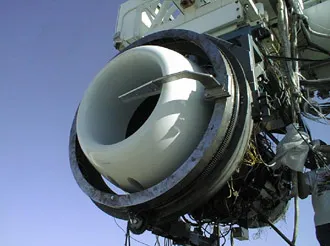
NASA Glenn researchers use rotating microphone rakes in a wide range of experiments. These include low-speed proof-of-concept tests in advanced noise-controlled fan rigs, tests in 9-by-15-foot low-noise wind tunnels, and ground tests of full-scale turbofan engines.
Locating Aircraft Noise Sources with Microphone Arrays
In a phased-array system, microphones are arranged in one-, two-, or three-dimensional configurations. When acoustic measurements from the microphones are processed correctly, engineers can accurately locate the sources of noise.
NASA Glenn’s Array48 microphone system has been used extensively to identify noise sources in scale-model jet streams, counter-rotating open-rotor fan models, and a full-scale F404 military engine.
With NASA funding, researchers also developed a method for locating noise sources on rotating blades using microphones embedded in engine fan ducts.
Measuring Airflow to Understand Engine Noise
Nuisance tones can be caused by periodic disturbances, including interactions between fan-blade wakes and downstream stator vanes. Aircraft engines can also generate broadband noise when they ingest turbulence.
To identify these noise sources and develop ways to reduce them, engineers need detailed velocity measurements of the air moving through an experimental propulsion system. Measuring airflow upstream, downstream, and between the rotor and stator requires specialized equipment such as hot-wire probes and laser Doppler velocimeters (LDVs).
Velocity measurement plots make it possible to visualize disturbances created by the rotor. Hot-wire and LDV data are routinely used to validate calculations for estimating noise from turbofan engines.
Learn More About NASA Aviation Noise Research
For more information about NASA’s research, software, and data, contact us using the link below.
Source: www.nasa.gov