


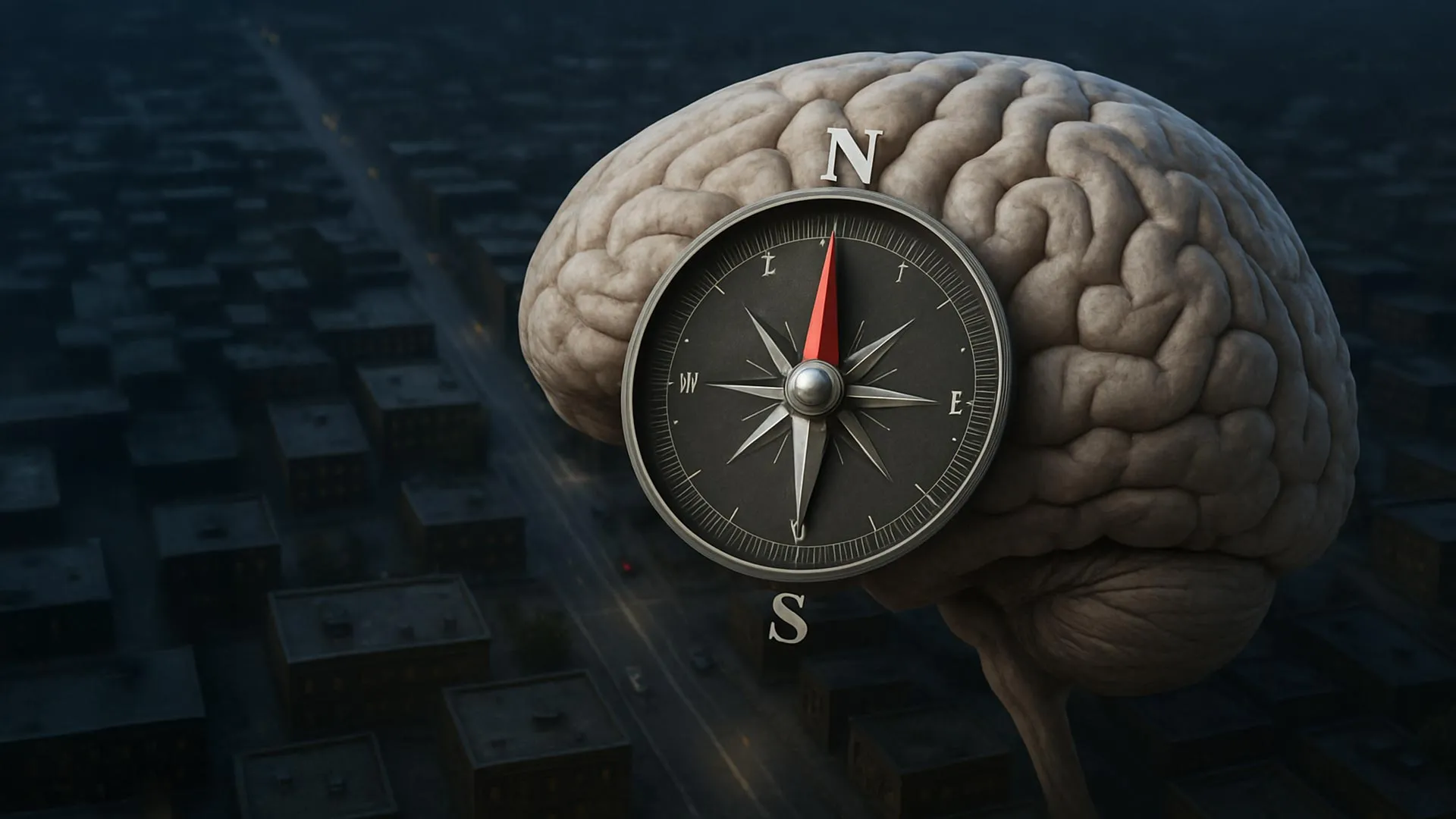
The stress hormone cortisol may disrupt the brain’s internal navigation system, making it harder to find locations and stay oriented. Researchers at Ruhr University Bochum in Germany found that cortisol reduces activity in grid cells—specialized nerve cells that help the brain create mental maps and navigate through space.
The findings come from a brain imaging study of 40 participants who completed a virtual navigation task while undergoing MRI scans. Participants who received cortisol before the experiment had more difficulty finding their way, while the normally organized activity patterns of their grid cells became significantly less distinct. The study was published in PLOS Biology.
Although stress is known to affect memory, attention, and behavior, scientists have had less information about how cortisol influences the brain circuits responsible for spatial navigation. Dr. Osman Akan from the Department of Cognitive Psychology at Ruhr University Bochum worked with colleagues in the university’s Department of Neuropsychology and researchers from University Hospital Hamburg-Eppendorf to investigate the connection.
Testing Spatial Navigation in an MRI Scanner
The study involved 40 healthy men who completed the experiment on two separate days. During one session, participants received 20 milligrams of cortisol. During the other, they received a placebo. On both days, they performed a spatial orientation task while researchers measured their brain activity with functional MRI.
Participants navigated through a large virtual meadow toward a series of trees. Each tree disappeared after they reached it. They were then asked to identify the most direct route back to their original starting point without being shown the correct path.
Researchers tested navigation in two types of virtual environments. In one setting, there were no permanent landmarks, and the trees acted only as temporary destinations. In the second setting, participants could use a lighthouse as a fixed visual reference point.
Cortisol Reduces Navigation Accuracy
The results showed that cortisol significantly impaired spatial orientation. Compared with their performance after taking the placebo, participants made considerably larger errors when trying to navigate to their destinations.
The reduction in navigation accuracy occurred whether or not permanent landmarks were available and did not depend on the complexity of the route.
Stress Disrupts the Brain’s Internal GPS
Researchers also detected cortisol-related changes in the functional MRI scans. Under normal conditions, specialized nerve cells in the entorhinal cortex activate in a repeating hexagonal pattern during navigation. Known as grid cells, these neurons help the brain calculate position, direction, and distance, effectively contributing to an internal GPS system.
After participants received cortisol, the grid-like activity became significantly weaker and less clearly defined. The disruption was particularly strong when participants navigated without permanent landmarks. In that setting, grid cell activity was almost completely absent.
“Under stress, the brain loses the ability to effectively use its internal navigation maps,” explains Akan.
The researchers also recorded increased activity in the caudate nucleus after cortisol administration. This finding suggests that the brain may try to compensate for impaired spatial mapping by switching to a different navigation strategy.
“This indicates that the brain is trying to compensate for the loss of the main navigation system in the entorhinal cortex through alternative strategies,” says Akan.
Potential Connection to Alzheimer’s Disease
The results could also provide new insight into Alzheimer’s disease, since the entorhinal cortex is one of the earliest brain regions affected by the condition.
“Because chronic stress is a risk factor for dementia, our study reveals a critical mechanism for how stress hormones destabilize this sensitive region,” explains Akan.
Source: www.sciencedaily.com