


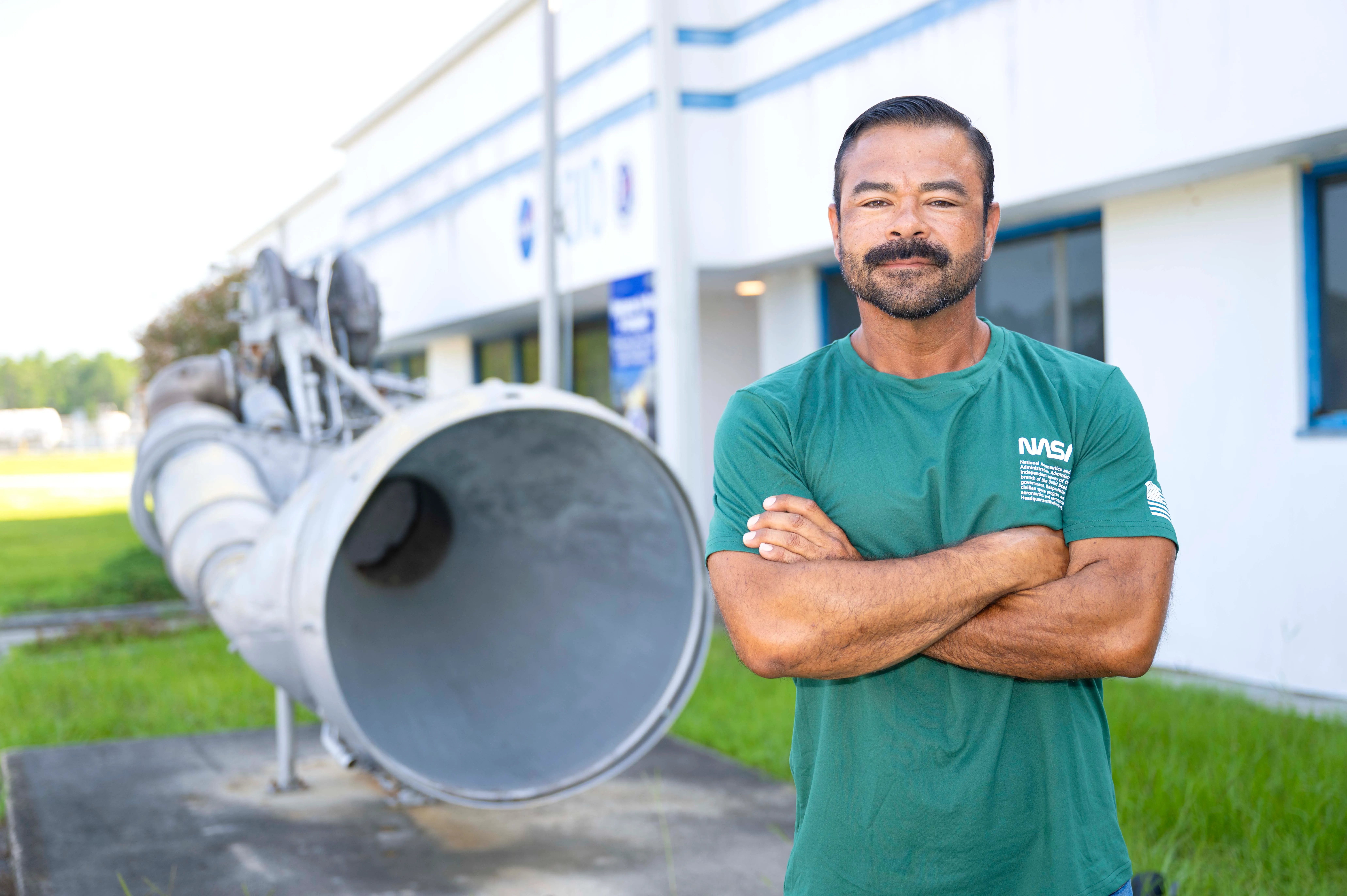
At 17, Jerret Howard raised his right hand to serve his country as a medic in the U.S. Army in Iraq. This summer, he raised his right hand again at NASA’s Stennis Space Center near Bay St. Louis, Mississippi, beginning a new chapter in his career as a NASA civil servant.
Hired through NASA’s Workforce Directive to restore core agency competencies by transitioning select contractor positions to civil service roles, Howard said his move from longtime contractor to logistics management specialist represents a lifelong commitment to national service.
For more than 15 years, Howard worked as a mechanical engineer at NASA Stennis Space Center, the nation’s largest rocket propulsion test site. As a contractor, he maintained equipment, turned wrenches and helped build critical test-bed infrastructure. Now, his new NASA role carries deep personal meaning.
“This is definitely a continuation of service,” Howard said. “I’m proud that I’ve come full circle—from being 17 years old and wanting to serve my country to wanting to retire from NASA one day.”
As a logistics management specialist, Howard helps secure the hardware, equipment and components required for rocket propulsion testing at NASA Stennis. He draws on his technical experience to anticipate engineering needs, support efficient operations and help ensure taxpayer dollars are used responsibly.
Howard’s expertise extends beyond logistics. He works closely with engineers, supports testing across multiple disciplines and helps prepare facilities for commercial spaceflight activities, including Blue Origin testing at NASA Stennis.
“Mechanical work is a challenge,” Howard said. “Everything is a puzzle. Even when it seems monotonous, something new always comes out. It’s a skill, and once you get really good at it after years of repetition, you don’t want to waste it.”
Howard’s commitment to public service is also rooted in family. As a resident of Kiln, Mississippi, he views his career at NASA as an opportunity to lead by example and make his family proud.
“My little girl looks at me and is so proud and knows she can do anything,” Howard said.
That message also resonates with his teenage son, who dreams of becoming a NASA engineer. Although his son faces physical challenges, the Howard family remains focused on his abilities and unlimited potential.
“We’re pushing him to focus on how much he can do instead of thinking about what he can’t do,” Howard said.
Away from work, the family balances a “work hard, play hard” lifestyle with time spent riding dirt bikes and enjoying their boat on the water.
The family’s passion for space exploration is especially meaningful as NASA prepares to return astronauts to the moon through the Artemis campaign. NASA is also working toward establishing a lunar base—the first sustained human outpost near the moon’s south pole—where astronauts will live, work and conduct scientific research.
The future of spaceflight has become a shared family passion for the Howards.
When the Artemis II mission began last April, the family set up a large tablet beside their boat and used a rugged sound system to amplify the launch broadcast.
“My daughter felt the bass of the launch,” Howard said. “I got chills.”
The family is already looking forward to Artemis III. Howard’s work supports NASA and a commercial company conducting rocket propulsion testing at Stennis. The mission is intended to demonstrate joint operations before Artemis IV returns astronauts to the lunar surface.
Howard’s transition to NASA’s civil service gives him a direct role in supporting the agency’s mission. His work at Stennis helps strengthen America’s leadership in space while inspiring the next generation of engineers, including his son.
Learn more about NASA’s Stennis Space Center at www.nasa.gov/stennis.
Source: www.nasa.gov