


MIT and EPFL Engineers Build a Robot That Can Swim Underwater and Fly
Water is about 1,000 times denser than air, so moving through these two environments requires completely different dynamics. Yet birds such as seagulls and puffins can dive into the sea, swim underwater, leap into the air and fly away. Engineers at MIT and EPFL in Lausanne, Switzerland, have now designed a robot capable of making the same transition.
A Lightweight Robot Designed for Water and Air
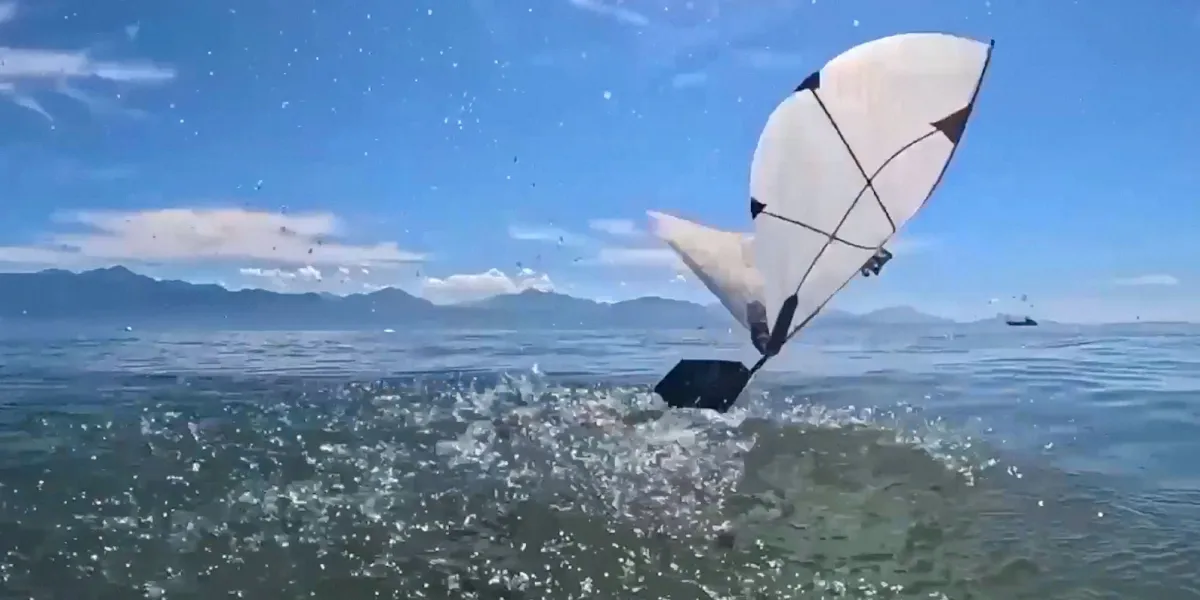
The Flapping Wing Aircraft (FAAV) weighs less than 300 grams, or approximately half a pound. It features a central fuselage, two flexible wings and a steerable tail. Inside the body, a battery powers a waterproof electric motor. The motor drives a crankshaft that moves the wings up and down at a preset frequency.
The wings consist of a thin membrane coated with hydrophobic nanoparticles, which help water run off their surfaces. A motorized tail allows the robot to jump upward or downward by changing its angle.
How the Robot Transitions From Swimming to Flight
During experiments in an aquarium and Lake Geneva, a team led by Rafael Zaffery, an assistant professor of mechanical engineering at the Massachusetts Institute of Technology, identified the combination of wing size, flapping frequency and tail angle needed for a smooth transition from swimming to flight.
The robot performed best with medium-sized wings that were flexible enough to reduce flapping amplitude underwater while remaining stiff enough to keep the vehicle airborne. Its speed and wing-flapping frequency were similar to those of real birds.
A relatively steep pitch of 70 degrees enabled the robot to jump from the water into the air. Unlike many diving birds, which use their feet to help lift themselves out of the water, the robot does not need feet.
Potential Applications for Ocean Research
The engineers’ work could help create a new class of drones and vehicles capable of flying and collecting water samples in areas too dangerous or difficult for traditional vessels to access.
“Our dream vision is for oceanographers, marine biologists, and coastal communities to launch this robot from boats or shores and fly it near areas of interest, such as icebergs or port facilities, or over pods of whales,” Zaffery said.
“We go underwater to take measurements or collect samples, and we fly back to provide the data at a fraction of the cost of traditional methods. Then we can dive further and dive further.”
Next Steps for the Swimming and Flying Robot
Researchers are currently working on wings that can both flap and rotate. They also plan to test the robot in turbulent conditions, including underwater swimming in strong waves and flight against the wind.
The team hopes to eventually deploy the vehicle to help answer questions in ocean science.
“One of the big challenges in marine science is collecting data frequently across many locations, and this robot could help us do that in the future,” Zaffery said. “You can send this not just weekly, but hourly. You can take off at high speed, dive in, come back, deliver data, and come back again, over and over again.”
Source: www.technologyreview.com