


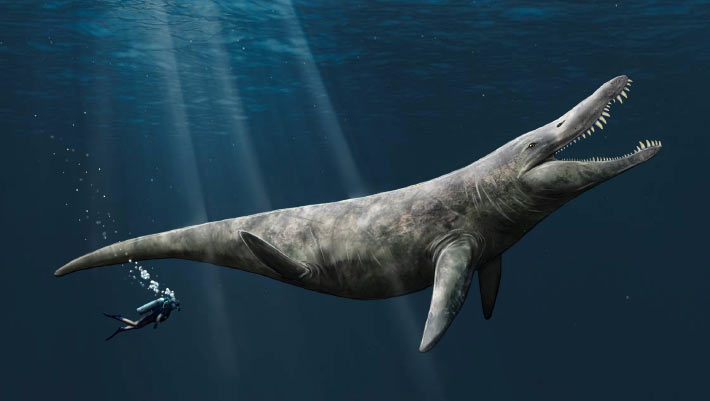
For decades, Liopleurodon ferox has captivated paleontologists and enthusiasts alike. This remarkable short-necked marine reptile inhabited the seas of present-day Britain and France approximately 163 million years ago. Renowned as one of the ocean’s largest predators, estimates suggest it could reach lengths of up to an astonishing 25 meters. Recent research conducted by paleontologists at the University of Portsmouth indicates that while Liopleurodon ferox is significantly shorter, its formidable skull still marks it as an apex predator in its ecosystem.
Artist’s impression of a pliosaur. Image credit: Megan Jacobs, University of Portsmouth.
“Liopleurodon ferox is a significant Thalassophonian pliosaur from the Middle Jurassic (Callovian) Oxford Clay Formation in England and a comparable formation in northwest France,” stated University of Portsmouth paleontologist Edward Bartlett and colleagues.
“This species represents one of the earliest known thalassophonians, thanks to a nearly complete skeleton.” This status has positioned Liopleurodon ferox as a benchmark for systematic studies and size comparisons within the Thalassophoniae group.
The complexity of its taxonomic history has led to a wide range of size estimates, varying from 6.39 meters to the mythic 25 meters popularized in the 1999 BBC television series Walk with Dinosaurs.
In their recent study, Dr. Bartlett and his team reevaluated all known specimens of Liopleurodon ferox. Their findings revealed a more realistic size range of about 2.46 to 8.09 meters, with complete skeletons averaging around 4.8 to 6 meters long.
The researchers concluded that the average length of this marine predator is likely closer to 5 meters, significantly less than the legendary 25 meters.
“Our study is the first comprehensive reassessment of all specimens associated with Liopleurodon ferox,” noted Dr. Bartlett. “By synthesizing available materials, we can now provide a reliable estimate of its size and body proportions.”
While smaller than some legendary reconstructions, Liopleurodon ferox remained a dominant marine predator in the Jurassic Oxford Clay Sea.
The researchers utilized two well-preserved skeletons—one located in Tübingen, Germany, and the other housed at the Natural History Museum in London—for their revised model. They also adjusted skull proportions based on new findings, discovering that the skull made up approximately 24% of the animal’s total skeletal length, a significantly larger ratio than previously thought, allowing Liopleurodon ferox to pursue larger prey compared to its contemporaries.
Despite being smaller than previously estimated, Liopleurodon ferox remains the largest known marine creature from the Oxford Clay ecosystem.
Interestingly, the researchers identified fossil fragments from the same geological layer that may belong to an even larger pliosaur, potentially measuring up to 12.2 meters in length. However, without the diagnostic features needed for species identification, the true identity of these specimens remains unknown. This indicates that true giants coexisted with Liopleurodon ferox in the mid-Jurassic oceans.
“The pliosaur specimen from the Oxford Clay Formation, estimated to be between 7.02 and 12.2 meters in length, suggests that gigantism in pliosaurs (over 10 meters) likely evolved during the late Middle Jurassic period,” the scientists concluded.
These findings will be published in the Journal of Vertebrate Paleontology.
_____
Edward O. Bartlett and others. Re-evaluating the body size of mid-Jurassic pliosaurs Liopleurodon ferox Sauvage, 1873. Journal of Vertebrate Paleontology, published online on July 16, 2026. doi: 10.1080/02724634.2026.2691149
Source: www.sci.news