



OpenAI Says New GPT Models Dramatically Improve COBOL, Fortran and Legacy Code Migration
OpenAI says its new models are significantly better at creating, maintaining and migrating software written in older programming languages, including COBOL, Fortran and Visual Basic.
The improvements could be important for organizations that still rely on legacy code to operate financial services, scientific systems and other critical infrastructure.
According to OpenAI, COBOL supports more than 40% of online banking systems, 80% of in-person credit card transactions and 95% of ATM transactions. Fortran remains in use for applications including weather forecasting and nuclear reactor safety analysis.
“These languages support critical infrastructure and essential services around the world, even though they require less code and documentation for models to learn than languages like Python and JavaScript,” OpenAI explained in a blog post.
OpenAI benchmarks AI performance across 20 programming languages
To measure progress, OpenAI created MultiLangBench, a test that requires a model to build a SQLite-compatible database engine from scratch across 20 programming languages.
The average test pass rate for GPT-6 Astra reached 87.4%, compared with 26.8% for GPT-5.6 Sol. The largest gains included a rise in COBOL performance from 10.9% to 72.1% and an improvement in Fortran from 21.4% to 83.5%.
OpenAI said the improvements extended across every language tested, including:
- COBOL: 10.9% to 72.1%
- OCaml: 25.6% to 85.8%
- Fortran: 21.4% to 83.5%
- Visual Basic: 27.5% to 89.4%
GPT-6.1 Sol improves COBOL migration accuracy
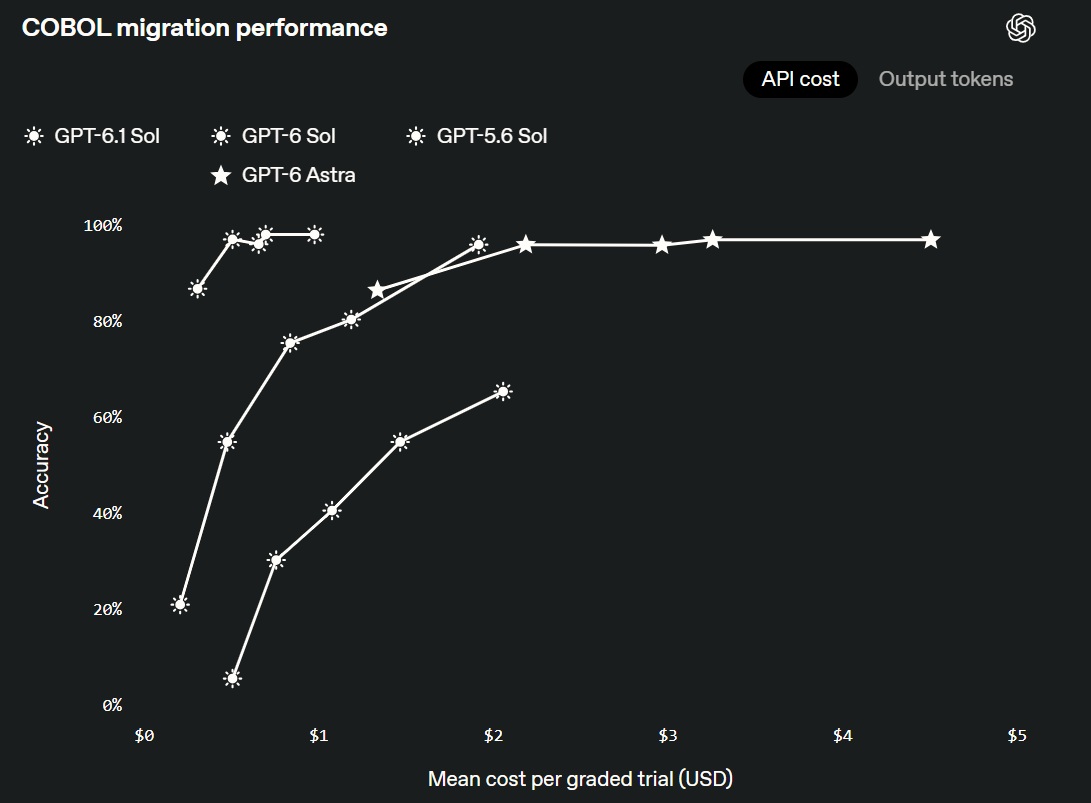
OpenAI also tested whether its model could migrate COBOL programs to C++, Java, Kotlin, Python or Rust without changing their behavior.
“GPT-6.1 Sol achieves 86.6% accuracy with less inference effort, while GPT-5.6 Sol has 5.4% accuracy with the same settings and only 61% API cost,” OpenAI said. “As we increase the inference effort, the accuracy reaches 97.9% and the evaluation approaches saturation.”
The results suggest that AI could help companies modernize older software and move legacy COBOL applications to newer programming languages. However, the migration process still requires expert review, validation and extensive testing before any code is deployed in production.

The overall prevention score can hide what happens after the initial access. If an attacker uses valid credentials, your defenses drop sharply.
The Blue Report 2026 measures defense techniques by technology across 338 million simulations run in customer production environments.
Source: www.bleepingcomputer.com