


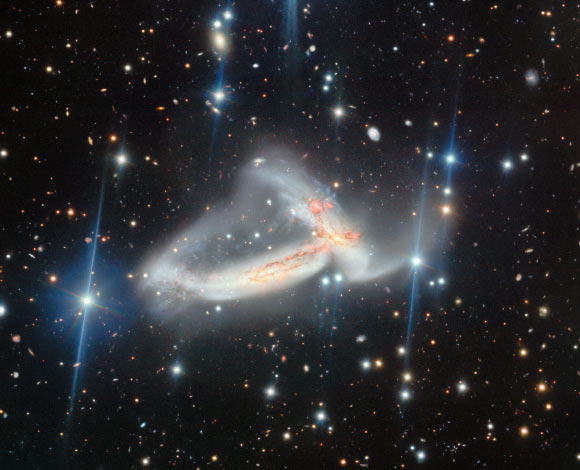
New Gemini North telescope images reveal the clearest view yet of NGC 7253, a striking pair of interacting spiral galaxies located more than 200 million light-years from Earth.
The interacting spiral galaxies NGC 7253, captured by the Gemini North Telescope on Mauna Kea, Hawaii. Image credit: International Gemini Observatory / NOIRLab / NSF / AURA / J. Miller & M. Rodriguez, International Gemini Observatory & NSF’s NOIRLab / TA Rector, University of Alaska Anchorage & NSF’s NOIRLab / D. de Martin & M. Zamani, NSF’s NOIRLab.
NGC 7253 is a pair of interacting spiral galaxies in the constellation Pegasus, more than 200 million light-years away.
The galaxy system was discovered on September 9, 1863, by German-British astronomer Albert Marth.
NGC 7253 consists of two relatively small spiral galaxies separated by approximately 4 million light-years. The northern galaxy is commonly known as NGC 7253A, while the southern galaxy is designated NGC 7253B.
The galaxies are close enough for their mutual gravity to distort their shapes and spiral arms. This unusual interaction has earned NGC 7253 a place in Halton Arp’s Atlas of Peculiar Galaxies, where the system is listed as Arp 278.
The new images of NGC 7253 were captured by the Gemini North Telescope on Mauna Kea, Hawaii. Gemini North is one half of the International Gemini Observatory, which is funded in part by the National Science Foundation and operated by NSF’s NOIRLab.
The image was produced as part of the NOIRLab Legacy Imaging Program, an initiative that dedicates telescope time to creating detailed, full-color images of celestial objects for scientific research and public outreach.
“NGC 7253 is a fascinating object because it is two galaxies merging into one over billions of years,” said NOIRLab intern Raiyan Rahman.
“But we primarily chose this object because it is one of the few that actually exists in the Hawaiian constellation, Ka Lupe O Kawelo.”
“After spending so much time on Mauna Kea, it was important to us to choose something that was both culturally and astronomically significant.”
The Gemini North image shows two similarly sized spiral galaxies whose slender arms are stretched and distorted by gravity. The galaxies are slowly moving toward a merger that will unfold over billions of years.
Bright pink patches scattered across the image mark regions where hydrogen gas has been ionized by intense radiation from newly formed stars. These glowing clouds are known as HII regions.
Star formation is common in interacting galaxies. As NGC 7253A and NGC 7253B approach one another, clouds of gas and dust in their spiral arms collide and become compressed. This compression can trigger bursts of new star formation.
The young, hot stars produced during this process emit powerful ultraviolet radiation. That energy strips electrons from nearby hydrogen atoms, causing the gas to glow with the distinctive pink color visible throughout the image.
“Stars are a source of life and health for us humans, because our Sun is a star and we cannot live without it,” said NOIRLab intern Manu Silva-Sampaio.
Source: www.sci.news