


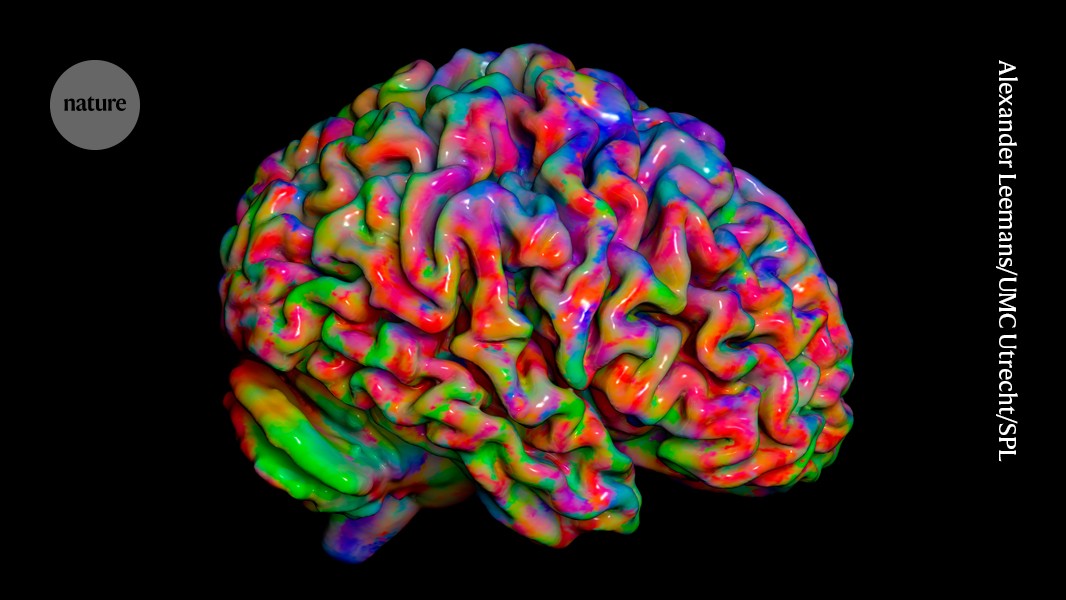
A region called the insula is buried deep beneath the wrinkled surface of the brain (artist’s illustration).
Credit: Alexander Leemans/UMC Utrecht/Science Photo Library
Scientists map the brain’s mysterious insula in unprecedented detail
Scientists have mapped one of the most mysterious parts of the human brain in unprecedented detail1. Their findings reveal how the insular cortex, or insula, is organized to process physical sensations such as pain and how it works with the brain’s higher-cognition regions to shape body perception.
The study identifies distinct areas of the insula with different roles. One region produces sensations of pain in specific parts of the body. Another generates sensations linked to internal organs, including nausea. A third region at the front of the insula communicates with brain areas involved in cognition and emotion, suggesting that it helps influence not only what we feel, but also how the brain interprets those sensations.
Contrary to conventional thinking, the insular cortex “doesn’t just read the body; it partially influences the story of how the body should feel,” says study co-author Joseph Parvizi, a physician-scientist at Stanford University in California.
The study is “quite a feat,” says Lucina Uddin, a cognitive neuroscientist at the University of California, Los Angeles. She adds that it is one of the most comprehensive studies of the insula and its role in producing bodily sensations.
The results are published today in Nature.
Why the insula is difficult to study
The insula is located deep within the brain, making it notoriously difficult to examine in detail. Previous research suggests that this region receives signals such as pain and pressure from different parts of the body and processes them into the sensations we experience.
However, much of what scientists know about the human insula comes from brain-imaging techniques that show what happens in the region when different sensations occur, Parvizi says. To build a more detailed map, he and his colleagues needed to stimulate different parts of the insular cortex directly and record the physical sensations that followed.
Implanting electrodes deep in the brains of healthy people would be unethical. Instead, the researchers studied 87 people who already had electrodes implanted for medical reasons.
Electrical stimulation reveals the brain’s map of bodily sensations
Across experiments conducted over more than a decade, Parvizi and his colleagues applied electrical current through electrodes to different parts of the participants’ insular cortex.
Stimulating the back of the insula caused pain, heat and other sensations, including tingling and numbness, in specific areas of the body such as the arms and legs.
By contrast, electrical stimulation at the centre of the insula produced more “visceral” sensations. Participants reported feelings including nausea, pressure and fullness in the chest.
Source: www.nature.com