


How Citizen Data Can Help Cities Become Healthier
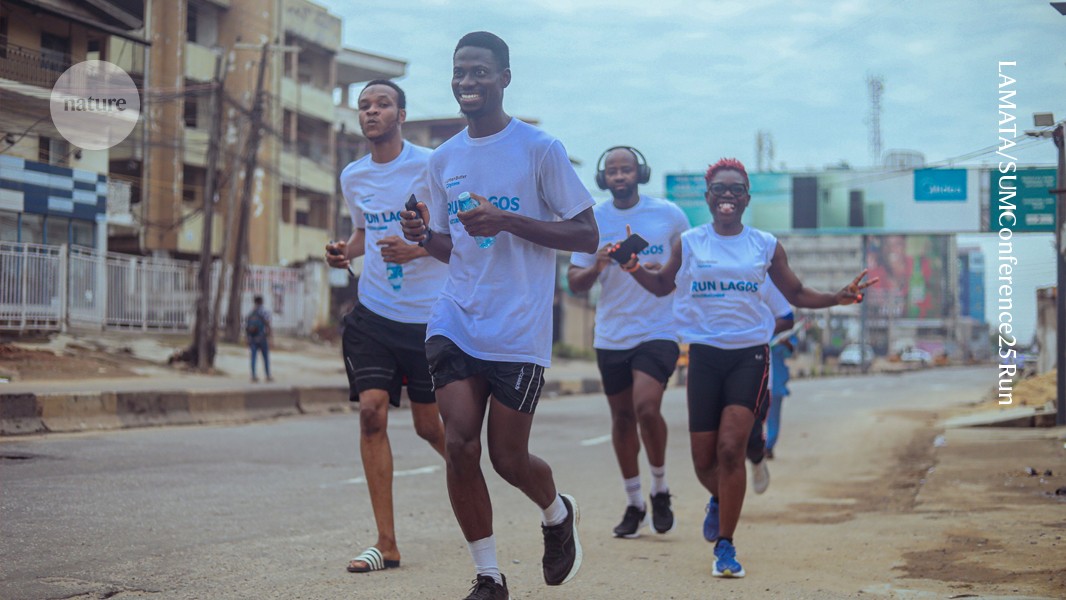
Tollulah Oni (right) runs with teammates during an event at the International Conference on Sustainable Urban Mobility in Lagos, Nigeria, in 2025.
Credit: LAMATA/2025 International Conference on Sustainable Urban Mobility Implementation
In 2016, public-health doctor Torla Oni was jogging through the streets of Dakar when she saw someone doing push-ups in the middle of a crowded roundabout. Cars were spewing smoke all around him as the sun burned down. As a doctor, she knew that the environment could affect his health — and the health of everyone living in the city.
More than half of the world’s population now lives in urban areas, but many cities do not support human health and well-being. Oni, a researcher at the University of Cambridge in the United Kingdom, describes herself as an urban epidemiologist whose patients are cities.
She collaborates with colleagues around the world to diagnose and treat “sick” cities, with the goal of improving residents’ health and quality of life. This work includes monitoring air quality, temperature and other variables that affect people living in urban areas. The resulting data can inform advocacy and interventions.
How to use research to inform humanitarian relief efforts
Frustrated by the lack of on-the-ground infrastructure in many cities, and by the struggle to connect researchers with residents, Oni founded UrbanBetter in 2019. The nonprofit organization supports research and advocacy by training citizens and local researchers to collect and analyse data. This helps communities diagnose the problems affecting their cities and use evidence to lobby for change.
UrbanBetter’s research arm, UrbanBetter Academy, has a centre in Cambridge. Its civic arm, Cityzens Hubs, operates in 11 African cities, as well as Bogotá and Bangkok.
The Nigerian-born Oni identifies as part of the African diaspora, which she describes as “the sixth distinct region of the African continent”. Now based in the United Kingdom, she recognizes the challenges of trying to work with a city from afar.
Through UrbanBetter, she wants to build a permanent virtual infrastructure that brings the intellectual capital of the diaspora back to the continent and helps to heal ailing cities.
How can doctors diagnose and treat cities?
A city cannot tell you that it is sick, so you have to reveal its symptoms first. What is happening to its lungs and air quality? What is happening in its green spaces? How does the city metabolize energy? What happens to its waste? Without data, we do not know whether a city is becoming unhealthy, and many cities do not measure these conditions at all.
It is important that the people identifying the symptoms are on the ground in that city — not a professor sitting thousands of miles away in Cambridge. People living there move through the city and breathe its air. We must equip local residents with the skills they need to diagnose their cities. Sensors can perform diagnostic tests, and their data can be mapped.
Urban treatments also need to be rooted in lived reality. Outsiders can evaluate a city and suggest evidence-based solutions, but they can be wrong for many reasons. Residents need to be included because they can identify priority areas and advocate for change.
For example, in Nairobi, a group of citizens collected air-pollution data and held a community meeting in 2025 to identify potential solutions. These included cleaner public transport, more trees and green space, and reduced open burning of waste. The recommendations were directly reflected in the Nairobi City County Air Quality Action Plan.
Developing a cure for cities is a collective effort. Accountability means administering that medicine through small, incremental changes that make urban areas healthier.
How UrbanBetter helps cities tackle air pollution and heat
Oni founded UrbanBetter in 2019 as an experimental platform designed to change the landscape of research by combining evidence with action and advocacy. The organization began with a $300,000 unrestricted grant from Unorthodox Philanthropy, a funding organization sponsored by the Lampert Bird Foundation in San Francisco, California.
Each UrbanBetter hub has different strengths. Lagos focuses on physical activity, air pollution and heat, while Bogotá focuses on transportation, cycling and car-free days. This means that cities seeking to work in a new area do not have to reinvent the wheel.
Ahead of the 2025 Lagos City Marathon, the local Cityzens Hub partnered with World Athletics’ “Running for Clean Air” project. The marathon takes place in February, one of the hottest times of the year in Lagos, a city that also has high levels of air pollution.
I took a break from my doctoral program for 11 years to save Madagascar’s oceans.
Throughout 2025, a group of residents ran the marathon route every month, beginning in January and continuing until the event. They wore air-quality sensors and used the UrbanBetter app to collect geotagged data.
Some runners observed a 60% reduction in air pollution on the day of the marathon, when cars were not allowed on the roads. The findings are now informing changes to the city’s transportation-policy implementation, with a goal of reaching net-zero emissions by 2050.
Government initiatives include increasing cycling and walking, overhauling public transport and expanding air-quality monitoring.
Cityzens Hub later identified heat as another major issue for people living in Lagos and reached out to UrbanBetter Academy to help analyse the complex data. In 2025, researchers from UrbanBetter, local partner agencies and the Lagos Transport Authority received £2 million (roughly US$2.6 million) from the Biomedical Funding Charity to investigate heat exposure and health risks in Lagos through a project called Hotsteppers.
This is how UrbanBetter works: research questions about heat emerged from people who raised problems they were experiencing in the field.
Source: www.nature.com