


David Smith
Duke University
The increasing number of spaceflight vehicles and satellites is propelling advancements in space situational awareness (SSA). The U.S. Space Surveillance Network (SSN) currently tracks objects as small as 4 inches, utilizing upgrades like the Space Fence. However, the requirements for ground-based monitoring of Low Earth Orbit (LEO) objects are limited by kilometer-scale radar arrays. For regions beyond LEO, ground-based solutions become impractical due to extreme distances and line-of-sight challenges. This limitation impacts coherent radar systems, as detection performance is inversely related to target distance; thus, it’s often more viable to shift to a space-based SSA solution.
Space-based radar systems present unique advantages for sensing capabilities, but monitoring lunar satellite traffic still necessitates large apertures for optimal performance. This presents a practical challenge, as current deployable structures typically do not exceed 100 meters. The limitation stems from the requirement that modern antennas—such as membrane, mesh, and inflatable designs—must fit within a single launch fairing. In contrast, in-space assembly offers a pathway to build scalable structures free from such launch restrictions, capable of meeting demanding long-range SSA requirements.
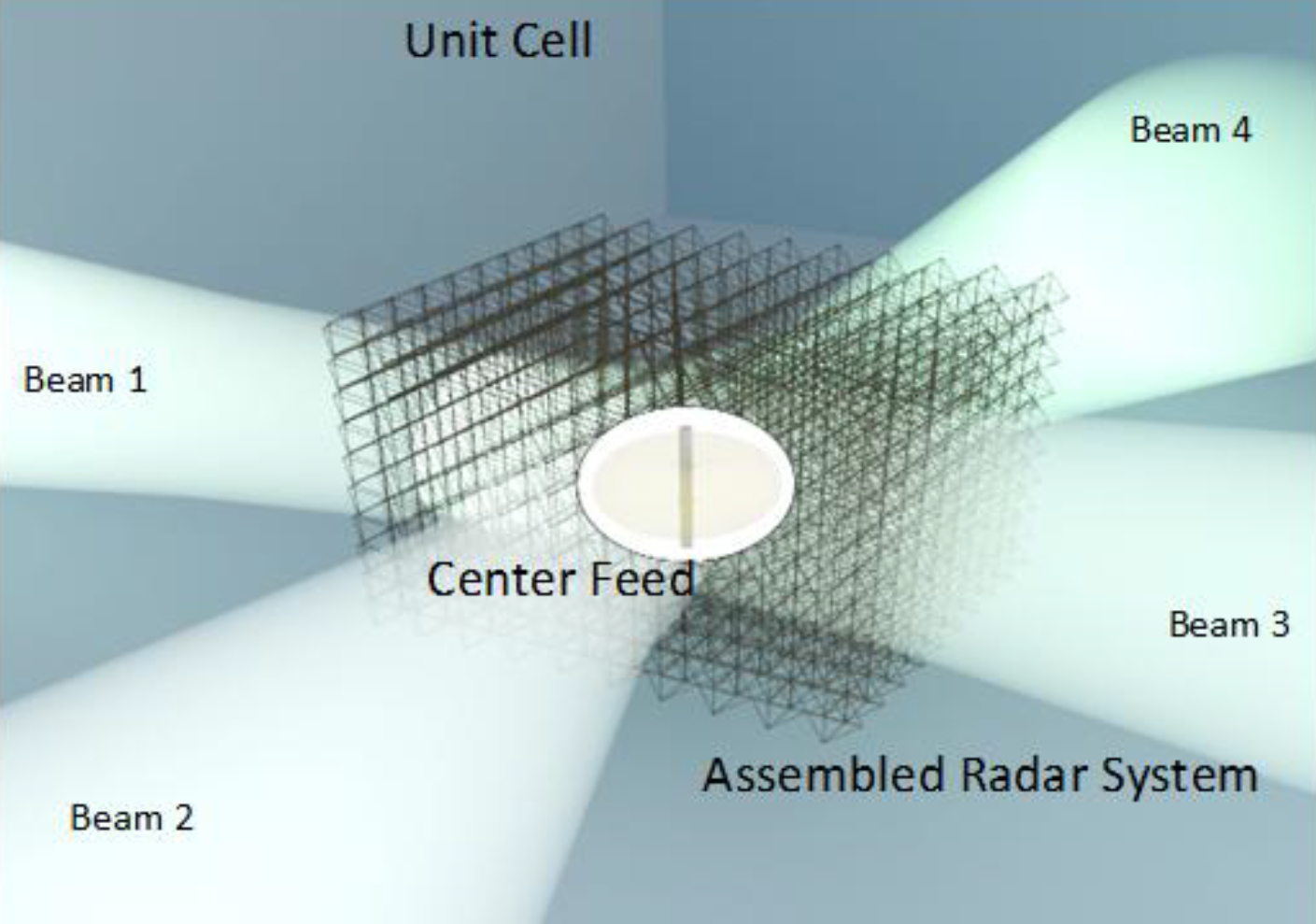
We propose a novel spaceborne radar system that integrates the reliability of robotically assembled stable structures with reconfigurable volumetric electromagnetic metamaterials. This innovative technology achieves precise construction of complex volumetric structures while offering a versatile design platform tailored to long-range SSA challenges. Using a unit cell-driven modular design approach allows for scalable, mechanically robust antenna platforms. This system ensures reliable assembly and efficient control of volumetric antenna structures, minimizing the need for slow mechanical antenna rotation and enabling advanced features like wide field of view (FOV) steering.
Our study showcases the scalability and efficacy of reconfigurable volumetric S-band metamaterials designed for various beam steering functions. It explores cutting-edge metamaterial design strategies for omnidirectional electromagnetic beam forming and evaluates reconfigurable unit cells suitable for robotic assembly. This design process employs an efficient dipole model validated at smaller scales and leverages comprehensive full-wave numerical methods for metamaterial element designs. The project’s framework aligns with practical constraints demonstrated by the Automated Reconfigurable Mission Adaptive Digital Assembly Systems (ARMADAS) initiative.
While this project mainly targets SSA applications, the design insights are also relevant for missions that require large physical apertures, such as low-frequency radiometry for Earth observation or deep space communications. Since resolution and sensitivity in beam steering, radar, and observational missions improve with increased aperture size, developing alternative electromagnetic strategies to reduce CSWaP could significantly benefit a variety of NASA programs.
2026 Selection
Source: www.nasa.gov