


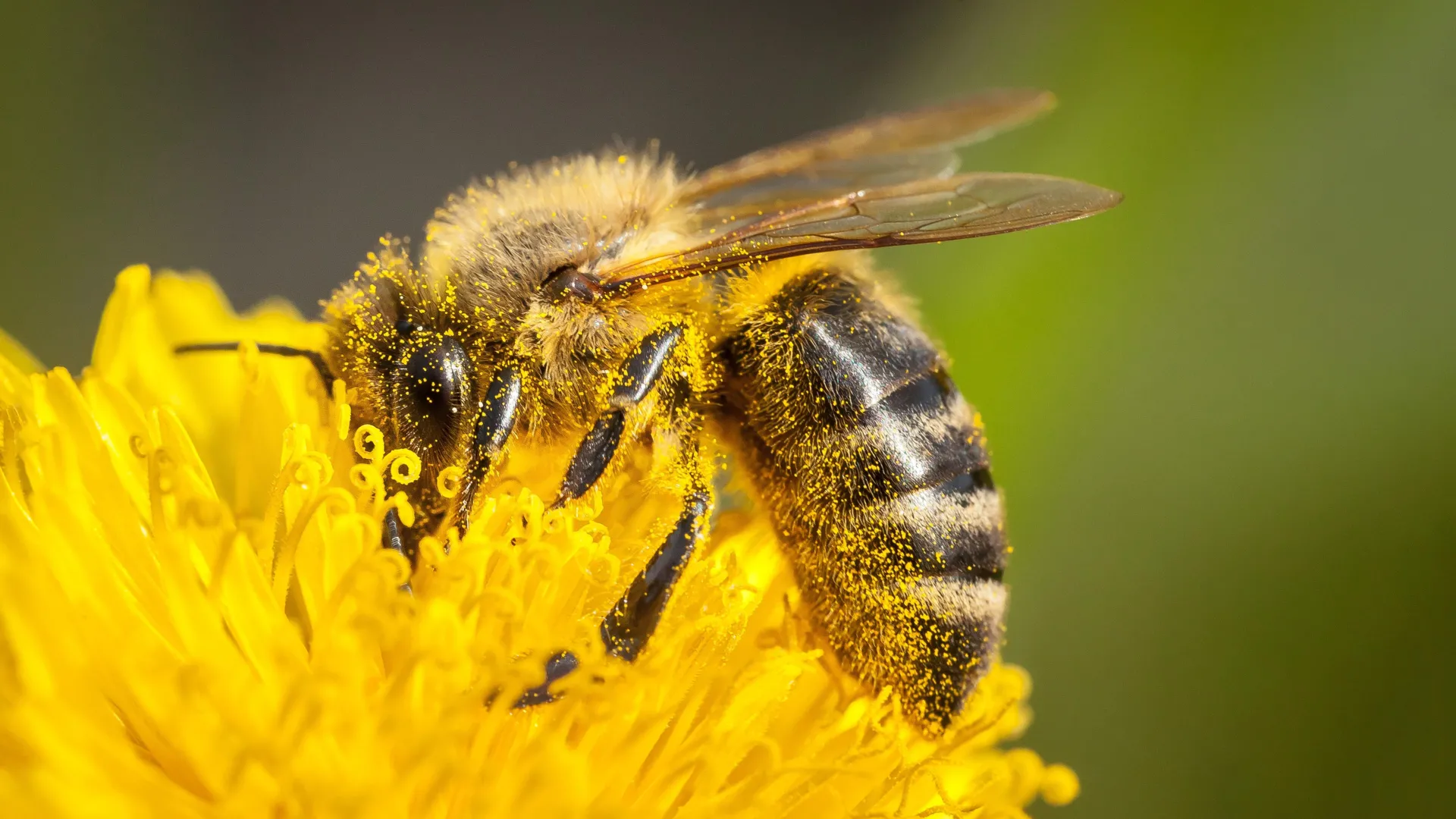
New research from the University of Oxford has revealed that honeybees can regulate how much they eat based on the balance of essential amino acids in their food. This feeding behavior may help bees avoid consuming excessive amounts of specific amino acids when pollen does not provide the nutrients they need.
Published in Current Biology, the study found that many types of pollen contain essential amino acids in proportions that do not precisely match bees’ nutritional requirements. Essential amino acids are the building blocks of proteins. Because animals cannot produce them naturally, they must obtain them through their diet. The findings could help farmers, landowners, conservationists and gardeners make better decisions about supporting healthy bee and pollinator populations.
Why pollen is not always the perfect food for bees
Bees obtain most of their food from flower nectar and pollen. Nectar primarily provides sugar, while pollen is the main source of protein and amino acids. However, pollen did not evolve solely as food for pollinators. It is the male reproductive material of plants, meaning its nutritional composition may not provide bees with the ideal balance of nutrients required for growth, survival and reproduction.
To investigate this nutritional mismatch, researchers compared the essential amino acid composition of bee tissue with pollen collected from 99 British flowering plant species across 26 plant families. They also developed artificial diets that mimicked the amino acid profiles of different pollen types and bee tissue. Newly emerged worker bees were fed these diets in controlled laboratory experiments.
Most pollen samples had an essential amino acid profile that differed from the composition of bee tissue. Bees fed a diet more closely matching their own tissue composition consumed more food, gained more weight and selected diets containing a higher proportion of protein.
One amino acid may help regulate bees’ appetite
The researchers suspected that histidine could play an important role in this feeding response. Although histidine is an essential amino acid, bees require it in relatively small amounts.
To study its effects, the research team created artificial feeds with either high or low levels of histidine relative to branched-chain amino acids, including leucine and isoleucine. These amino acids are important for bee growth and development. When the relative amount of histidine was high, bees reduced their overall food intake, including both protein and carbohydrate consumption.
According to the researchers, this response may be controlled by a post-digestive feedback mechanism that prevents bees from consuming potentially harmful amounts of certain amino acids. Instead of simply eating more pollen to compensate for a missing nutrient, bees may reduce their intake when another nutrient is present in excess. Similar responses have been observed in other animals. In rats, for example, excess histidine is converted into histamine, which activates brain receptors involved in appetite regulation.
Lead author Professor Geraldine Wright, from the University of Oxford’s School of Biology, said: “Pollen is often considered to be a near-perfect food for bees, but pollen is the male gamete of plants and, unlike nectar, is rarely produced solely as a reward for pollinators. This creates a conflict of interest between plants and pollinators.”
Bees create more balanced food for young bees
Honeybees appear to have additional ways to overcome nutritional limitations in pollen, particularly when feeding developing larvae.
Worker bees collect pollen from multiple flowers and store it inside the hive as “bee bread.” They consume and process this material into glandular secretions, including royal jelly, which is used to feed developing larvae.
The researchers found that bee bread contained a more balanced essential amino acid profile than most individual pollen sources. Royal jelly more closely matched the amino acid composition of bee tissue. This suggests that by combining pollen from different plants and processing it within the hive, honeybee colonies can compensate for nutritional deficiencies in individual pollen sources.
Professor Wright added: “We predict that bees have evolved to produce glandular secretions that provide optimal nutrition for larvae, supplying an essential amino acid ratio that maximizes growth.”
Wild bees may face additional nutritional challenges
This nutritional system is not available to every bee species. Many wild bees, including bumblebees and solitary bees, provide pollen directly to their offspring. In areas with limited flowering plant diversity, these bees may struggle to obtain the right balance of essential amino acids for themselves and their developing young.
The findings suggest that pollinator-friendly planting plans should focus on more than simply providing a large number of flowers. The nutritional quality of pollen and the diversity of plants producing it may also play an important role in supporting bee health.
Professor Wright said: “Our findings suggest that planting for pollinators should focus not only on providing flowers throughout the season, but also on ensuring a diversity of pollen sources. A varied diet may be essential for bees to receive the correct balance of nutrients.”
The research also involved scientists from the University of Southampton, Lancaster University, Newcastle University and the Hebrew University of Jerusalem.
Source: www.sciencedaily.com