


Colorado River’s Upper Basin Lost Nearly Twice as Much Groundwater During Recent Drought
A new analysis finds that Colorado, New Mexico, Utah and Wyoming may be more vulnerable to long-term drought than scientists previously thought.
Western states once thought to be resilient to long-term droughts may be more vulnerable than scientists previously thought, according to a new analysis of groundwater reserves in the Colorado River Basin.
Researchers found that the four states in the basin’s upstream region—Colorado, New Mexico, Utah and Wyoming—lost nearly twice as much groundwater as the downstream region during the severe drought from 2020 to 2022. The unexpected finding could mark a tipping point for the region, because the Upper Basin has long been considered more drought-resilient than the Lower Basin, said Esther Eudel, a doctoral student in geosciences at Virginia Tech and the study’s lead author.
“The upper Colorado River basin has historically been thought to be more resilient because of its higher precipitation, especially snowfall in the Rocky Mountains,” Eudel told Live Science in an email. “I think the important lesson is that we should not assume that the Upper Basin will remain relatively resilient simply because it has historically had more precipitation and snowmelt.”
Why the Upper Basin’s groundwater loss was surprising
The Lower Basin includes parts of Nevada, California and Arizona. It receives less rain and snowfall, meaning it naturally gets less groundwater recharge and replenishment from other water sources than the Upper Basin. Downstream areas also generally experience higher evaporation rates and greater water demand.
Approximately 30 million of the 40 million people who depend on the Colorado River for water live downstream, according to Eudel.
In a study published Oct. 13 in the journal Water Resources Research, researchers used satellite and hydrological data to estimate groundwater decline across the Colorado River Basin from 2004 to 2023. The data included measurements of surface water, soil moisture and snow-water storage, along with observations from NASA’s Gravity Recovery and Climate Experiment mission and its successor, GRACE Follow-On.
The Colorado River Basin lost 14 cubic miles of groundwater
Groundwater depletion has become a deep-rooted problem in the Colorado River Basin. The basin has been losing water for the past 20 years, but losses accelerated in 2019, Eudel said. The three-year drought that began in 2020 was a major factor, causing reduced snowpack in the Rocky Mountains, increased evaporation and greater water demand across the basin.
During the 2020–2022 drought, the Upper Basin lost approximately 4.2 cubic miles (17.5 cubic kilometers) of groundwater, while the Lower Basin lost about 2.3 cubic miles (9.4 cubic kilometers).
Between 2004 and 2023, the Colorado River Basin lost a total of 14 cubic miles (58.3 cubic kilometers) of groundwater—the equivalent of approximately 25 million Olympic-size swimming pools.
Less snowmelt may be putting the Upper Basin at risk
It is unclear why groundwater losses were substantially higher in the Upper Basin than in the Lower Basin. However, the Upper Basin is more closely connected to the mountains and depends on them for aquifer recharge, Eudel said.
As snow melts, some of the water replenishes groundwater. That means reduced snowfall during the 2020–2022 drought may have had an especially severe impact on the Upper Basin.
The Upper Basin also recorded more aquifer recharge than the Lower Basin during the wetter period before the drought. Its sharp decline during the drought may therefore be related to the higher groundwater levels it had at the start of the study period, Eudel said.
Groundwater and surface water are connected
The researchers used advanced statistical methods to examine the relationship between groundwater and surface water in the Colorado River Basin.
Global warming and the over-allocation of Colorado River water have placed additional pressure on the system. Under the 1922 Colorado River Compact, water allocations were based on conditions that no longer reflect the river’s current flow. The river now carries about 35% less water than its 20th-century average.
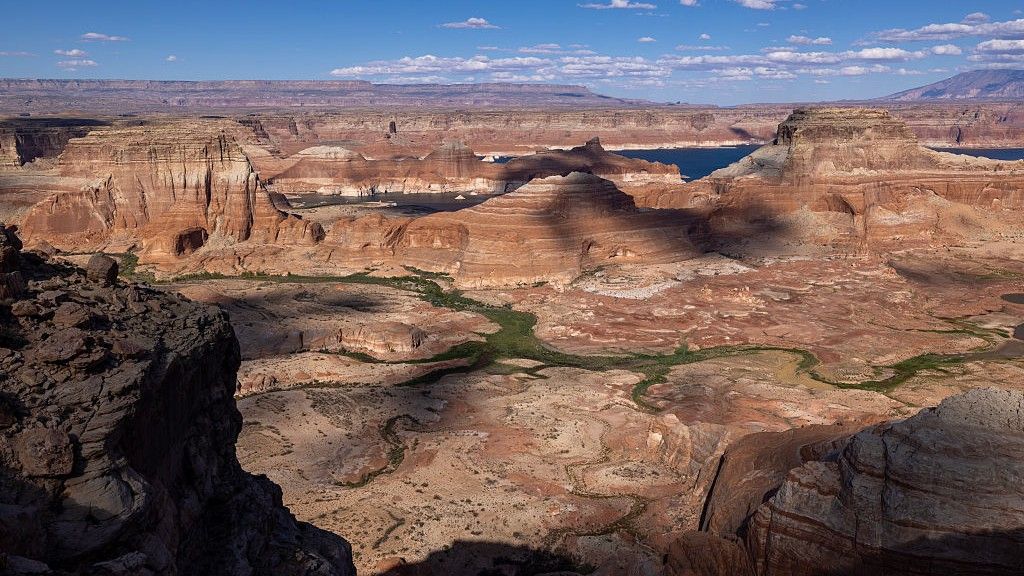
Water scarcity in the basin has reached alarming levels, with Lake Mead and Lake Powell—the two largest reservoirs in the United States—recording record-low levels in August.
In the Upper Basin, groundwater levels changed in the same direction as surface water levels, but with a slight delay. This suggests groundwater loss may result from insufficient recharge and increased aquifer pumping during droughts, when surface water levels decline.
The connection was weaker and more complex in the Lower Basin. During the study period, groundwater depletion sometimes occurred before surface water depletion. This suggests that groundwater loss is not simply caused by reduced surface water filtering into the ground or by people pumping groundwater when surface water becomes scarce.
“This distinction is important because it suggests that groundwater depletion is not simply a direct response to surface water scarcity,” Eudel said. “Water use by humans, especially continued groundwater extraction, may also play an important role.”
What the findings mean for future droughts
It remains difficult to determine whether upstream areas will continue to lose more groundwater than downstream areas, or what that could mean for the region. However, the findings show that the Upper Basin is more vulnerable to drought than experts previously thought.
“Continued warming, changes in snow cover, prolonged droughts and increased water demand could put further pressure on groundwater resources in both basins,” Eudel said. Future groundwater responses will depend on several factors, including precipitation, snowmelt, water use and water-management decisions.
Eudel suggested that water managers treat groundwater and surface water as interconnected resources rather than managing them separately. Groundwater helps keep rivers flowing, while rivers can recharge aquifers. Although groundwater often acts as a backup during droughts, it should not be treated as a resource that can be stored indefinitely.
Study details
E. O. Eudel, S. Wirth and G. Karlsson (2026). “Contrasting groundwater responses to surface water scarcity in the upper and lower Colorado River basins.” Water Resources Research, 62(10).
Source: www.livescience.com