


FDA-Cleared Personalized Brain Stimulation Therapy Offers New PTSD Treatment Option
A new personalized approach to treating post-traumatic stress disorder (PTSD) has been cleared by the U.S. Food and Drug Administration (FDA), offering a potential alternative for people who have not found sufficient relief from existing treatments. Developed by California-based Wave Neuroscience in collaboration with researchers at the Texas A&M Health Institute for Biosciences and Technology, the system uses brain-activity measurements to guide targeted magnetic stimulation.
Early clinical trial results have been encouraging. Wave Neuroscience reported that patients’ PTSD symptoms were reduced by 52%, while 68% achieved remission. The full study results are still being prepared for publication, so the findings should be considered preliminary. Researchers say the technology could expand treatment options for millions of people living with PTSD.
There is a significant need for more effective PTSD care. According to the U.S. Department of Veterans Affairs, approximately 17.5 veterans die by suicide every day. About 7% of veterans are diagnosed with PTSD each year.
PTSD can develop after traumatic experiences, including military combat, serious accidents, natural disasters and violence. An estimated 6% of Americans experience PTSD at some point in their lives, with rates higher among women and veterans.
Why Current PTSD Treatments May Not Work for Everyone
PTSD was officially recognized as a diagnosis in 1980. Since then, treatment has primarily focused on psychotherapy and medications known as selective serotonin reuptake inhibitors (SSRIs), including sertraline and fluoxetine.
These approaches can be effective, but many patients continue to experience symptoms despite treatment.
A 2020 review of PTSD medications found that patients reported improvements ranging from 6.8 to 10.1 points on symptom-rating scales. However, the maximum remission rate reported in the review was 10.9%.
Wave Neuroscience reported more favorable preliminary results in its clinical trial. Dr. Eric Wong, the company’s chief medical officer, said the findings represent a substantial improvement over previously reported results for PTSD medication treatment.
“Compared to that study, our FDA trial reported a 52% reduction in symptoms and more than a four-fold increase in efficacy,” Wong said. “And more importantly, we saw 68% remission in clinical trials. So this is really a quantum shift, a tipping point in what we can offer our patients. From a clinical care perspective, this is very meaningful.”
Because the results came from different studies, however, they should not be interpreted as a direct comparison of treatment effects. Additional published research will be needed to assess the therapy’s effectiveness and durability.
How Personalized Brain Stimulation for PTSD Works
The newly cleared system uses magneto-electron resonance therapy, or MeRT. The technology combines measurements of brain activity with targeted magnetic stimulation.
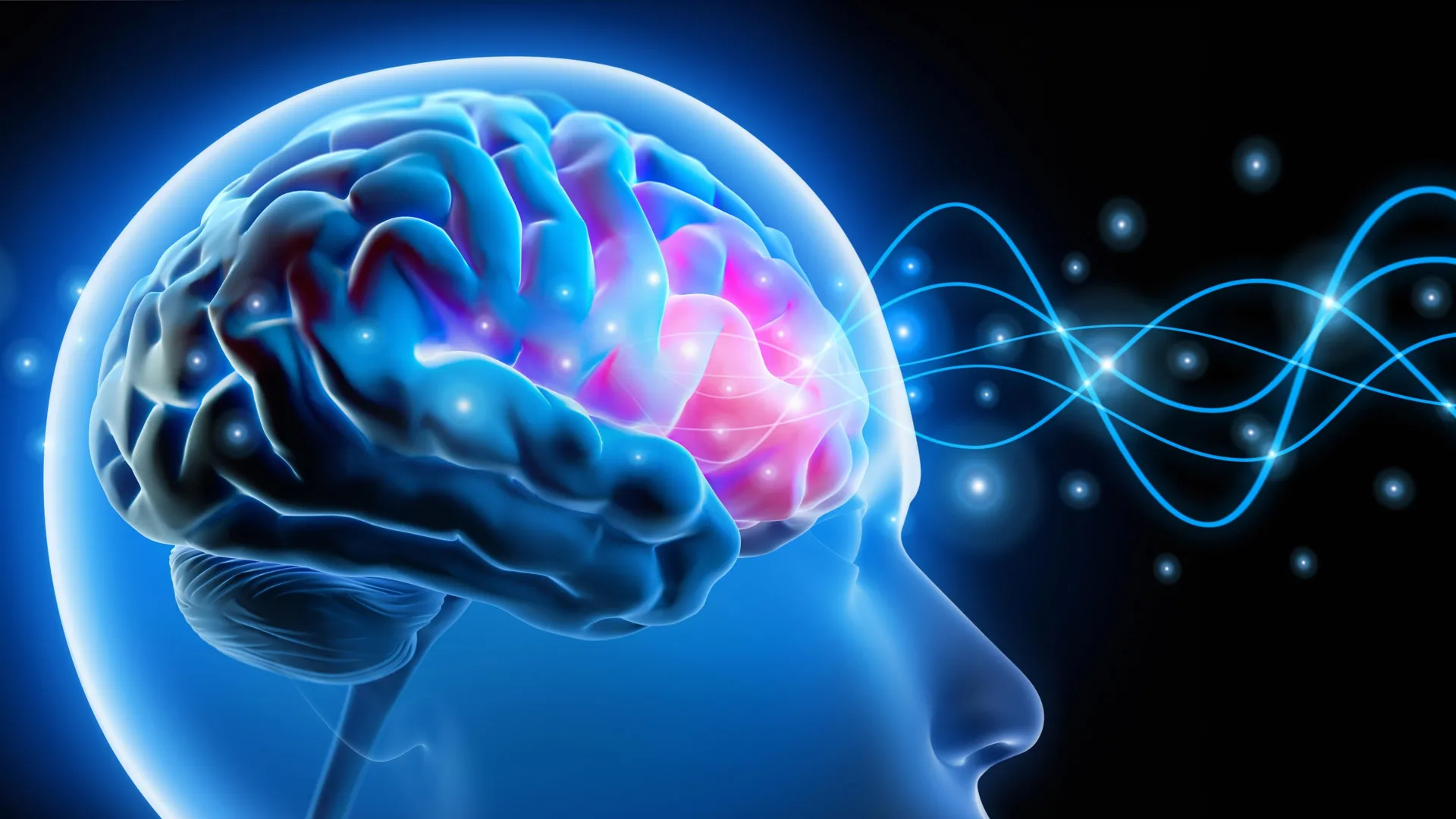
First, an electroencephalogram (EEG) records the brain’s electrical signals. That information is then used to create a personalized treatment plan involving transcranial magnetic stimulation (TMS).
During TMS, a coil placed on the scalp sends magnetic pulses to stimulate brain activity. TMS is already used to treat some other mental health conditions, including treatment-resistant depression.
MeRT differs from more standardized TMS protocols because it uses AI-assisted algorithms to customize stimulation based on each patient’s brain activity.
“Transcranial magnetic stimulation (TMS) was previously approved by the FDA for treatment-resistant depression,” Wong said. “By adding an enhanced AI-derived multivariate algorithm, we were able to customize an FDA-cleared protocol for post-traumatic stress disorder, which should open market access to the approximately 13 million people suffering from PTSD.”
Dr. Kenneth S. Ramos, a Texas A&M Health physician-scientist with extensive experience in precision medicine, helped lead the study. His research focuses on adapting medical care to individual patient characteristics rather than assuming that all patients will respond to the same treatment.
“Most clinical interventions to treat PTSD are not very successful,” Ramos said. “So this is a very large area where identifying interventions that have the potential to improve the quality of life for people affected by this disorder would have a huge impact.”
Wave Neuroscience CEO Fred Walke said Ramos’ expertise in personalized medicine made him a natural fit for the project.
Could Personalized TMS Treat PTSD More Precisely?
Traditional TMS generally follows a less individualized treatment protocol. MeRT is based on the same underlying technology but tailors the treatment to a patient’s specific brain activity.
Ramos emphasized that even small biological differences between people can have important medical implications. Humans are approximately 99.9% genetically similar, but the remaining 0.1% can contribute to individual differences and influence responses to treatment.
By taking these differences into account and tailoring magnetic stimulation to each patient’s brain, researchers observed a significant reduction in PTSD symptom severity.
Ramos compared the difference to repairing a leaking roof. He likened traditional TMS to covering the leak with a tarpaulin and managing its effects. MeRT, by contrast, aims to provide a more targeted solution comparable to identifying and replacing the damaged roof shingle causing the problem.
The broader goal is to move beyond standardized treatment protocols and develop interventions based on measurable biological information.
From FDA Breakthrough Device Designation to Clearance
The MeRT system received FDA Breakthrough Device Designation in 2024, an important milestone in its regulatory development.
Dr. Rick Silva, executive director of clinical trials at the Texas A&M Health Institute for Biosciences and Technology, explained that the designation can help promising technologies move more efficiently through regulatory review.
Breakthrough Device Designation does not remove scientific or medical requirements. Instead, it can streamline communication with the FDA and reduce administrative delays while maintaining the standards required for clearance.
Silva said the progress was particularly notable because the project began during the COVID-19 pandemic and moved through the regulatory process unusually quickly.
According to Silva, the development and clinical evaluation of medical devices can take up to 10 years before clearance or approval. The project completed the related processes in just over two years.
He credited the experience and dedication of the Wave Neuroscience team with helping make that accelerated progress possible.
“Over the years, I have been involved in probably close to 1,000 projects at academic medical centers of varying degrees of depth and detail,” Silva said. “The reason I do this work is for the patients. It’s difficult, the failure rate is high, and it’s hard work. But when you get to the point where something helps patients, it’s very rewarding professionally, and it’s rewarding personally in many ways.”
A Drug-Free Treatment Option for People With PTSD
Dr. Israel Liberzon, distinguished professor of psychiatry and behavioral sciences at the Texas A&M Naresh K. Vashisht School of Medicine, served as the study’s lead psychiatrist and PTSD expert.
He said the authorization could significantly expand the treatment options available to people with PTSD.
According to Liberzon, if MeRT is offered to patients as described, it would be the only FDA-cleared non-drug treatment specifically for PTSD.
“Currently, there are only two FDA-approved drugs to treat PTSD,” Liberzon said. “It doesn’t mean that only two of them will be used, but they’re both SSRIs. This is the first time there’s a non-drug option in addition to medication.”
Psychotherapy is also widely used to treat PTSD, but it requires patients to actively participate in treatment. Liberzon said that psychotherapy can be highly anxiety-provoking, leading some people to discontinue it.
In the clinical trial, participants received five treatment sessions each week for five to six weeks. Researchers reported that improvements appeared to persist after the treatment sessions ended, suggesting that the effects may continue beyond the period of active treatment. Further published data will be needed to clarify how long those benefits last.
For patients who experience medication side effects or have difficulty completing psychotherapy, personalized brain stimulation may provide another treatment option.
“People living with PTSD are left with trial-and-error treatments, medications and their side effects, and limited results, even when treated by the most dedicated and experienced physicians,” Wong said. “FDA approval of Wave signals a fundamentally different future, one in which PTSD can be objectively assessed, accurately treated, and meaningfully cured.”
Wong also said the technology could eventually be applied to other mental health conditions, including depression and anxiety.
Could Personalized Brain Therapy Change Mental Health Care?
Dr. Leslie S. Pritchep, Wave Neuroscience’s chief scientific officer, said the FDA clearance is an important step toward using objective measurements of brain function to guide mental health treatment.
“FDA’s clearance of the MeRT system reflects decades of scientific research using electrophysiological biomarkers in identifying aberrant brain activity profiles and guiding personalized intervention strategies,” Pritchep said. “We believe this is an important step forward toward a more objective, data-driven model of mental health care.”
Walke said clearer information about brain activity could also help change public attitudes toward mental illness. He compared the concept to treating a broken bone with a cast: showing measurable physical information may make mental health conditions easier to understand and could help reduce stigma.
“One of the company’s goals is to create a mental health care platform that uses objective images to help patients understand why they are experiencing life the way they are,” Walke said. “That insight, combined with proven technology, promises incredibly high effectiveness when personalized.”
The next challenge is making sure patients can access the treatment. Wave Neuroscience and Texas A&M Health are working with other stakeholders to expand availability and make the therapy more affordable through insurance coverage.
For researchers, the project represents years of work across medicine, neuroscience, clinical research and technology. The goal is to develop more effective, personalized and precise treatments for people affected by PTSD.
The opportunity to support veterans is especially important to Ramos because Texas A&M has a long history of involvement in military and veteran initiatives.
“Texas A&M has a very rich history of prioritizing military members and veterans,” Ramos said. “It makes sense that Texas A&M faculty would be interested in and support this initiative that hopes to bring positive solutions to a big problem. And anything we can do to alleviate that problem will go a long way toward making a difference not only in the lives of individuals, but also in the lives of those close to them. We at Texas A&M feel very fortunate to have been meaningfully involved in this project.”
Although the early findings are promising, patients should discuss PTSD treatment options with a qualified health professional. The full clinical trial results and additional independent research will be important for determining how MeRT compares with existing PTSD therapies.
Source: www.sciencedaily.com