


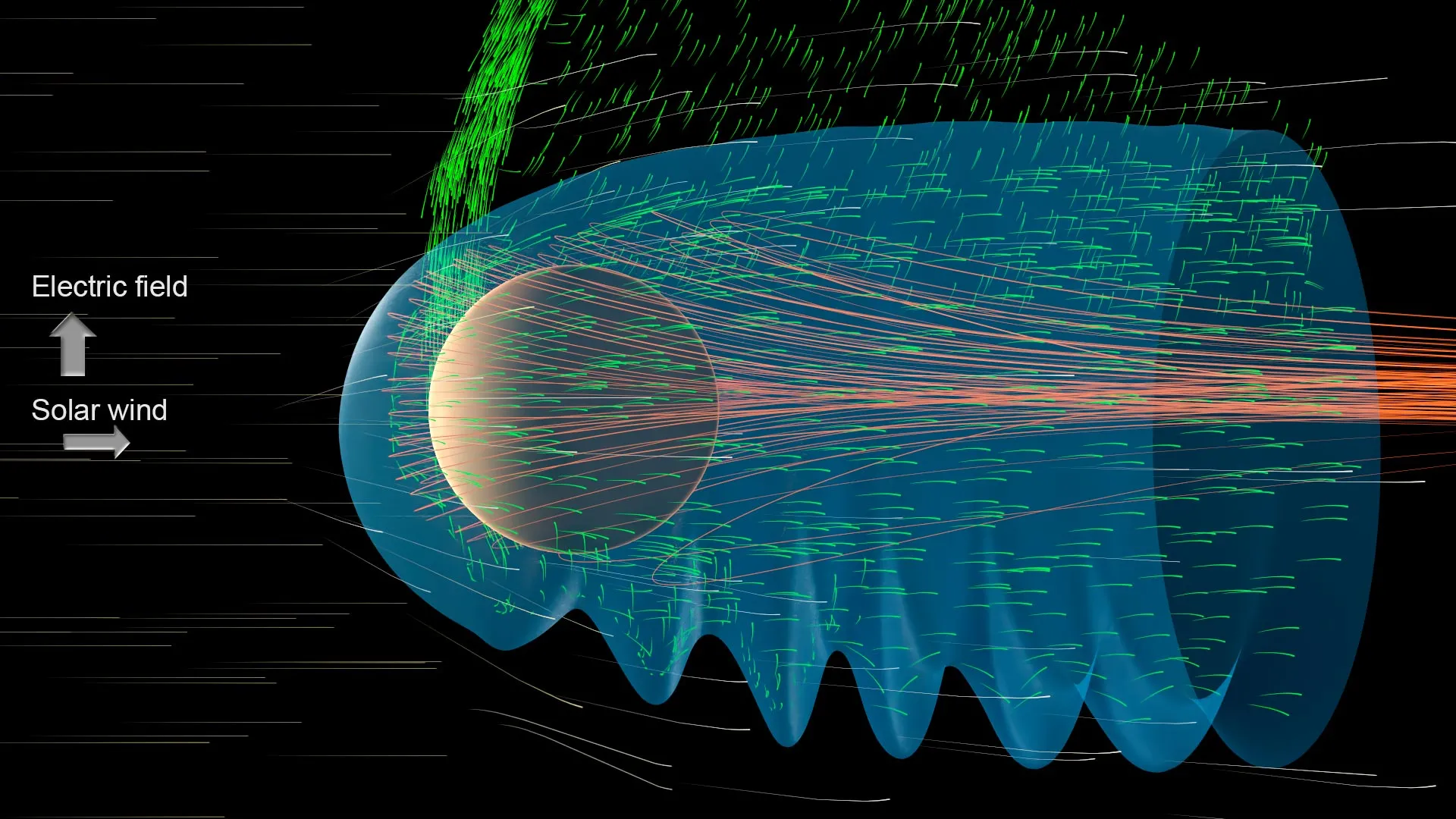
The solar wind is a continuous stream of charged particles released by the Sun and carried through space. Earth is protected from most of this flow by its global magnetic field, but Mars lacks a comparable planetary shield. As a result, the Martian upper atmosphere is directly exposed to the solar wind, which can strip atmospheric particles away and send them into space.
A new study led by Boston University and published in Science Advances suggests that atmospheric loss on Mars may occur in a way similar to wind moving across water. When wind blows over a body of water on Earth, it can create rolling waves and swirling vortices. At Mars, the solar wind appears to produce a comparable effect by stirring the outer edge of the planet’s upper atmosphere.
This interaction creates enormous boundary waves known as Kelvin-Helmholtz waves, which may play a major role in driving atmospheric escape from Mars.
First author Chi Zhang, a research scientist at Boston University’s Center for Space Physics, a collaboration between the University’s College of Arts & Sciences and College of Engineering, worked with colleagues to analyze observations from NASA’s MAVEN mission and China’s Tianwen-1 spacecraft. Tianwen-1 measured the solar wind before it reached Mars, while MAVEN tracked atmospheric ions escaping from the planet.
By combining these observations, the researchers directly compared changes in the incoming solar wind with the movement of Martian atmospheric particles into space.
Two Spacecraft Reveal How Mars Loses Its Atmosphere
Large clouds of plasma in the Martian upper atmosphere can cause what scientists describe as the “bulk escape” of atmospheric ions. Researchers had proposed several possible explanations for the formation of these clouds, but their origin remained uncertain because direct observational evidence was limited.
A major challenge was that one spacecraft could not simultaneously monitor the undisturbed solar wind upstream of Mars and measure atmospheric ions escaping closer to the planet.
In an earlier study published in Nature Communications, Zhang and his colleagues demonstrated that simultaneous observations from MAVEN and Tianwen-1 could link changes in the solar wind with conditions around Mars. The new Science Advances study builds on that research and identifies Kelvin-Helmholtz waves as an important mechanism behind the loss of atmospheric ions from Mars.
The researchers found strong evidence that these waves create the large plasma clouds associated with atmospheric escape. They also discovered that this process is not evenly distributed around the planet.
“Instead, it is mainly observed on one side of the planet, depending on the direction of the solar wind electric field,” said Zhang.
These findings establish a direct link between Kelvin-Helmholtz waves and enhanced atmospheric ion escape at Mars.
Measuring the Waves Stripping Mars’ Atmosphere
“Future research will focus on identifying the conditions that favor the formation and growth of Kelvin-Helmholtz waves and determining how much they contribute to atmospheric escape from Mars,” Zhang noted.
Answering these questions will require additional spacecraft observations and advanced computer simulations. NASA’s MAVEN mission is now approaching the closeout stage, but scientists expect future missions to continue investigating how the solar wind removes Mars’ atmosphere.
“Its rich scientific legacy will be complemented by NASA’s ESCAPADE mission, which has already launched and will provide an important new opportunity to investigate solar-wind-driven atmospheric loss at Mars,” said Zhang.
“We want to know when these waves are most likely to form, how they evolve, and how strongly they can drive atmospheric escape,” said Chuanfei Dong, a Boston University Center for Space Physics faculty member and a College of Arts & Sciences assistant professor of astronomy. “This process could also occur on other planets that lack a strong magnetic field, including some exoplanets.”
A Clue to Mars’ Lost Habitability
Understanding how Mars loses its atmosphere could help explain the planet’s dramatic transformation over billions of years.
“Mars is thought to have once been potentially habitable, with a thicker atmosphere and surface liquid water. Understanding how it became the cold, dry planet we see today is important for understanding how planetary environments evolve over time,” said Zhang.
Source: www.sciencedaily.com