


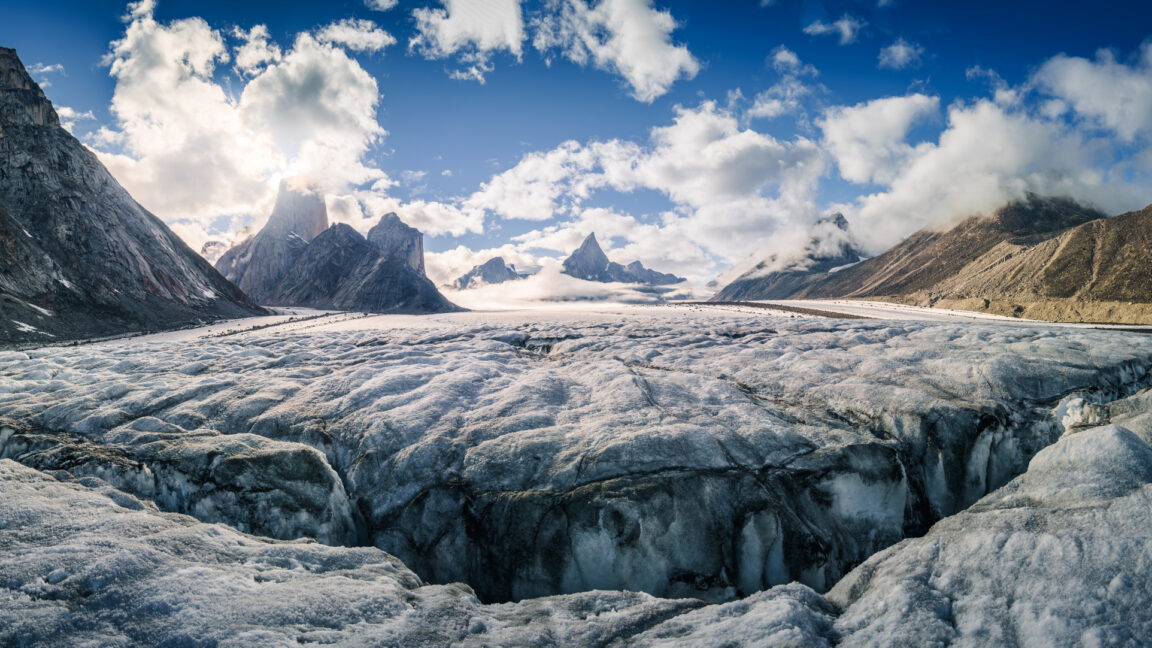
Researchers reconstructed how the Laurentide Ice Sheet retreated and later began advancing again by combining two kinds of evidence: beryllium-10 preserved in exposed rocks and radiocarbon dates from plants killed by advancing ice. Their results suggest that the ice had reached roughly its modern margin by 3,600 years ago, while the later advance began about 2,000 years ago and culminated around the peak of the Little Ice Age.
Rocks and plants
The first method measures beryllium-10, an isotope that accumulates in the top few centimeters of rocks exposed to the sky. By sampling the tops of boulders and measuring the amount of beryllium, researchers can determine how long the rocks have been exposed. This technique established when the ice sheet retreated. By 3,600 years ago, the Laurentide Ice Sheet had retreated to roughly today’s ice margin, potentially shrinking by about 3,000 more.
The second dating method examined dead plants. “There were a lot of plants growing there, just like there are today, including moss, which is a small moss with roots in the ground,” Young says. “They’re out there, living their lives, and eventually the Laurentide Ice Sheet starts to re-expand. And when that ice edge covers the moss, it literally kills the moss.”
By radiocarbon-dating the moss remains, the researchers could pinpoint when the plants died—a measurement glaciologists call the die-off date, or the moment the ice reached a particular location. The scientists reconstructed the ice edge’s advance by connecting multiple die-off dates from moss samples collected at different sites.
About 70 percent of the research team’s radiocarbon dates cluster around 1800 AD, the peak of the Little Ice Age. “It’s all kind of the same thing,” he says. The Little Ice Age was the period when glaciers in the Northern Hemisphere were most extensive in recent millennia. Young argues that, at Burns, it represented only a delayed pulse in a 2,000-year progression.
However, the most important plant evidence for Young’s team remains hidden beneath the ice. The Burns rim has receded by 200 to 800 meters since 1960, exposing moss that was killed after about 1000 AD. Anything older remains buried. To identify when the ice began advancing, the team therefore had to study neighboring ice caps.
Pinpointing the turn
Other, smaller ice sheets scattered across the same plateau are far enough apart to have experienced the same climate. Earlier research collected nearly 200 kill dates from beneath them, but none were older than 2,000 years.
“What this means is that all the ice caps out there didn’t start advancing or reinflating until about 2,000 years ago,” Young said. “The Barnes Ice Cap is right next door, so it’s probably safe to assume that it too started expanding 2,000 years ago.”
Source: arstechnica.com