


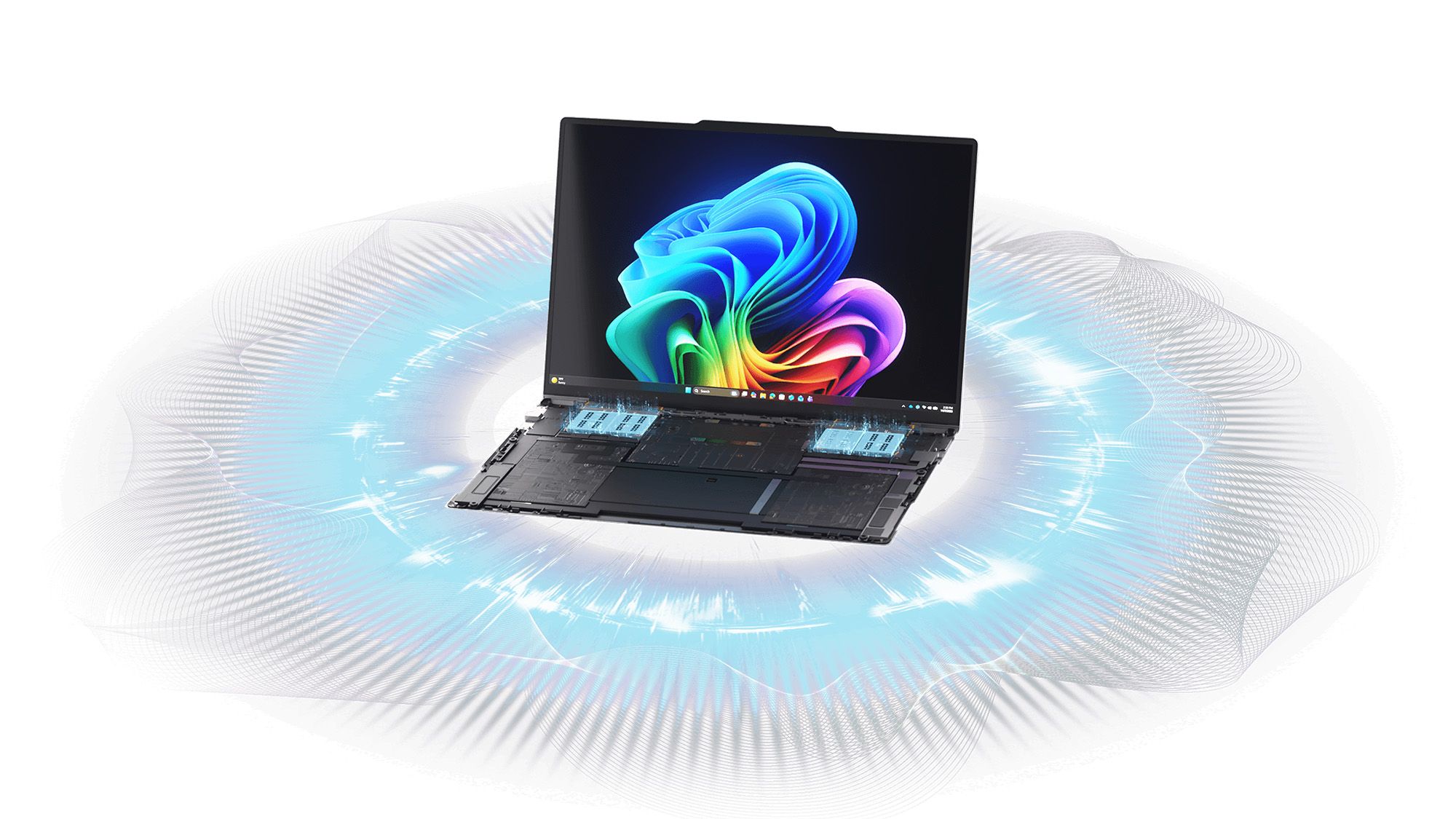
Lenovo’s AeroBlade Concept Laptop Uses Ultrasonic Air Jets Instead of Traditional Fans
Lenovo has unveiled a concept laptop that uses high-velocity air and solid-state cooling chips to cool its processor without conventional fans or bulky heatsinks.
The AeroBlade laptop uses four low-power AirJet Mini chips developed by Flore Systems. Each chip has no moving parts and uses an active cooling system designed to move heat away from the computer’s processor and graphics hardware.
How Lenovo’s fanless AeroBlade cooling system works
Each AirJet Mini chip contains a small membrane that vibrates at ultrasonic frequencies. The vibration creates approximately 2,000 Pascals of backpressure, forcing surrounding air through internal jets and into the laptop’s copper base layer at speeds of about 124 miles per hour (200 kilometers per hour).
The fast-moving air carries heat away from the central processing unit (CPU) and graphics processing unit (GPU) before being expelled through a small vent in the rear hinge.
Lenovo representatives announced the AeroBlade at Lenovo Innovation World ’26 on September 3 at IFA 2026, held in Berlin from September 4 to 8.
The Lenovo AeroBlade concept laptop is equipped with four AirJet Mini cooling chips.
Image credit: Lenovo and Flore Systems
A thinner, lighter concept laptop
The AeroBlade is equipped with a 14-inch (355.6-millimeter) OLED display. It is less than 0.39 inches (10 millimeters) thick and weighs just 1.8 pounds (830 grams).
Comparable laptops are about 0.51 inches (12 millimeters) thick at their thinnest point. Although laptops weighing around 1.8 pounds do exist, they are rare. The 1.76-pound (799-gram) Acer Swift Blade 14 is one example, while comparable 14-inch laptops are generally considered lightweight at between 2.2 and 2.86 pounds (1 and 1.3 kilograms).
The laptop’s compact design is possible because the AirJet Mini chips are intended to replace traditional cooling components. Each chip measures 1.63 by 1.06 by 0.1 inches (41.5 by 27 by 2.65 millimeters) and weighs just 0.02 pounds (9 grams).
Designed for cooler, quieter AI laptops
Lenovo and Flore Systems present the technology as a way to cool the next generation of high-end laptops built for on-device artificial intelligence (AI).
Most laptops marketed as “AI PCs” contain neural processing units (NPUs) that handle relatively simple AI tasks, such as manipulating or enhancing webcam video in real time. Future laptops could also run larger language models and AI agents locally, without an internet connection. The upcoming Nvidia RTX Spark Laptop series is one example of a system designed to tune AI agents locally.
Running AI models on a laptop can require substantial power, particularly when the workload is handled by a professional-grade GPU. Traditional laptop fans help remove the resulting heat but can be noisy. Passive heatsinks, such as those used in the MacBook Air and Microsoft Surface Pro, rely on metal plates near the heat source to absorb thermal energy. However, those systems can be more prone to throttling, in which software reduces performance to control temperatures.
How much heat can AirJet Mini remove?
AirJet Mini uses a high-speed jet mechanism to flush hot air out of the laptop. Flore Systems representatives said the device operates at 21 decibels at peak power—roughly equivalent to rustling leaves or a whisper—and can remove 7.5 watts of heat.
Four AirJet Mini chips can therefore remove 30 watts of heat, which is consistent with the heat output of traditional laptop fans, although cooling performance varies between models.
The AeroBlade’s 2,000 Pascals of backpressure is approximately 10 times higher than that of regular laptop fans, which typically produce between 100 and 200 Pascals.
When will fanless AirJet laptops be available?
The underlying AirJet cooling technology was first announced in December 2022. The chip was previously used in the ZOTAC ZBOX PI430AJ Pico Mini PC.
However, no commercially available tablets or laptops currently use the chip. The Lenovo AeroBlade remains a concept model, and there is no word yet on when production-ready laptops with this cooling technology will arrive.
Source: www.livescience.com