


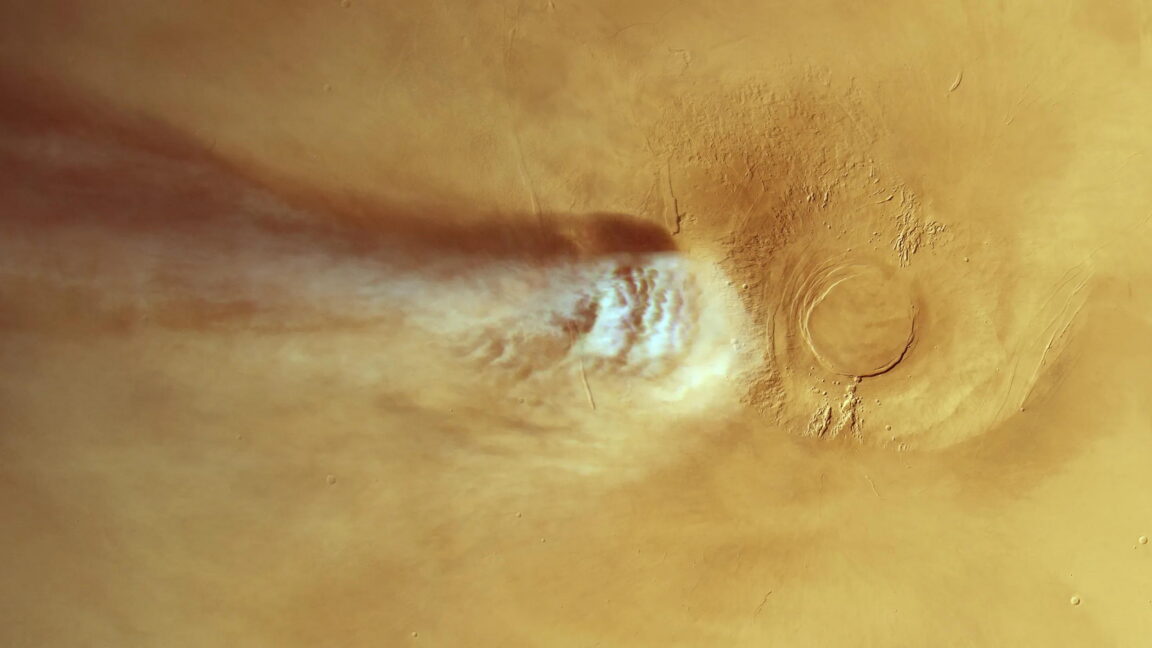
A mysterious cloud over Mars may be forming through a process unlike ordinary cloud formation on Earth, according to new research published in Nature Geoscience. The findings suggest that the cloud, known as AMEC, could form through homogeneous nucleation, in which water vapor transforms directly into ice crystals without the aid of dust or other particles.
An unexpected way to form clouds
On Earth, clouds typically form when water vapor condenses into droplets or ice crystals around small particles such as dust or salt. AMEC, however, may form without those particles.
“This is similar to condensation droplets appearing in the center of the room instead of on the window,” Hernandez Bernal explained. “It’s totally unexpected.”
The process requires extreme conditions, including a sudden temperature drop of 30 degrees Celsius within 10 minutes and very high relative humidity. Mount Arsia, a 65,000-foot-tall volcano, also plays an important role. When wind strikes the volcano, it creates a powerful wave that launches moist air into the atmosphere within minutes.
Extreme humidity on Mars
Scientists had assumed that similar phenomena could occur in the upper atmospheres of other planets, including Venus and Earth, but they had never been observed. That is not particularly surprising given the extreme humidity required—more than 100,000 times higher than the levels measured on Earth.
Before this modeling, such humidity levels were not known to exist on Mars, either. “We don’t have much information about the Martian atmosphere,” Hernandez Bernal said. “It’s a great success that we were able to recreate AMEC to this degree, just as we did on Earth.” He added, “The results were amazing.”
This story was originally published by WIRED Czech Republic and Slovakia. Translated from Czech.
Source: arstechnica.com