


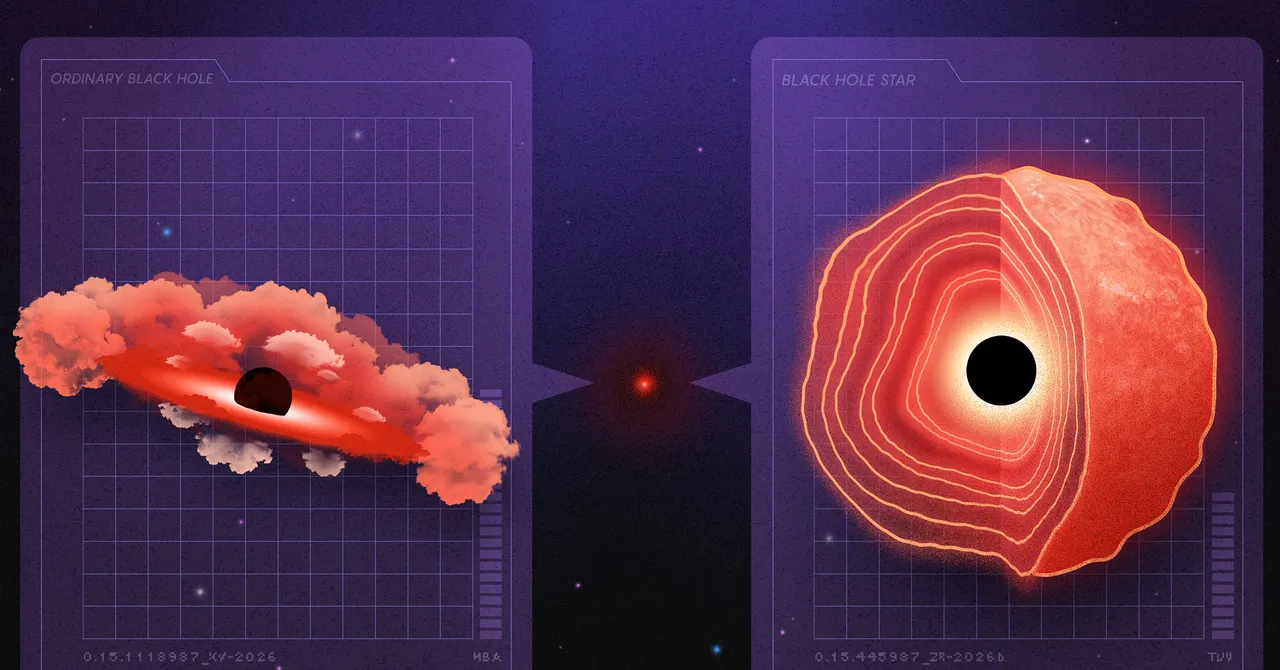
Astronomers remain divided over what the small red dots observed in the early universe actually are. Some argue that they are ordinary supermassive black holes, while others suspect a more unusual black hole-star interpretation. At a conference in Aspen, Colorado, in April 2026, even a discussion of trace amounts of blue light became contentious, illustrating how little consensus exists about these objects.
Dale Kosefsky, an astrophysicist at Colby College, recalled leading that discussion. He began by outlining what he hoped would become an uncontroversial idea about the blue light. “An argument broke out in the group and we couldn’t even get past the first bullet point,” he said.
Many astronomers still argue that the little red dot—and the two newly identified dots—are traditional black holes. “The data are really convincing,” says Roberto Maiorino of the University of Cambridge. “I have some doubts about the interpretation.”
Maiorino offers a rebuttal for each piece of evidence cited in favor of the alternative explanation. The objects do not appear to flicker, but black holes in the early universe may have had a more stable supply of material to consume, and therefore a steadier diet. The apparent lack of X-rays may also have a conventional explanation: a standard galactic black hole is surrounded by a thick doughnut-shaped region of gas and dust that can block most X-rays. Maiorino sees no reason to conclude that the tiny red dot is anything other than a standard supermassive black hole.
He acknowledges that the objects’ red color is striking and indicates that a large amount of gas lies between the black hole and Earth. But that gas could be arranged as a doughnut or as a diffuse cloud covering part of the black hole’s apparent sky, rather than as a shell surrounding the black hole’s star. Maiorino also agrees that electron scattering probably broadens spectral lines in some of the small red dots. However, electron scattering can also affect hydrogen lines from supermassive black holes.
Maiorino and his colleague Piero Madau of the University of California, Santa Cruz, argue that the dots’ redness is primarily a result of viewing angle. The reddest dot, they suggest, may simply be one seen from the side, with a gaseous doughnut blocking the view. Webb has also observed a “little blue dot.” According to their interpretation, these could be the same exposed black holes viewed from above, as outlined in spring 2026. They also invoke Occam’s razor, arguing that black holes can readily explain tiny dots of any color.
For now, either the black hole theory or the black hole-star theory could match what the Webb telescope observed. “I don’t think there’s any compelling reason to favor one over the other,” said Mauro Javarisco, an astronomer at the University of Massachusetts Amherst. Javarisco has spent much of his career interpreting the spectra of distant galaxies.
To distinguish between the interpretations, astronomers need a clearer understanding of how black hole stars form and what, exactly, they should look like.
Source: www.wired.com