


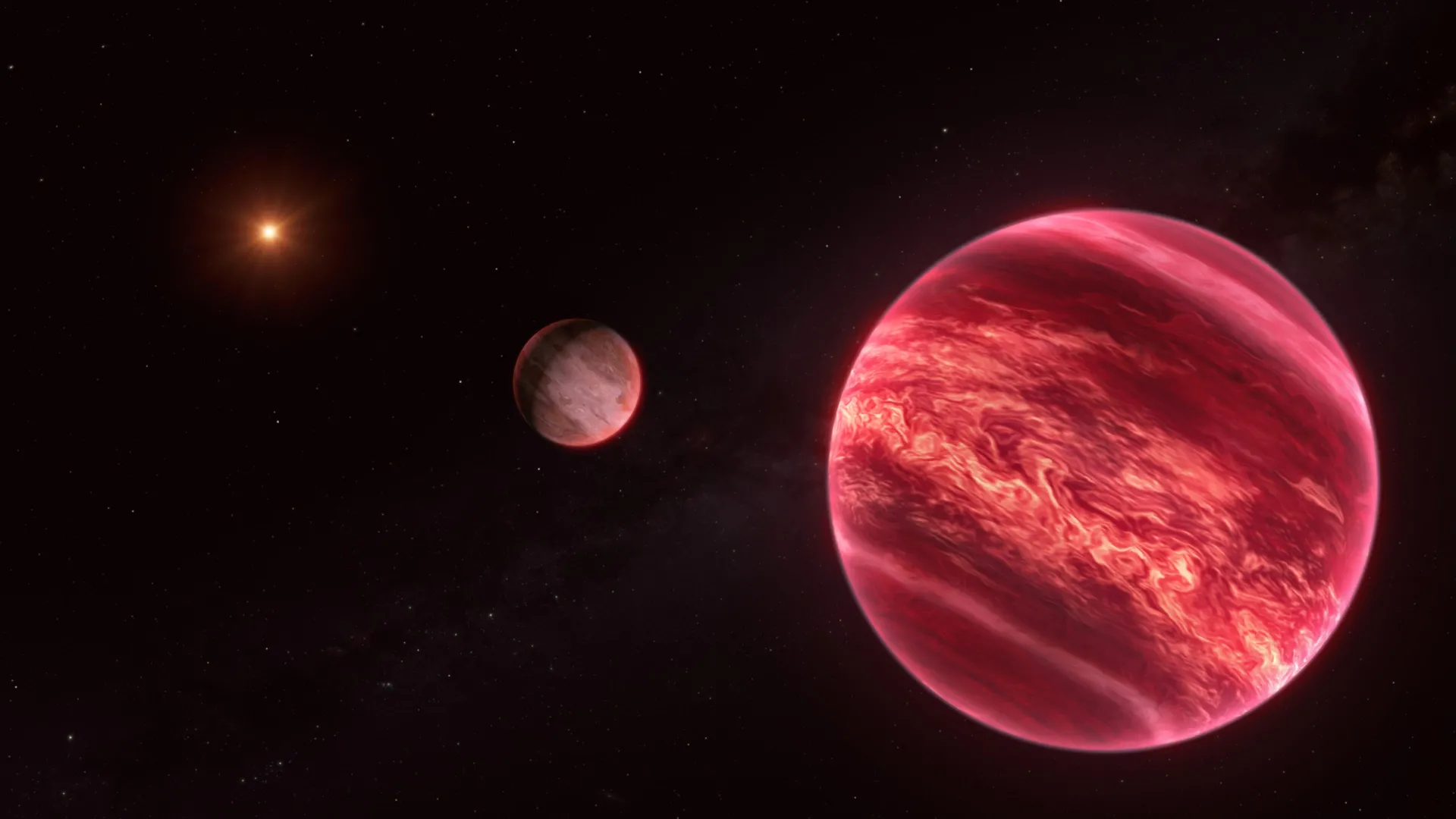
Astronomers may have found the first moon beyond the Solar System, although the candidate is unlike any natural satellite known to us. Observations made with the European Southern Observatory’s Very Large Telescope (ESO’s VLT) have revealed evidence of a giant moon-like object in the CD-35 2722 system. Rather than orbiting a planet, the object appears to orbit a brown dwarf—an object more massive than a planet but not massive enough to become a star.
If confirmed, the discovery would mark the first detection of a natural satellite outside our Solar System and could force astronomers to reconsider how they define moons and planets.
A star system unlike our own
Kevin Hoy, an ESO student based in Chile and lead author of the study published in Nature, spent several months investigating the CD-35 2722 system. He describes its configuration as “very strange” compared with the Solar System.
At the center of the relatively young system is CD-35 2722, a star with about half the mass of the Sun. A brown dwarf orbits the star. Brown dwarfs occupy an uncertain boundary between planets and stars: they are generally too small to sustain the hydrogen fusion that powers ordinary stars, but they are more massive than planets.
The newly identified object appears to orbit the brown dwarf, creating an unusual arrangement in which a giant satellite circles an object that itself orbits a star.
“This system is a little difficult to define using Solar System-based terms like ‘planet’ or ‘moon,’” says Hoy, who is also affiliated with Universidad Diego Portales in Chile and the Millennium Nucleus of Young Exoplanets and Moons (YEMS).
Researchers refer to the candidate as an exosatellite. It has at least the mass of Jupiter, while the brown dwarf it orbits has more than 30 times Jupiter’s mass. If confirmed as a moon, it would therefore be much more massive than any natural satellite in our Solar System.
“An exomoon clearly has enough mass to be a planet, but it orbits an object that orbits a star, but it doesn’t orbit the star,” Hoy says. “Even though it’s nothing like the little rocky moon in our system, being the third wheel of our system makes us want to call it a moon.”
A giant exomoon challenges familiar definitions
The potential discovery highlights the difficulty of applying familiar astronomical labels to objects in distant systems.
An exosatellite is a natural satellite located outside the Solar System. The term exomoon generally refers to a natural satellite orbiting a planet or another celestial body outside the Solar System, but astronomers have not established a universally accepted definition.
That distinction is especially important in the CD-35 2722 system. The candidate itself may be massive enough to qualify as a planet under some classification systems, even though it appears to orbit a brown dwarf rather than the star.
Alice Zurlo, director of YEMS and a research collaborator, explains: “The satellite we are reporting is a giant gas body orbiting a very massive companion star with a mass several times that of Jupiter.”
The arrangement differs sharply from the familiar structure of our Solar System, where planets orbit the Sun and moons orbit planets.
“It’s easy to define something like a satellite because there are clear boundaries between the planets and the Sun in our Solar System. In the CD-35 2722 system, the boundaries between stars, planets and moons blur, making it even more complicated to describe the whole,” added Zurlo, who is also an astrophysicist at Universidad Diego Portales.
The search for the first confirmed exomoon
Astronomers have spent years searching for moons around objects outside our Solar System, but no candidate has yet been detected with enough certainty to establish a confirmed discovery.
The latest findings are therefore significant. Scientists have identified more than 6,000 exoplanets, but only a small number of possible exomoons have emerged from observations, and the evidence for them remains limited.
In early 2026, a research team led by Quentin Krall reported possible signs of a satellite in the HD 206893 system. Observations made with ESO’s Very Large Telescope Interferometer suggested the presence of a moon-like companion, but they did not establish a definitive detection.
The CD-35 2722 system provides another promising opportunity. The evidence comes from measurements of how the suspected moon affects the motion of its larger companion, the brown dwarf.
How the possible moon was detected
To study CD-35 2722, Hoy, Zurlo and their colleagues used the CRIRES+ instrument on ESO’s Very Large Telescope.
The team applied the radial velocity method, which was also used to discover the first exoplanet orbiting a Sun-like star.
The method measures very small changes in an object’s motion. When two celestial bodies orbit one another, their mutual gravity causes both to move around a common center of gravity. Even a much smaller companion can produce a detectable wobble in the motion of a larger object.
By examining subtle changes in the brown dwarf’s motion, the researchers identified what they believe is strong evidence that another massive object is orbiting it.
“Although exotic, this system is truly unique and a breakthrough. This is the first detection of a potential suborbital satellite,” Zurlo said.
A new era of satellite exploration
Confirming satellites outside the Solar System would do more than add another category of objects to astronomical catalogues. Such discoveries could help researchers understand how planetary systems form, how their components interact and why some systems develop structures that differ so dramatically from our own.
Future observations may show whether giant moons such as the candidate in CD-35 2722 are rare exceptions or part of a broader population of unusual objects.
ESO’s upcoming Extremely Large Telescope (ELT) is expected to play an important role in that search. It will be equipped with a 39-metre mirror and advanced scientific instruments designed to detect small exomoons that are beyond the reach of current observatories.
As scientists identify more moons in distant planetary systems, they may find that the distinctions between stars, planets and moons are less universal than previously assumed.
What is an exomoon?
A satellite is an object that moves around another object. Satellites can be natural, such as Earth’s Moon, or artificial, such as spacecraft.
An exosatellite is a satellite located outside the Solar System. Although astronomers have not agreed on a formal definition, the term exomoon generally refers to a natural satellite orbiting a planet or another celestial body beyond our Solar System.
The possible companion to CD-35 2722 illustrates why the definition matters. It has a mass equal to or greater than Jupiter and is planet-like in size and composition, but its orbit around a brown dwarf makes its classification uncertain.
Source: www.sciencedaily.com