


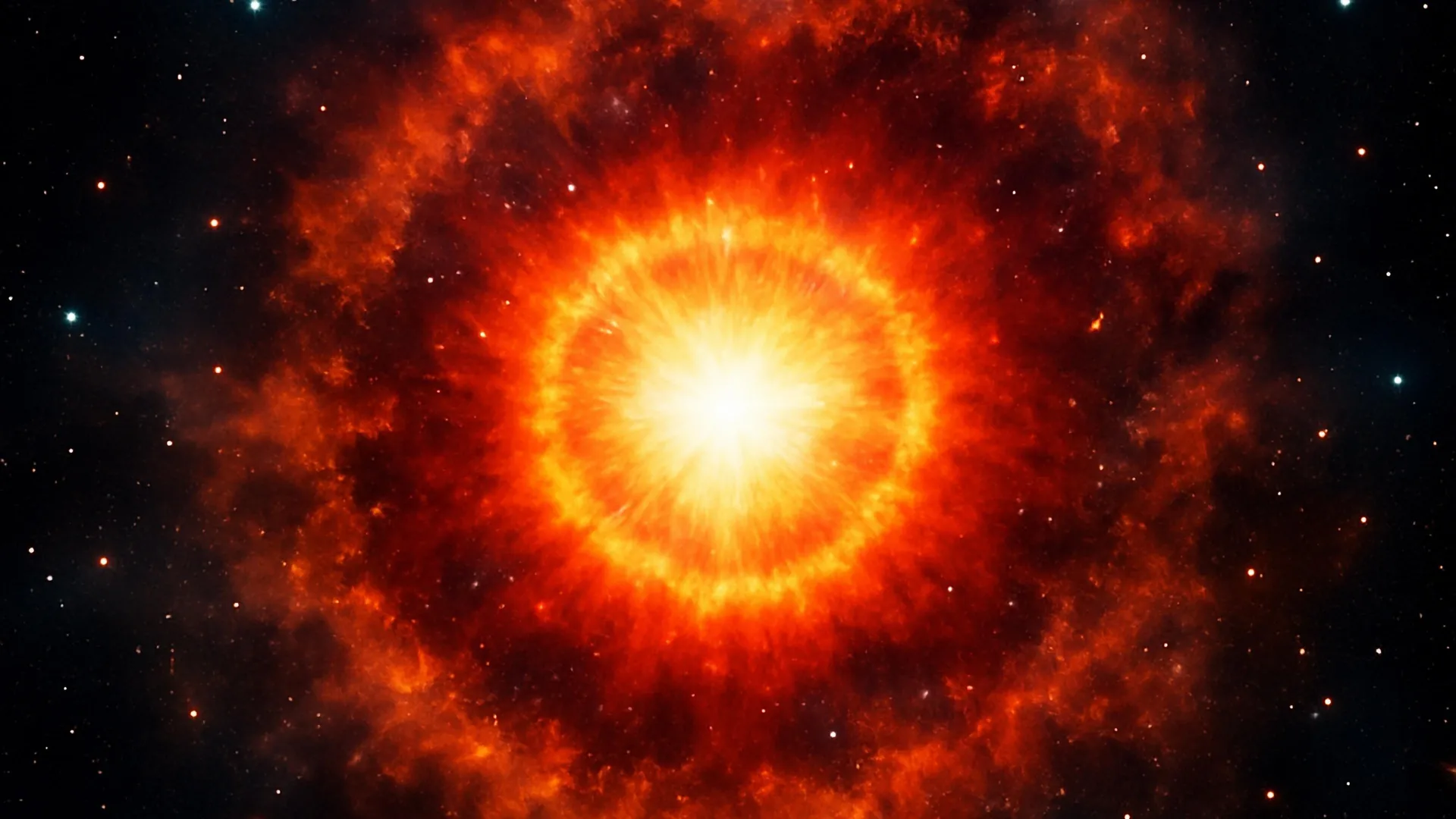
Primordial black holes may cause white dwarf stars to explode as Type Ia supernovae, according to a new study. These rare cosmic explosions could also help explain unusual chemical abundance patterns found in stars throughout the Milky Way. The research was recently published in The Astrophysical Journal.
Primordial black holes (PBHs) are hypothetical black holes that may have formed during the earliest moments of the universe. Researchers propose that they could have emerged during cosmic inflation, a period of rapid expansion that amplified tiny variations in the distribution of matter.
Because primordial black holes could account for some or all of dark matter, they remain a major focus of modern astrophysics. Dark matter cannot be observed directly, but its gravitational influence can be detected in galaxies and across the universe.
As PBHs travel through space, some could pass through white dwarf stars. Previous research suggested that the black hole’s intense gravity might generate powerful tidal forces inside the star. These forces could destabilize the white dwarf and trigger a Type Ia supernova.
A white dwarf is the extremely dense remnant left behind when a low-mass star exhausts its nuclear fuel. Type Ia supernovae are exceptionally bright stellar explosions that typically occur when a white dwarf becomes unstable and undergoes a runaway thermonuclear reaction.
Investigating a New Type Ia Supernova Mechanism
The study was led by Shing-Chi Leung, an assistant professor at SUNY Polytechnic Institute and a visiting associate scientist at The University of Tokyo Kavli Institute for the Physics and Mathematics of the Universe (Kavli IPMU). The research team also included Kavli IPMU Visiting Senior Scientist Ken’ichi Nomoto and Kavli IPMU Senior Fellow Alexander Kusenko.
The researchers analyzed the motion, brightness, and chemical composition expected from supernovae produced when primordial black holes trigger white dwarf explosions.
In a previous study published in 2025, the team found that PBH-triggered explosions could produce Type Ia supernovae with characteristics similar to those predicted by conventional supernova models.
Comparing Primordial Black Hole Models With Observations
In the latest research, the scientists compared their models with several well-known supernova remnants, including Tycho, Kepler, and 3C 397. They also examined nearby supernovae such as SN 2011fe and SN 2012cg, along with chemical abundance data from stars in the Milky Way.
The results showed that primordial black hole-triggered Type Ia supernovae could reproduce several features observed in these explosions and their remnants.
The team studied radioactive isotopes, including Ni-56 and Ni-57, as well as stable elements such as manganese and nickel. These chemical signatures helped the researchers estimate the original stars’ masses and metallicities.
Metallicity refers to the abundance of elements heavier than hydrogen and helium in a star. Because metallicity changes over cosmic time, it can provide clues about when a star formed and the chemical environment present during its birth.
Primordial Black Holes Could Influence the Milky Way’s Chemical Evolution
The researchers also used their supernova models to investigate how PBH-triggered explosions might contribute to galactic chemical enrichment. Supernovae scatter newly formed elements into space, where they can later become part of new stars, planets, and other cosmic objects.
The analysis suggests that a measurable fraction of Type Ia supernovae may be triggered by primordial black holes. Including this channel could help explain chemical abundance trends observed in stars across the Milky Way, indicating that PBHs may have played a role in the galaxy’s chemical evolution.
“Our work suggests that some supernova that we observe in the sky could be a result of the PBHs. Therefore, even though we cannot directly observe these evasive entities, they leave many interesting clues in nature for us to probe their properties,” Leung said.
The researchers plan to expand the study by examining how primordial black hole-triggered explosions could affect the overall population of conventional supernovae. They also aim to estimate the combined rate of these brief but powerful cosmic events.
Source: www.sciencedaily.com