


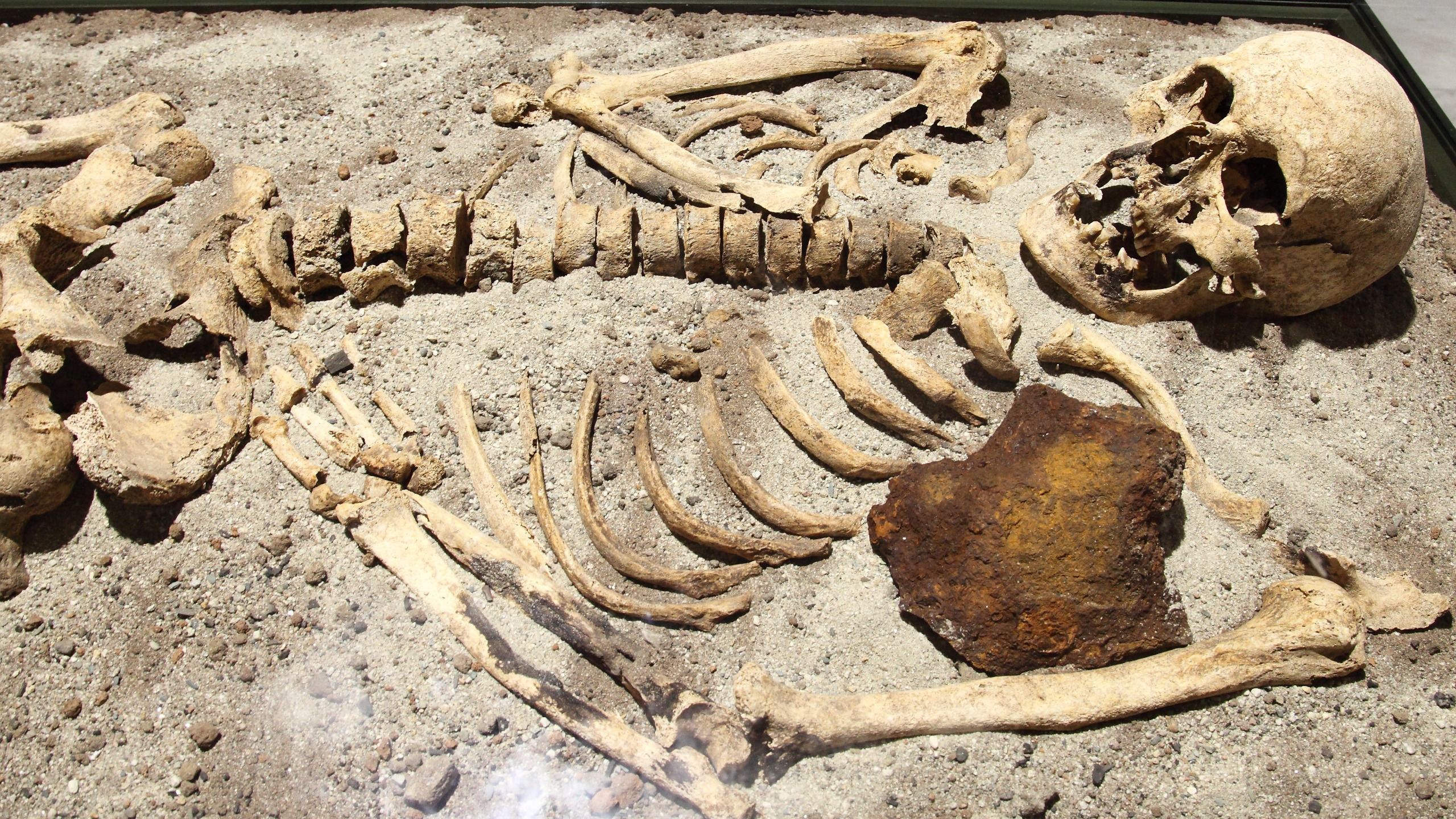
In the 17th and 18th centuries, fear of vampires led communities across Europe to take extreme measures against suspected “restless” corpses, including decapitation, burial face down and the use of iron restraints. In Killing the Dead: The Vampire Epidemic from Mesopotamia to the New World (Princeton University Press, 2025), historian John Blair examines how printing helped spread vampire lore and how stories about consuming blood, organs or ashes from suspected vampire corpses may have been copied, reshaped and misunderstood.
One example comes from Poland, where archaeologists found the body of a young boy buried with an iron padlock attached to his leg. Such measures reflected a widespread belief that the dead could return to terrorize villages and spread disease. Some corpses were decapitated, some were buried face down, and others were restrained with sickles, padlocks or other objects intended to prevent them from rising.
Printing transformed vampire folklore
The invention of printing greatly accelerated the circulation of European stories about restless corpses. Occasional references to such beings were followed by theological and philosophical discussions from around 1580 to 1610, and then by a steady increase in printed scholarly and historical commentary from the 1670s onward. This process reached a high point in 1732.
Another important milestone came in 1746, when the Benedictine scholar Dom Augustin Calmet published his Inquiry into Supernatural Beings. The book was reprinted in several editions, including an English version in 1759. Its section on vampires became the most influential scholarly work on the subject, offering a comparatively straightforward, evidence-based approach after a long succession of increasingly derivative accounts.
Calmet’s work appeared at a moment when readers were encountering fragmented and repetitive discussions of “vampires,” a relatively new word at the time, and were seeking books that gathered such material together. His work inspired numerous followers and popularizers. One example was an 1820 notebook that repackaged Calmet’s ideas for a mass audience as a history of vampires and other malevolent supernatural beings.
Calmet’s books helped shape much of the later vampire literature of Europe and America, both fictional and purportedly historical. Printing fixed stories on the page and carried them to a much wider audience. But the printed versions remained stories rather than necessarily reliable records, and each retelling could alter the material it transmitted.
The alleged cure: consuming the dead
The complicated history of consuming blood from vampire corpses begins in an unexpected place. Alongside beliefs about undead bodies, some accounts describe people ingesting blood or organs from suspected vampires—or consuming the ashes of burned corpses—as a treatment for illnesses blamed on them.
The idea was not entirely without precedent. An 11th-century belief recorded in England held that a victim might recover by watching smoke rise from the burning organs of a vampire. What made the later accounts especially disturbing was their alleged physical practice: collecting material from a corpse and eating it or using it as a poultice.
One complication is that early modern medicine already included the use of human blood and body parts. These practices were associated with the theories of “Paracelsus,” the name used by the physician, philosopher and alchemist Theophrastus von Hohenheim (c. 1493–1541). Paracelsus believed that matter could heal through occult influences or “spirits,” and that substances taken from the human body might be especially powerful against illnesses affecting that body.
Modern medicine rejects these ideas, but people in the past did not necessarily regard them as more irrational than other medical treatments. Materials collected from Egyptian mummies, for example, were used medicinally, as was the blood of executed criminals. During public beheadings in Vienna in 1668 and 1669, men reportedly rushed forward to catch blood in the belief that it could cure epilepsy.
From Angola to Poland
In 1687, the Capuchin missionary Giovanni Antonio Cavazzi published a major ethnographic account of parts of West Africa in Bologna. Cavazzi described magical and medical practices among the Mbundu people of Angola, including a method for obtaining therapeutic fluids from corpses that had not decomposed.
“It is said that, if fresh and intact at the time of excavation, the head is separated from the body, from which blood flows (this may occur through some illusion or deception). If you collect it and make it into a poultice for the sick or mix it with food, health will definitely be guaranteed. After that, the dead lose their power and can no longer torment them.”
Six years later, in May 1693, a related account appeared in the French society magazine Mercure Galant. Its author, Pierre des Noyers (1607–1693), was a courtier and polymath who had spent several years in Poland as an aide to Queen Louise Marie.
In a letter written as early as 1639, Des Noyers described a being called an Upir in Ruthenian or a Striga in Polish. According to the account, the creature was born with teeth, ate through its burial shroud and then consumed its hands and arms, causing a series of deaths within a family. It could supposedly be stopped by cutting off its head and releasing the blood that had accumulated inside it.
The story is vivid, particularly its description of a corpse eating its own hands and arms, but it may have originated in genuine oral reports about people chewing on a burial shroud.
Des Noyers’ 1693 account was different. It claimed that the devil extracted blood from living people and animals and stored it inside a corpse, leaving the body between noon and midnight before returning with more blood. The corpse was said to bleed from its mouth, nose and ears, and to torment the deceased person’s former colleagues and relatives until the entire family died.
The supposed cure was to exhume a corpse that appeared soft, swollen, red and flexible, cut off its head, open its heart and collect the blood. The blood was then mixed with flour and baked into bread. In the account, this was described as a “surefire cure” that would prevent further suffering.
A copied story becomes vampire folklore
There are serious problems with Des Noyers’ story. The notion that demons used corpses as blood stores appears to be unique, and the details about the hours between noon and midnight read like clerical additions. Blair suggests that a Polish priest may have supplied Des Noyers with an explanation that was imposed on older and more authentic observations.
More fundamentally, Des Noyers’ account of Poland closely reworks Cavazzi’s description of Angola, which had been published eight years earlier. An earlier common source cannot be entirely ruled out, but the possibility remains unconfirmed. The similarity between the blood mixed with food or used in poultices and Paracelsian medical ideas also raises the possibility that Cavazzi’s account was shaped by his own medical assumptions.
Whatever its origin, Des Noyers’ version appears to have little value as evidence of Polish folk beliefs. It was nevertheless copied and repeated throughout the vampire literature. The following year, a lawyer named Marigner accepted the story and expanded it with a lengthy philosophical discussion of vampires. In 1746, the account was republished in Calmet’s work, making it permanently available to readers familiar with vampire lore.
Calmet retained much of Des Noyers’ account but altered its terminology. Rather than presenting the attacker simply as a demon inhabiting a corpse, he described it as a “vampire, or a demon in the form of a vampire.” Later retellings removed the demonic element altogether and presented the story as a straightforward ethnographic report.
The 1713 trial
The story might seem to be mainly a lesson in plagiarism and uncritical copying. But in 1713, villagers in Dombrovka, in present-day western Ukraine, were tried before the United Episcopal Tribunal after digging up the bodies of women and dismembering them.
The villagers admitted exhuming a woman because they believed she was walking around and attacking people. They also admitted drinking blood from the corpse after mixing it with vodka. They denied cutting out the heart, mixing the blood with flour and baking cakes from it, but the judge was skeptical and made them swear under oath.
The case resembles early modern witch trials, in which suspects were often pressured into confessing to elaborate fantasies created by their persecutors. Blair argues that at least some of the details about mixing blood into food may have been suggested by the judge. The same may be true of the alleged blood-drinking, even if the defendants eventually confessed to it.
It is possible, though not likely, that an ordinary case of corpse desecration was embellished with fictional details by judges who knew Des Noyers’ account from two decades earlier. The trial therefore illustrates how printed stories could move into legal proceedings, where they could be transformed again into apparent evidence of vampire beliefs.
Killing the Dead: Vampire Epidemics from Mesopotamia to the New World. Copyright © 2025 by John Blair, published by Princeton University Press, reproduced here with permission.
Source: www.livescience.com