


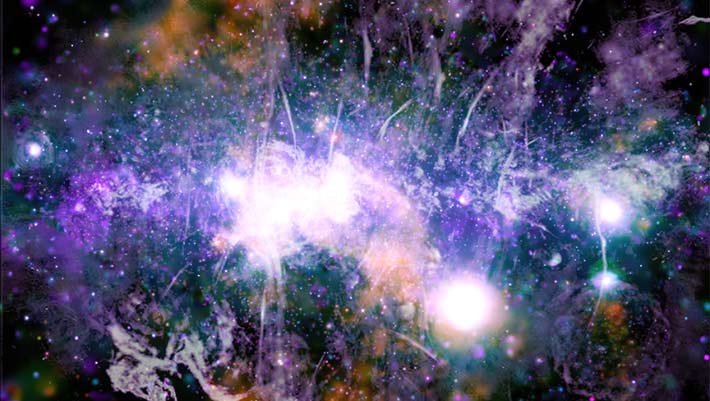
New observations from NASA/ESA/CSA’s James Webb Space Telescope suggest that the enrichment of the Galactic Center with metals—elements heavier than hydrogen and helium, including carbon, oxygen, iron and gold—likely reflects contributions from generations of exploding stars. The data also provide a detailed view of gas orbiting Sagittarius A*, the supermassive black hole at the center of the Milky Way, while separate research finds that local conditions make it difficult to determine whether the gas preserves evidence of past black-hole outbursts.
JWST examines gas near Sagittarius A*
“We know that there is a black hole at the center of our galaxy (Sagittarius A*) that is drawing matter into itself, but we know that it is eating far less material and much more slowly than other supermassive black holes,” said McGill University student Nicole Ford, first author of the study published in The Astronomical Journal.
“To understand why this is happening, we need to examine the properties of the materials that can be consumed, such as gas, dust, and the stars we orbit.”
For the study, Ford and her colleagues analyzed data from NASA/ESA/CSA’s James Webb Space Telescope. JWST measures infrared light across a wide range of wavelengths with unprecedented spectral and spatial resolution.
That capability allowed the researchers to distinguish the thermal signatures of multiple gas clouds orbiting near Sagittarius A*. They could also measure the metallic composition of each cloud with greater precision.
Local conditions complicate the search for past outbursts
In a separate study published in The Astrophysical Journal, McGill University astronomer Mayura Balakrishnan and her colleagues searched the gas for signs of past energy bursts from black holes.
They found that local conditions influence the gas so strongly that isolating the black hole’s effects is difficult. This does not rule out the possibility that Sagittarius A* experienced past explosions, but it means the gas cannot serve as a reliable record of the black hole’s history.
“To understand how black holes attract matter, we need to compare these observations with simulations of how gas evolves over longer timescales,” Ford said.
Research references
Nicole M. Ford et al. 2026. “Ionization structure and metal enrichment of the galactic center mini-spiral observed by JWST.” The Astronomical Journal 172, 267. doi: 10.3847/1538-3881/ae994d.
Mayura Balakrishnan et al. 2026. “Isolation of Sgr A East: The first uncontaminated X-ray map of a supernova remnant at the center of the galaxy.” The Astrophysical Journal 1003, 128. doi: 10.3847/1538-4357/ae5dbe.
Source: www.sci.news