


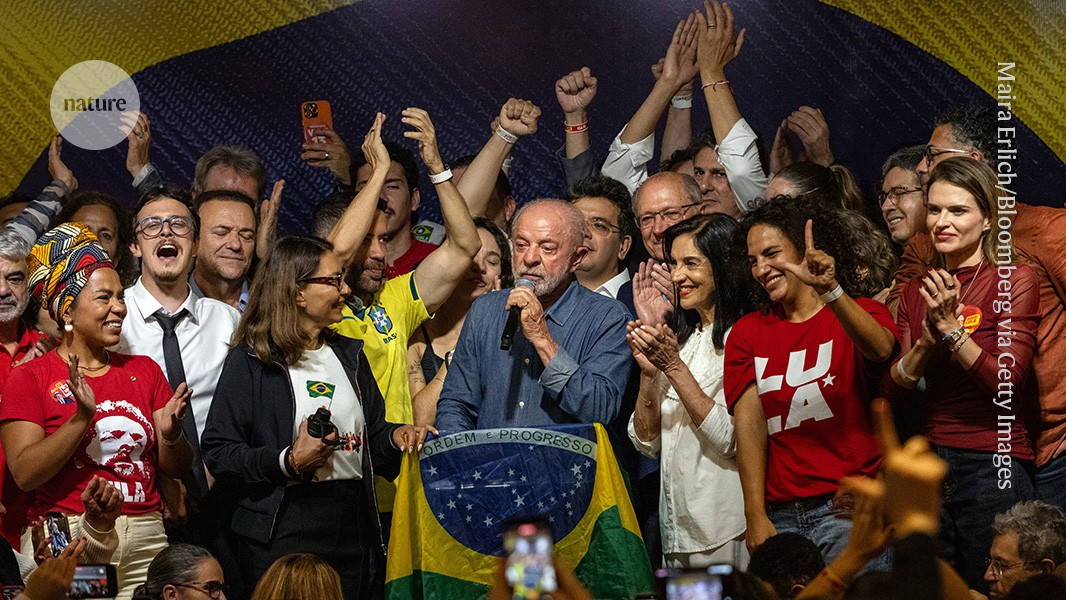
Brazilian President Luiz Inácio Lula da Silva won re-election on October 25 with 51.8% of the vote, defeating right-wing candidate Flavio Bolsonaro by 48.2% to 48.2%. The result was welcomed by many Brazilian scientists, who had feared cuts to research funding, weaker support for universities and a rollback of environmental protections under Bolsonaro.
Luiz Inacio Lula da Silva won re-election as President of Brazil and held a celebration on the night of October 25th.Credit: Maira Erlich/Bloomberg, Getty Images
“Words cannot express how happy the scientific community and Brazilian society are at Lula’s victory,” said Paulo Artaxo, a physicist at the University of São Paulo.
In recent weeks, some of Brazil’s leading scientific organizations, including the Brazilian Academy of Sciences in Rio de Janeiro, circulated open letters supporting Lula, a left-wing former labor leader. More than 20,000 signatures were collected.

The rise of scientific philanthropy in Brazil – upending a long tradition
Many researchers feared that Flavio Bolsonaro would reduce support for Brazilian science and undermine the sector, as his father, Jair Bolsonaro, did during his presidency from 2019 to 2023. Jair Bolsonaro cut science funding, used anti-science rhetoric, questioned vaccines and promoted unproven treatments during the coronavirus pandemic. He was unable to run again after being sentenced to prison for a coup plot he instigated after losing to Lula, who was seeking re-election in 2022. He is currently serving his sentence at home because of health concerns.
Lula’s victory was unexpected. He finished second to Bolsonaro in the first round on October 4, when neither candidate secured more than 50% of the vote, forcing a second round. “It was very moving to witness this historic shift,” said Sidharta Ribeiro, a neuroscientist at the Federal University of Rio Grande do Norte in Natal.
The result came at the end of a chaotic election day. Shortly before voting ended, a judge from Brazil’s Supreme Court ordered polling stations to remain open for an additional two hours. Both campaigns had called for the extension because public-transport problems had made it difficult for voters to reach polling places. In a short speech yesterday, Bolsonaro said he would not accept the results.
Support for science
Lula will serve his fourth term as Brazil’s president, a record for the country. He previously led Brazil for two terms, from 2003 to 2011. During that period and in his current term, which began in 2023, he championed and pledged to continue expanding federal universities and making higher education accessible to a wider range of Brazilians.
In 2024, Lula also launched a programme intended to bring about 600 Brazilian scientists back from international organizations. Some of those researchers had left the country in search of better funding and resources.
“In his victory speech, Mr. Lula made it clear that we need to strengthen federal universities and federal institutes and significantly improve the way we prepare young people for the new world — [artificial intelligence] and robotics,” Ribeiro said.
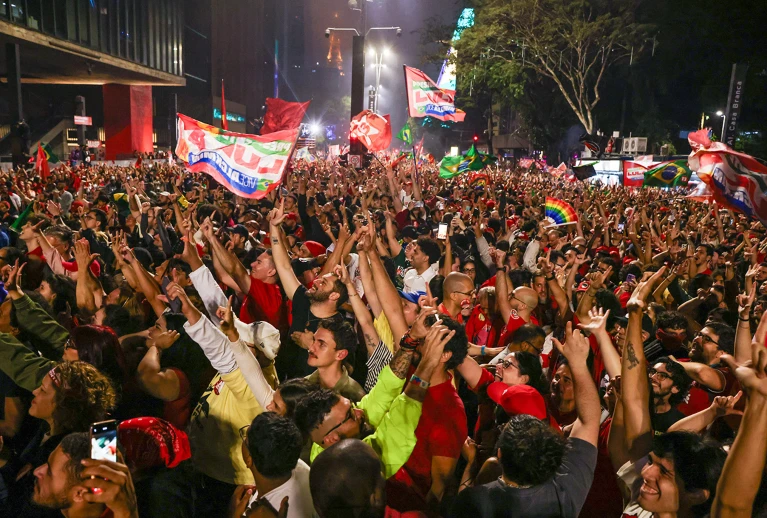
On October 25, supporters of Brazilian President Lula cheered in the streets of São Paulo after it was announced that he had won re-election in a close election.Credit: Rodrigo Paiva/Getty
Flavio Bolsonaro had promised to transfer management of Brazil’s 69 federal universities from the Education Ministry to the Science and Technology Ministry, which has a much smaller budget. He also said he would prioritize applied science over basic research, a proposal that worried some researchers.
“The countries that have made the most scientific progress are the ones that have a very strong foundation in basic research,” Ribeiro said.
Environmental policy
Researchers were also concerned about the direction of Brazil’s environmental policy. During Lula’s presidency, deforestation across large parts of the Amazon rainforest fell to its lowest level since measurements began in 1988. By contrast, deforestation rose by almost 60% between 2019 and 2023 under Jair Bolsonaro’s government, and some researchers expected a similar trend under his son.
The Amazon rainforest is considered one of the world’s largest carbon sinks, although research suggests that deforestation could cause it to release more carbon than it absorbs.
During his recent campaign, Lula said he would work to end deforestation in Brazil by 2030 and reduce the country’s greenhouse-gas emissions in line with the Paris Agreement, which countries signed nearly a decade ago to curb climate change.
“The Lula government’s plan is very clear. He will aim for zero deforestation in the Amazon and work towards implementing an energy transition program that will end the use of fossil fuels in Brazil,” Altaxo said.
Source: www.nature.com