


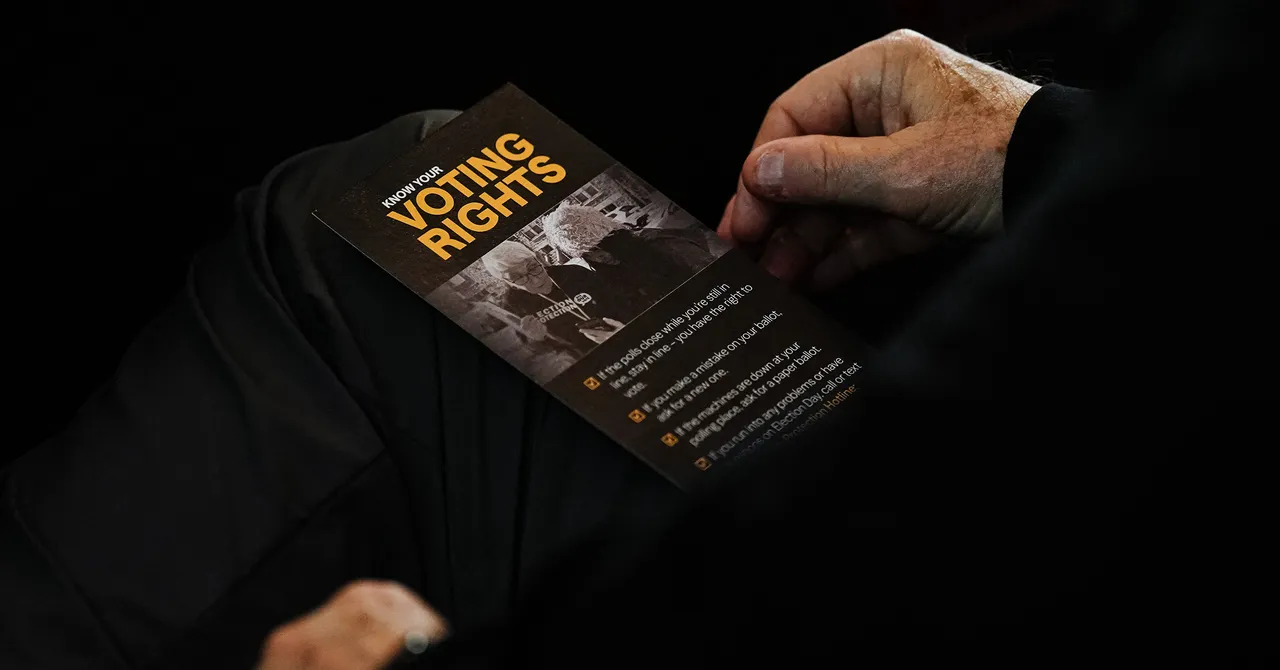
The Franklin County Board of Elections at 1700 Morse Street in downtown Columbus, Ohio, will serve as an early voting location for next week’s midterm elections. The site is in the middle of a large Somali-American community targeted by Immigration and Customs Enforcement (ICE) during Operation Buckeye last December. Although the number of arrests was small, the operation has left a lasting sense of anxiety and persistent harassment, with some residents fearing that ICE agents could return during the election.
ICE said Operation Buckeye was intended to identify “the worst illegal alien of the worst criminals,” according to the agency’s announcement. Several months later, persistent harassment and the possibility of renewed enforcement activity continue to shape how some people view the election site.
Volunteers prepare to monitor polling locations
“Our early voting locations here in central Ohio are in neighborhoods that have been hardest hit by ICE and are also neighborhoods of immigrant communities,” Liliana Rivera Byman, an organizer with the 614 ICE Watch Group and the Ohio Good Neighbor Network, told WIRED. “So we knew that that neighborhood was at risk, and that people were going to vote there, and that a lot of the communities there, including the Somali community and the Latino community, who could vote, were going to walk to that location.”
Byman’s group is responding to what it describes as threats from the Trump administration to target immigrant communities during the midterm elections. Dozens of volunteers are already patrolling Columbus’ early voting locations each day, she said. That number is expected to rise to about 250 on Election Day.
The volunteers are trained to document, log and report sightings of federal immigration agents. They distribute information through dozens of Signal and WhatsApp groups.
“We teach people that they need to observe behavior. We show them what to look out for, what ICE looks like, this is the type of uniform that agents wear, these are the types of vehicles they drive,” Byman said. “We give them an example so they can get used to what they see.”
A nationwide network of election observers
Similar efforts are taking place in towns and cities across the country. WIRED spoke with more than a dozen people involved in the response, which they see as an effort to counter what they consider an existential threat to American democracy.
Training sessions are being organized by national groups including Common Cause, the American Civil Liberties Union and Indivisible, as well as local organizations such as Living United for Change in Arizona and NorCal Resist. These organizations are building networks of volunteers who can document and record ICE operations, learn about voter rights and prepare for worst-case scenarios.
DHS says ICE will not target polling places
The Department of Homeland Security has officially said that ICE does not plan to send agents to polling places on Election Day.
“ICE does not plan operations targeting polling places,” a DHS spokesperson told WIRED. The spokesperson added that “ICE conducts targeted enforcement operations based on intelligence, and if an active threat to public safety endangers a polling place, those targeted enforcement operations may result in arrests.”
Source: www.wired.com