


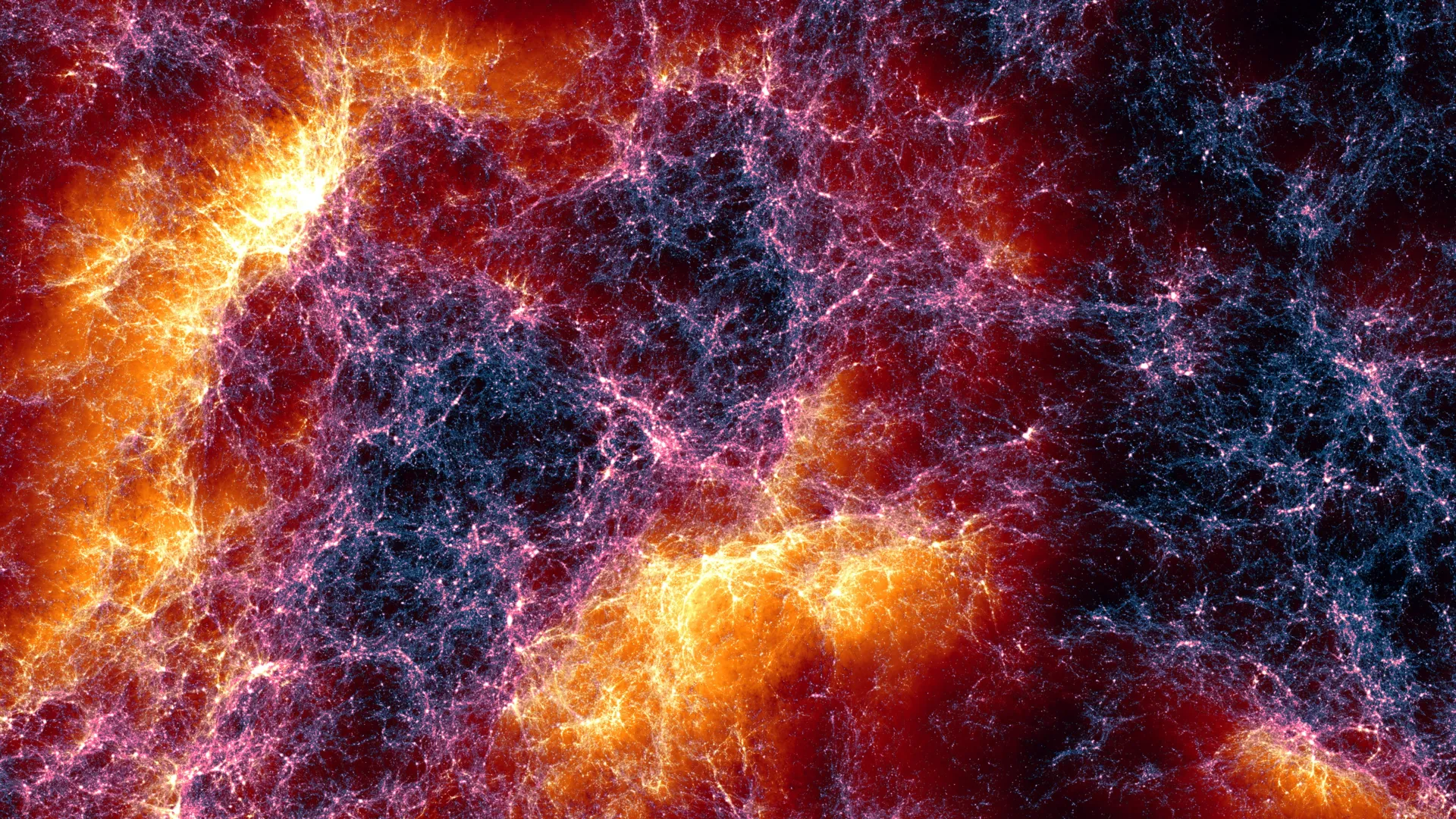
Scientists have developed Lumina, one of the largest and most detailed simulations of the early universe, to investigate how the cosmos evolved during the first two billion years after the Big Bang. Built by researchers at the Center for Astrophysics, with Harvard University and the Smithsonian Institution helping astronomers interpret observations, the simulation is designed to support studies using powerful instruments including the James Webb Space Telescope (JWST) and the Nancy Roman Space Telescope.
The research, published in Monthly Notices of the Royal Astronomical Society, models interactions among ordinary matter, dark matter and radiation. By comparing Lumina’s predictions with observations from JWST, Roman and other telescopes, scientists can test how well current theories explain cosmic evolution and identify findings that could challenge existing ideas about the fundamental laws of the universe.
Astronomers have spent centuries developing explanations for the formation of stars, galaxies and other cosmic structures. Modern supercomputers allow researchers to turn those ideas into detailed simulations that predict how the universe should develop. When observations match those predictions, confidence in current theories grows. Unexpected differences, however, could point to physical processes that scientists do not yet fully understand.
“JWST has made the early Universe an exciting new frontier in astrophysics,” said lead author Oliver Zayer, ITC Fellow at the Center for Astrophysics. Harvard University and Smithsonian University. “To understand what we’re seeing with this telescope, we need to translate theory into detailed predictions. After several years of work with many ups and downs, it’s very rewarding to see the simulation results and see the predictions come to life on video.”
Recreating the first two billion years
Lumina is described as the largest cosmic radiation-hydrodynamics simulation ever created. It uses powerful computers to calculate how gas, dark matter and light interact as the young universe develops. By following these interactions through the first two billion years after the Big Bang, researchers can study how the earliest galaxies formed and how their activity altered the enormous gas clouds around them.
The simulation represents a region more than 100 times larger than those covered by previous comparable projects. Its virtual universe is a cube measuring about 1.5 billion light-years on each side, offering a view of cosmic evolution on a scale comparable to the vast regions that can be examined with today’s most advanced telescopes.
Another major advance is Lumina’s treatment of helium reionization, a process in which radiation strips electrons from helium atoms. For the first time, this type of simulation follows the process as it occurs while also modeling its effects on the surrounding universe. This allows scientists to examine the relationship between evolving galaxies, radiation and the gas filling the space between galaxies.
“We feel very fortunate to be able to build simulations like Lumina,” said Aaron Smith, assistant professor of physics at the University of Texas at Dallas and an author of the paper. “For the first time, we can follow the transformation of both hydrogen and helium into their modern forms across the vast expanses of the universe, while unraveling the galaxies and other luminous objects driving that transformation.”
A virtual universe powered by a supercomputer
Reconstructing such a large portion of cosmic history required substantial computing resources. The team used more than 15,000 graphics processing units on Frontier, one of the world’s fastest supercomputers, at Oak Ridge National Laboratory in Tennessee.
That processing power enabled the researchers to simulate extremely large regions of the early universe without giving up the resolution needed to study individual galaxies and other important structures. Lumina can therefore track both the broad evolution of the universe and the processes involved in the formation of stars, galaxies and black holes.
Investigating the early universe
Lumina is intended not only to recreate cosmic history but also to provide a framework for investigating how the universe developed. The researchers plan to use it to study the movement of gas between galaxies, the effects of radiation left over from the Big Bang and the emergence of regions where stars formed at particularly high rates.
By comparing these predictions with observations from the James Webb Space Telescope, the Nancy Roman Space Telescope and other instruments, scientists hope to build a more complete picture of the universe’s early chapters. Differences between the simulated and observed universes could offer valuable clues about where current theories need to be refined or reconsidered.
Source: www.sciencedaily.com