


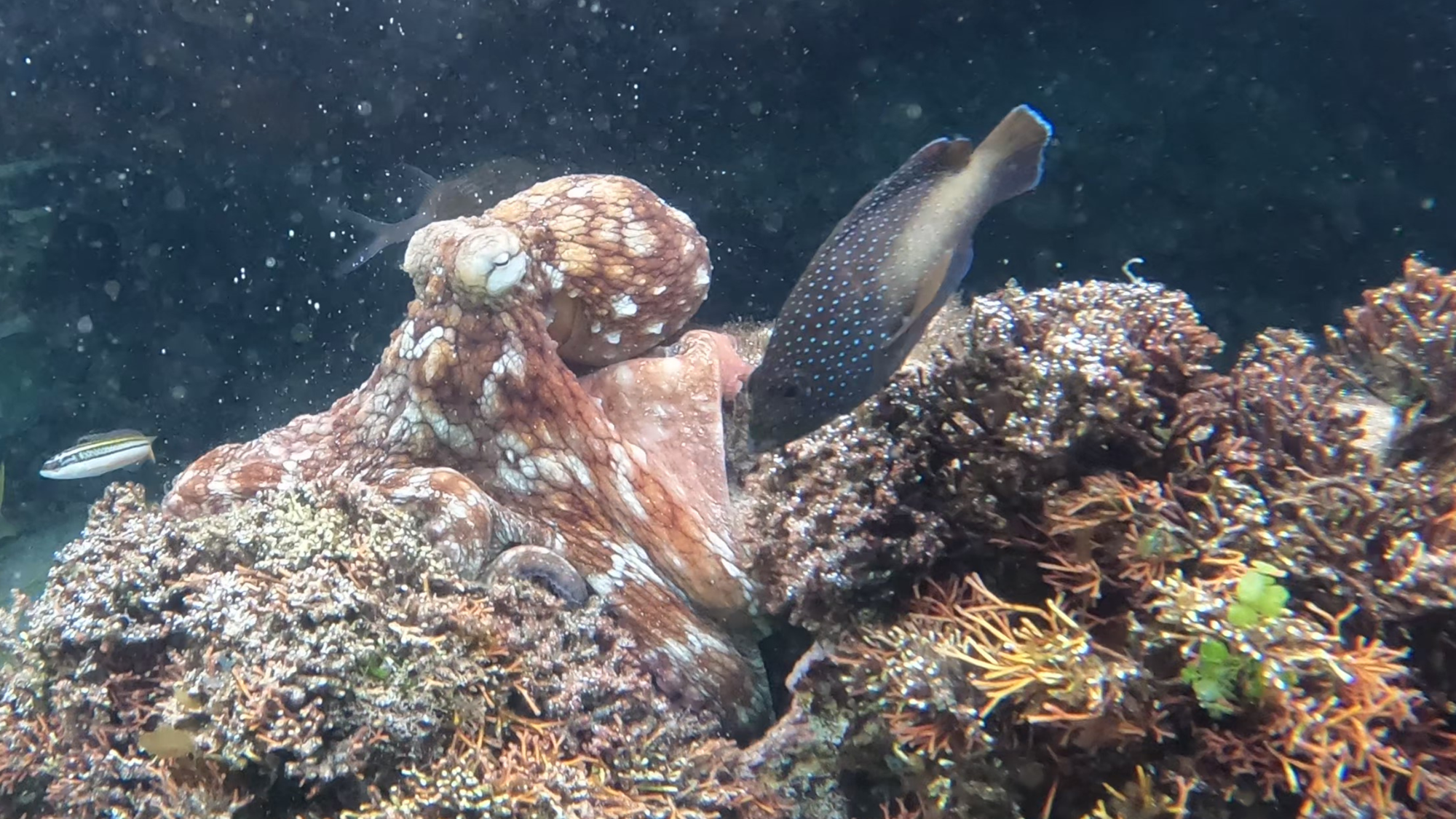
Why Octopuses Slap Some Fish During Underwater Territorial Disputes
Octopuses are known to strike fish that get too close, but new research suggests these underwater “slaps” are not random acts of aggression. Instead, juvenile octopuses appear to respond differently depending on whether a fish is defending its territory or simply following the octopus while it searches for food.
The findings reveal that octopus aggression is part of a complex, context-dependent communication system. When territorial fish jab or swipe at an octopus, the cephalopod may respond with a rapid arm slap or defensive movement.
Researchers observed 101 interactions between juvenile Brazilian reef octopuses (Octopus insularis) and 10 species of coral reef fish. The encounters took place in shallow waters and around oceanic islands along Brazil’s northeastern coast.
The observations showed that young octopuses do not treat every fish the same way. Territorial species, which appeared to be defending their reef habitat, triggered fast defensive responses, including arm slaps. By contrast, nonterritorial fish generally followed or circled the octopus as it continued hunting.
From the latest videos Live Science
Interactions with nonterritorial fish involved fewer physical confrontations and typically lasted longer because the octopus continued foraging. The study’s results were published July 31 in the journal Behavioural Processes.
According to the researchers, the behavior of juvenile O. insularis changed according to the actions of the fish it encountered.
“Clearly, there is more than one way they interact,” said study co-author Jennifer Mather, a retired octopus behavior researcher at the University of Lethbridge in Alberta. “Territorial fish are trying to do one thing, and nonterritorial fish are trying to do something else.”
Different Fish Trigger Different Octopus Behaviors
The researchers recorded 38 juvenile octopuses interacting with fish. They grouped the encounters according to whether the fish were territorial damselfish from the family Pomacentridae or nonterritorial blue tangs (Acanthurus coeruleus), sometimes called blue surgeonfish.
The difference between the two types of encounters was clear. Interactions with territorial fish lasted about 14 seconds on average. During these brief confrontations, the fish attempted to drive the octopus away with jabs and swipes, while the octopus reacted by flinching and striking with its arms.
Interactions with fish outside their territory lasted approximately 46 seconds. These fish were more likely to follow or circle the octopus while it continued searching for prey.
The researchers used lag-sequential analysis, a statistical technique that determines whether one behavior predictably follows another. The analysis confirmed that territorial and nonterritorial encounters produced distinct behavioral sequences.
In other words, a fish attempting to chase an octopus away caused a very different response from a fish that merely followed the cephalopod during its hunt.
“Fish territoriality had a significant impact on the behavior of both fish and octopus,” the researchers wrote. “These interactions are adaptive and highly context-dependent.”
The Octopus Slap Is Only Part of the Story
Scientists have previously documented octopuses hitting or swiping at fish. However, this study provides a more systematic look at when arm slapping occurs and what behaviors happen before and after the contact.
To record the interactions, researchers snorkeled in shallow water and filmed the juvenile octopuses without disturbing their normal behavior. The site’s exceptionally clear water sometimes offered visibility of about 66 feet (20 meters), allowing the team to observe a broad area of the reef.
The footage also suggested that individual octopuses have distinct personalities. Some appeared shy, while others reacted more strongly during encounters with fish. Researchers do not yet know whether these behavioral differences are related to sex or age, or whether an octopus’s personality remains consistent over time.
A juvenile Octopus insularis hiding among coral.
Image credit: Michaela Andrade
The octopuses were also curious about the researchers. During field sessions, they often approached the camera and reached out to touch it. In one instance, an octopus reportedly took a diver’s weight and carried it back to its den.
“One of the key findings was that octopuses sometimes divided their skin patterns into two contrasting colors when interacting with fish,” researchers Michaela Pereira Andrade and Charles Morphy Santos told Live Science.
What Is the Octopus “Half-Blotch” Pattern?
The researchers called this distinctive display a “half-blotch” pattern. It involved a circular white spot appearing on the side of the octopus’s body facing the fish, particularly during encounters with territorial species.
After the octopus displayed the pattern, the fish sometimes appeared to retreat. The researchers believe the marking could act as a visual warning, although more research is needed to determine whether octopuses intentionally produce the pattern as a signal and exactly how fish perceive it.
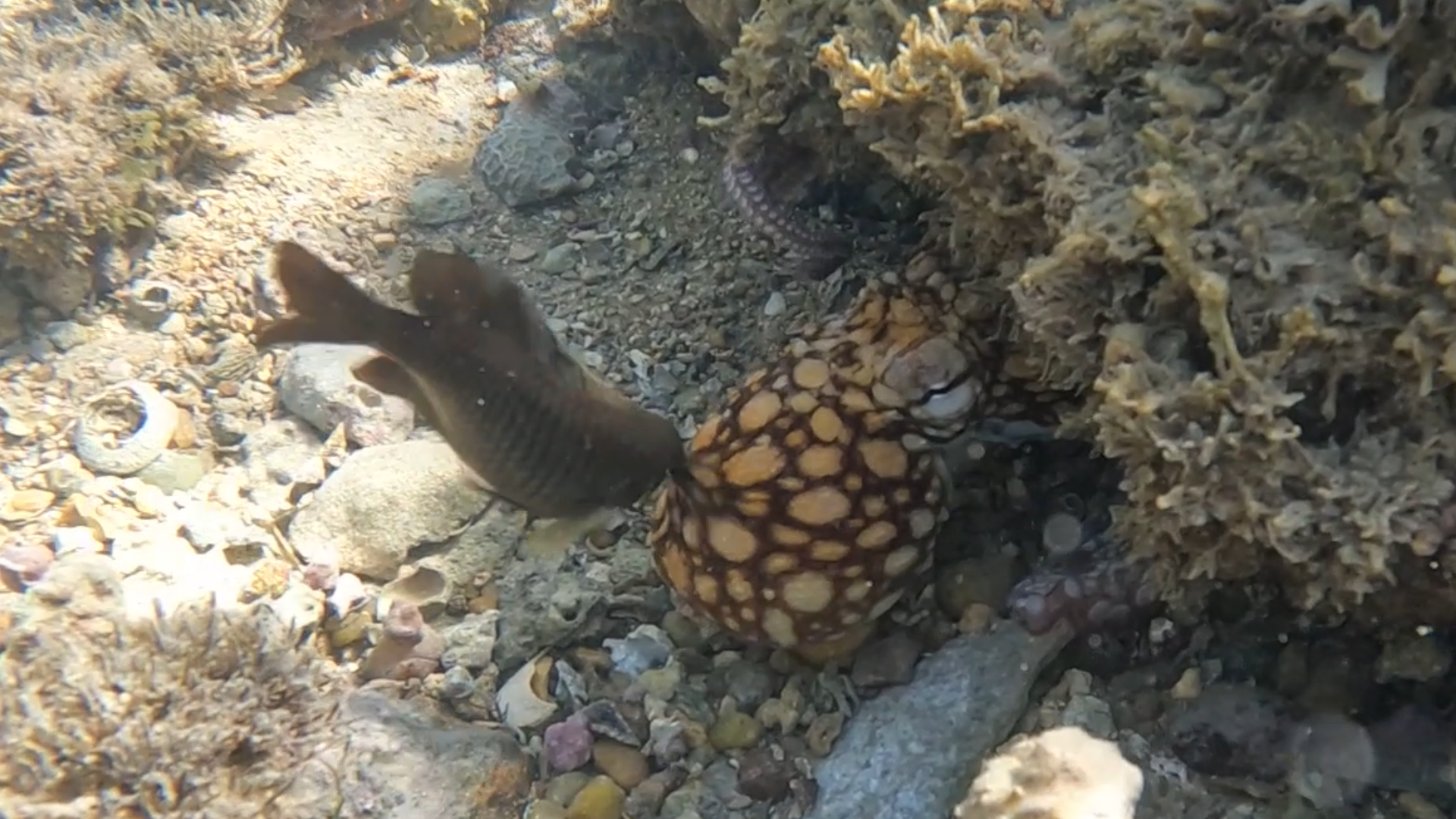
An octopus displays a distinctive “half-blotch” pattern near a fish.
Image credit: Michaela Andrade
Researchers still do not know whether the half-blotch pattern is an intentional warning signal or an automatic response to a nearby threat. Nevertheless, the discovery highlights the sophistication of octopus communication and camouflage.
The findings may also help divers and snorkelers better understand octopus behavior in the wild. Recognizing signs of territorial conflict could make it easier for people to observe these animals without interfering with their natural interactions.
Andrade MP, Mather J., Santos CMD (2026). Hunting in complex areas: Interactions of juvenile octopuses with territorial and follower fish. Behavioural Processes, 241, 105413.
How much do you know about octopuses? Test your knowledge with our octopus quiz!
Source: www.livescience.com