


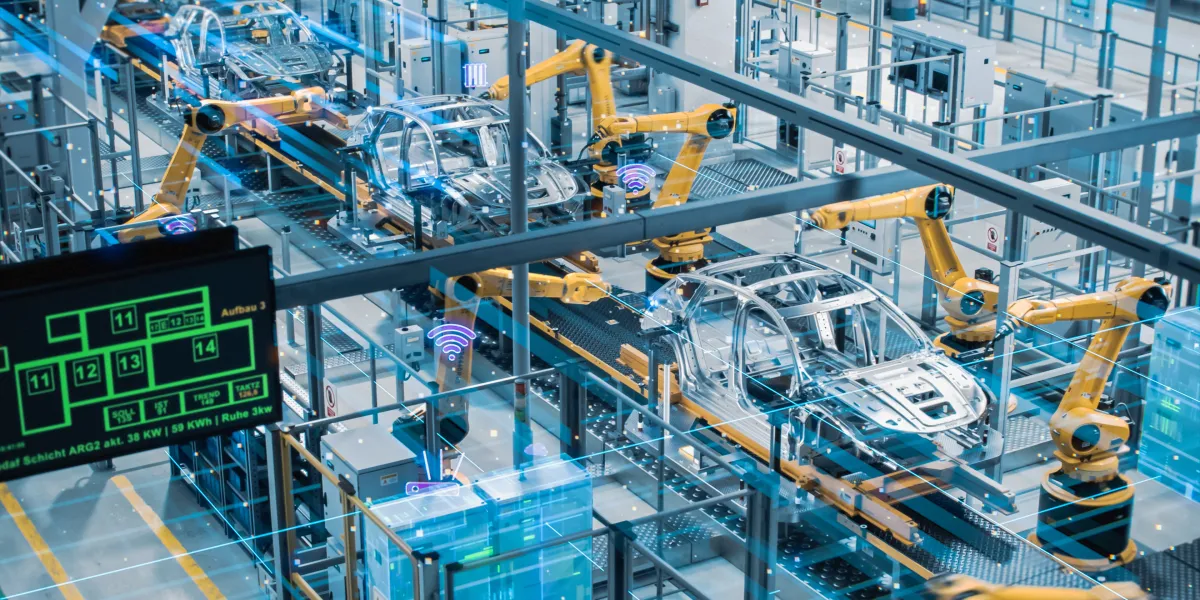
Industrial intelligence is helping manufacturers move from simply detecting problems to understanding their causes and responding safely. At Toyota Industries, connecting previously fragmented paint-shop data cut analysis cycles from five days to less than four hours and reduced associated paint defects by approximately 25% in a pilot. Elsewhere, simulation, operational safeguards and AI-assisted tools are giving workers more context while preserving the role of human judgment.
At Toyota Industries, connecting data from across the paint shop gave engineering and operations teams the context needed to identify the causes of defects. The company reports that analysis cycles fell from five days to less than four hours, while the pilot reduced associated paint defects by approximately 25%.
The improvement was not simply a matter of finding another signal. By linking previously fragmented information, teams could understand why defects occurred and take action before their consequences were finalized.
Why industrial intelligence needs context
Industrial intelligence is essential in situations where data alone cannot provide the full answer. Data may show what is happening, but industrial intelligence adds context about what should happen, which constraints cannot be broken and when uncertainty requires human judgment.
Simulation allows manufacturers to evaluate proposed actions before applying them to equipment. Teams can explore how process changes might affect operations in a digital environment. Simulation does not remove the need for physical validation, but it creates an opportunity to learn without turning the production line into the first experiment.
Responsible deployment therefore begins with operational discipline. Leaders must establish clear authority, ensure that systems can be changed safely, maintain reliable connections to equipment, define safety boundaries and keep records of decisions and actions. Workers must be able to recognize uncertainty, intervene and return equipment to a safe condition. Trust depends on these practical arrangements, not on models alone.
More capable machines, more capable people
Manufacturing has long combined human ingenuity with increasingly sophisticated tools. Physical AI extends that relationship by enabling intelligent devices to take on more repetitive or physically demanding tasks. Agent-assisted operations can also help people make information-intensive decisions and respond to changing conditions.
The goal is not simply to make machines smarter. It is to understand what people can build when knowledge can move more freely, intelligence can be applied where it is needed and ambition has more room to become reality.
Rockwell Automation illustrates this approach at its Singapore plant, where technicians use a maintenance co-pilot that combines manufacturing data, machine manuals and knowledge from experienced workers. The system reduced the time required for new employees to learn how to troubleshoot hundreds of machines from nine months to three months.
Engineers can also consider more process alternatives before making changes. The system helps operators improve the response of the operation rather than repeatedly managing the same exceptions.
This progress requires investment not only in equipment but also in people. Training, dedicated learning time and meaningful involvement in shaping how systems work are all essential. As machine capabilities improve, human capabilities can improve alongside them.
Source: www.technologyreview.com