


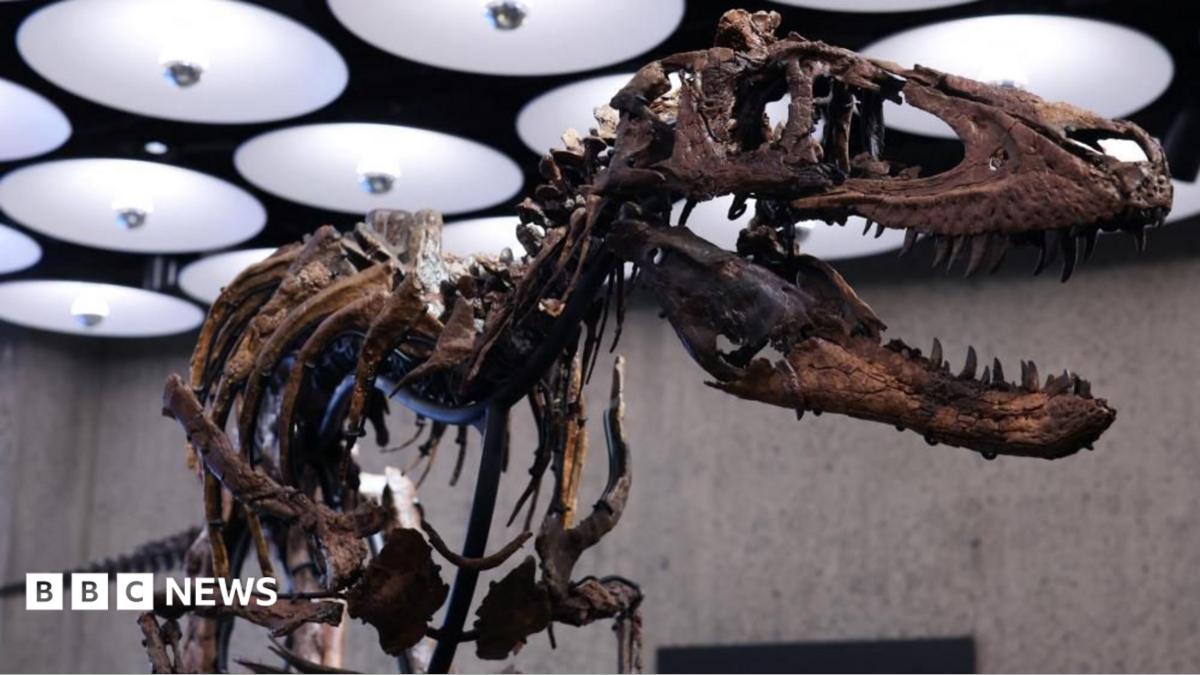
A dinosaur skeleton once identified as a juvenile Tyrannosaurus rex has been recognized as belonging to the separate genus Nanotyrannus and sold at auction for at least $6 million. Nicknamed “Jody,” the nearly 10-foot-tall (3-meter) fossil was offered by Sotheby’s in New York, amid debate over whether scientifically important dinosaur remains should be sold to private collectors.
A rare Nanotyrannus skeleton
Sotheby’s described the specimen as an “excellent display-friendly” skeleton containing approximately 191 fossilized bone elements and a “beautifully preserved, nearly complete skull.” The auction house said it was one of only three Nanotyrannus skeletons known to science.
The skeleton was the first specimen of the genus to be offered on the market since US researchers confirmed its classification in October last year. Sotheby’s had estimated that it could sell for up to $9 million.
The sale followed Sotheby’s auction of a Tyrannosaurus rex named Gus, which sold for a record $50.1 million, or about £37.4 million, in July.
Megan Jenkins, a palaeontologist at the University of Portsmouth, told BBC Radio 4’s Today programme that Nanotyrannus had “for a very long time [been] thought to be something like a teenage Tyrannosaurus.”
“But it’s much smaller and much more lithe. So it’s very smooth and slender in a way,” Jenkins said. “These are blade-like teeth for slicing meat.”
Tyrannosaurus rex and Nanotyrannus lived alongside each other during the same geological period, about 67 million years ago.
From juvenile T. rex to Nanotyrannus
“Jody” was first exhibited as a juvenile Tyrannosaurus rex at the Frieze Masters International Art Fair in London in October 2023. It was later classified as a member of the genus Nanotyrannus.
Rancher Jody Pearson discovered the skeleton on her property in Montana’s geologically well-studied Halls Creek Formation. Commercial palaeontologist Clayton Phipps later excavated it.
Phipps also discovered the fossils known as the “dueling dinosaurs.” The specimen, apparently representing a Nanotyrannus and a Triceratops locked in combat, was found in 2006 about 8 miles (13 km) from Jody’s discovery.
The “Duel of the Dinosaurs” was central to research by Lindsay Zanno and James Napoli that classified Nanotyrannus as separate from Tyrannosaurus. Their paper brought decades of debate over the dinosaurs’ identities to a conclusion.
Concerns over private fossil sales
The auction took place as some scientists warned that high-profile sales could usher in a new era of fossil collecting by the ultra-wealthy. After the sale of Gus, researchers told the BBC that such remains should be displayed in public institutions, where they could be studied more freely.
Professor Steve Brusatte, a palaeontologist at the University of Edinburgh and a consultant on the Jurassic Park films, described the Tyrannosaurus auction as a “concern” in July on the BBC World Service programme What in the World.
“I don’t know of any museum or university that can command that kind of price,” he said. “Imagine if the Mona Lisa was owned only by the super-rich, not on display, and not available for people to see or enjoy.”
Brusatte said he hoped such sales would not become a trend, warning that they could harm scientific research and public education.
After the auction, Brusatte said it was “tragic” that “Jody” might disappear from public view.
“We just learned that Nanotyrannus is real, and now one of the best skeletons is about to be sold to the highest bidder,” he told the BBC. “It’s heartbreaking to think that it could end up in a collector’s vault rather than being displayed in a museum where it can surprise and inspire children, families and the general public.”
Jenkins said there were two sides to the debate, noting that considerable time, effort and money had been spent excavating the fossils.
“I don’t begrudge anyone involved for wanting to sell it for such a high price,” she said. “It’s a frightening prospect, but the reality is that many of them will be exposed to the public eye. These things will no doubt end up in museums someday.”
Source: www.bbc.co.uk