


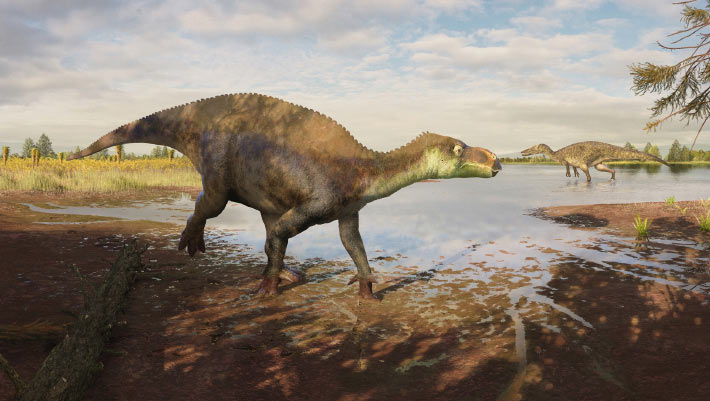
A partial dinosaur skeleton discovered at a brickworks in Surrey in 2001 has been identified as a previously unknown genus and species of early-diverging hadrosauroid iguanodontian. Named Paludohadros proudlovii, the herbivorous dinosaur lived in the wetlands of what is now southern England about 125 million years ago, during the Early Cretaceous.
The new species belonged to Iguanodontia, a group of herbivorous dinosaurs known for the thumb spikes on many of its members. It is the first iguanodont dinosaur to be formally named after the geological formation in which it was found: the Weald Clay Formation at Smokejacks Brickworks.
An early-diverging iguanodontian
“Iguanodontia was one of the first dinosaur groups to be named and is one of the most diverse and widespread ornithischian groups, with fossils dating from the Middle Jurassic to the Late Cretaceous,” said lead author Dr. Ricardo Sakamoto of the Natural History Museum and the University of São Paulo, together with students and colleagues.
“This includes the first ornithischian genus to be named, Iguanodon. In 2021, Iguanodontia was defined as the smallest clade containing Dryosaurus altus, Iguanodon bernissartensis, Rhabdodon priscus and Tenontosaurus tilletti.”
“While the diversity of this clade was relatively low during the Jurassic, recent descriptions and reinterpretations suggest that it was more diverse than previously thought.”
Paludohadros proudlovii was about 5 metres long and weighed an estimated 1.5 to 2 tonnes, making it approximately the size of a rhinoceros. Because its bones had not yet fully matured, the specimen was probably a juvenile that could have grown to roughly twice that size.
“Paludohadros proudlovii is the first species I’ve ever named, and it’s an honour to work on it,” Sakamoto said.
“I still remember that amazing moment when I realised this was a new species that no one had seen before.”
Found near Baryonyx remains
“Paludohadros proudlovii was discovered just 100 metres (328 feet) away from Baryonyx remains, which are also held at the Natural History Museum,” said lead author Professor Susannah Maidment, a palaeontologist at the Natural History Museum and the University of Birmingham.
“Although Baryonyx is best known for eating fish, the dinosaur’s last meal also included a baby iguanodontian.”
“We can’t know for sure which species the baby belonged to, so perhaps Baryonyx scavenged the bodies of young Paludohadros proudlovii, or even hunted them when it had the opportunity.”
A paper describing the discovery has been published in the Journal of Systematic Palaeontology.
Ricardo J. Sakamoto et al. 2026. A new species of iguanodont dinosaur discovered in the Weald Clay Formation (Early Cretaceous) at Smokejacks Brickworks in southern England. Journal of Systematic Palaeontology 24(2). doi: 10.1080/14772019.2026.2726221
Source: www.sci.news